HOMONID STUDIES
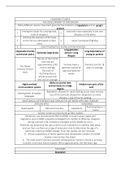
THE DEVELOPMENT OF BIPEDALISM
Many different reasons have been given for the evolution of bipedalism and an upright
posture
freeing the hands for carrying food, improved vision especially to see over
1 2
tools or weapons tall grass on the plains
reducing the exposure of the body
3 to the hot sun (decreased surface 4 easier hunting and fighting
area)
5 easier feeding from bushes and low branches
Long gestation
Opposable thumbs Long dependency of
Extremely large brains period + Long
and shorter palms young on parents
lifespan
The size of the human
brain equals
approximately 1350 Humans have a Parental care for 18
This allows
cm3 on average. gestation period of years on average
humans to hold
The brain of approximately 40
tools
Australopithecus weeks
africanus was only
450 cm3 on average
Ability to control their
Highly evolved Inhabit most parts of the
environments to a large
communication system land
degree
Bipedalism allowed for rapid walking across many terrains
Development of spoken
Use of fire and tools allowed for adaptation to many
languages
climates + Use of fire for heating
ANATOMICAL DIFFERENCES AND SIMILARITIES BETWEEN APES AND HUMANS
AFRICAN APES HOMONIDS
Australopithecus +
Quadrupeds Old world monkey bipedalism
homo
Genetic evidence (mitochondrial DNA studies)
Geneticists use mitochondrial DNA (mtDNA) to study human origins and
migrations since mtDNA is passed unchanged from mother to offspring. However,
during a person’s life, mutations (changes) to the mtDNA do occur.
Scientists can determine the rate at which such mutations (or markers) take place,
and can then use them as a type of molecular clock to determine the age of a
particular maternal mtDNA lineage. From the studies, we can conclude:
1) African populations of Homo sapiens have the greatest number of mtDNA
markers and are thus the oldest.
2) The most recent common ancestor whose genetic marker is found in all living
humans, must have lived in eastern Africa approximately 150 000 years ago.
FEATURES
bipedalism
, Long arms to walk on knuckles, and support Relatively short arms used for many
their weight on their front limbs functions.
Pelvic girdle
long and narrow short and wide
Spinal curve
more curved (S-shaped)
less curved (C-shaped)
foramen magnum - the hole in the base of the skull
where the spinal cord leaves / enters the skull – has changed position. As
human evolution has progressed, Quadrupeds have the foramen magnum is
in a backward position
in a backward position in a forward position
Brain case size - as early humans evolved, the brain
grew in size and complexity. Over the course of human evolution, brain size
THE DEVELOPMENT OF BIPEDALISM
Many different reasons have been given for the evolution of bipedalism and an upright
posture
freeing the hands for carrying food, improved vision especially to see over
1 2
tools or weapons tall grass on the plains
reducing the exposure of the body
3 to the hot sun (decreased surface 4 easier hunting and fighting
area)
5 easier feeding from bushes and low branches
Long gestation
Opposable thumbs Long dependency of
Extremely large brains period + Long
and shorter palms young on parents
lifespan
The size of the human
brain equals
approximately 1350 Humans have a Parental care for 18
This allows
cm3 on average. gestation period of years on average
humans to hold
The brain of approximately 40
tools
Australopithecus weeks
africanus was only
450 cm3 on average
Ability to control their
Highly evolved Inhabit most parts of the
environments to a large
communication system land
degree
Bipedalism allowed for rapid walking across many terrains
Development of spoken
Use of fire and tools allowed for adaptation to many
languages
climates + Use of fire for heating
ANATOMICAL DIFFERENCES AND SIMILARITIES BETWEEN APES AND HUMANS
AFRICAN APES HOMONIDS
Australopithecus +
Quadrupeds Old world monkey bipedalism
homo
Genetic evidence (mitochondrial DNA studies)
Geneticists use mitochondrial DNA (mtDNA) to study human origins and
migrations since mtDNA is passed unchanged from mother to offspring. However,
during a person’s life, mutations (changes) to the mtDNA do occur.
Scientists can determine the rate at which such mutations (or markers) take place,
and can then use them as a type of molecular clock to determine the age of a
particular maternal mtDNA lineage. From the studies, we can conclude:
1) African populations of Homo sapiens have the greatest number of mtDNA
markers and are thus the oldest.
2) The most recent common ancestor whose genetic marker is found in all living
humans, must have lived in eastern Africa approximately 150 000 years ago.
FEATURES
bipedalism
, Long arms to walk on knuckles, and support Relatively short arms used for many
their weight on their front limbs functions.
Pelvic girdle
long and narrow short and wide
Spinal curve
more curved (S-shaped)
less curved (C-shaped)
foramen magnum - the hole in the base of the skull
where the spinal cord leaves / enters the skull – has changed position. As
human evolution has progressed, Quadrupeds have the foramen magnum is
in a backward position
in a backward position in a forward position
Brain case size - as early humans evolved, the brain
grew in size and complexity. Over the course of human evolution, brain size