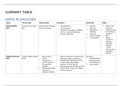
SUMMARY TABLE
JOINTS IN SHOULDER
NAME TYPE OF JOINT ARTICULATION LIGAMENTS MOVEMENT OTHER
GLENOHUMERAL Synovial, ball & socket Glenoid cavity of scapula o Glenoid labrum Flexion & Rotator cuff
JOINT joint & head of humerus o Coracohumeral Extension muscles &
o Glenohumeral (superior, middle & Abduction & coracoacromial
inferior - capsular thickenings) adduction arch enhances
o Transverse humeral Internal & stability of
external rotation joint
Circumduction Fibrous
capsule has
openings,
redundant
inferiorly
→ stops
humerus from
dislocating
laterally
STERNOCLAVICULAR Synovial, saddle (double- Sternal end of o anterior & posterior sternoclavicular Of clavicle:
JOINT plane) clavicle (between clavicle & manubrium) predominantly in
Manubrium of o costoclavicular ligament(accessory) antero-posterior
sternum & part of → helps mostly with stability & vertical planes
1st costal(rib) (between 1st rib & clavicle) Some rotation
cartilage o Interclavicular ligament (between left
Articular disc divides & right clavicle, it runs over superior
cavity into 2 end of manubrium)
(enhances stability)
, ACROMIOCLAVICULA Synovial, plane Lateral aspect of o Acromioclavicular(superior & inferior) Of clavicle:
R JOINT clavicle (oval shape → attaches acromion to clavicle Predominantly in
facet) o Coracoclavicular(accessory) → 2 parts - Antero-posterior
Medial aspect of trapezoid & conoid ligaments & vertical planes
acromion (between coracoid process & clavicle) Some axial
Articular disc. rotation
SCAPULOTHORACIC Not a usual joint Scapula moves on
JOINT thorax, on very loss
areola tissue (made up
of connective tissue &
fat)
LIGAMENTS OF GLENOHUMERAL JOINT
NAME ATTACHMENT FUNCTION
GLENOID LABRUM Outer rim of glenoid fossa Provides attachment for
(fibrocartilaginous rim) → Therefore, deepening it Long head of biceps brachii (supraglenoid
tubercle)
Long head of triceps brachii (infraglenoid
tubercle)
CORACOHUMERAL LIGAMENT Anterior surface of humerus & coracoid process Reinforce anterior part of joint capsule
(located above glenohumeral ligaments)
GLENOHUMERAL LIGAMENTS Anterior surface of humerus & glenoid cavity Reinforce anterior part of joint capsule
3 sets of fibres:
JOINTS IN SHOULDER
NAME TYPE OF JOINT ARTICULATION LIGAMENTS MOVEMENT OTHER
GLENOHUMERAL Synovial, ball & socket Glenoid cavity of scapula o Glenoid labrum Flexion & Rotator cuff
JOINT joint & head of humerus o Coracohumeral Extension muscles &
o Glenohumeral (superior, middle & Abduction & coracoacromial
inferior - capsular thickenings) adduction arch enhances
o Transverse humeral Internal & stability of
external rotation joint
Circumduction Fibrous
capsule has
openings,
redundant
inferiorly
→ stops
humerus from
dislocating
laterally
STERNOCLAVICULAR Synovial, saddle (double- Sternal end of o anterior & posterior sternoclavicular Of clavicle:
JOINT plane) clavicle (between clavicle & manubrium) predominantly in
Manubrium of o costoclavicular ligament(accessory) antero-posterior
sternum & part of → helps mostly with stability & vertical planes
1st costal(rib) (between 1st rib & clavicle) Some rotation
cartilage o Interclavicular ligament (between left
Articular disc divides & right clavicle, it runs over superior
cavity into 2 end of manubrium)
(enhances stability)
, ACROMIOCLAVICULA Synovial, plane Lateral aspect of o Acromioclavicular(superior & inferior) Of clavicle:
R JOINT clavicle (oval shape → attaches acromion to clavicle Predominantly in
facet) o Coracoclavicular(accessory) → 2 parts - Antero-posterior
Medial aspect of trapezoid & conoid ligaments & vertical planes
acromion (between coracoid process & clavicle) Some axial
Articular disc. rotation
SCAPULOTHORACIC Not a usual joint Scapula moves on
JOINT thorax, on very loss
areola tissue (made up
of connective tissue &
fat)
LIGAMENTS OF GLENOHUMERAL JOINT
NAME ATTACHMENT FUNCTION
GLENOID LABRUM Outer rim of glenoid fossa Provides attachment for
(fibrocartilaginous rim) → Therefore, deepening it Long head of biceps brachii (supraglenoid
tubercle)
Long head of triceps brachii (infraglenoid
tubercle)
CORACOHUMERAL LIGAMENT Anterior surface of humerus & coracoid process Reinforce anterior part of joint capsule
(located above glenohumeral ligaments)
GLENOHUMERAL LIGAMENTS Anterior surface of humerus & glenoid cavity Reinforce anterior part of joint capsule
3 sets of fibres: