
A2 Psychology: Organisations
Motivation to work- Need Theories (Pt 1)
Motivation- A force that energises, directs and sustains behaviour towards goals
• Though difficult to study because it cannot be observed directly, motivation can be inferred by:
o Observing behaviour
o Using psychological measurement
Need theories: Motivation is the interaction among various needs and one’s drive to satisfy them
• Needs: Physiological or psychological deficiencies that an organism is compelled to fulfil
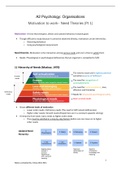
1) Hierarchy of Needs (Maslow, 1970)
The need to reach one’s highest potential
Growth and attain a sense of fulfilment
needs
The need for recognition of
accomplishments
The need for social acceptance, love,
affection and friendship
Deficiency
needs Needs for physical & psychological safety
Basic survival needs
• Shows different levels of motivation
o Lower order needs= Deficiency needs (The need to fulfil natural deficiencies)
o Higher order needs= Growth needs (People here are in a constant upwards striving)
• A hierarchy from lower, basic needs to higher order needs
o They must be satisfied in a step-by-step fashion before one can move on to higher
order needs
Updated Need
Hierarchy:
1
Notes compiled by: Chew Wen Min
, 2) ERG Theory (Alderfer, 1972)
Collapses Maslow’s 5 categories into 3:
➢ Existence: Physiological & Safety needs
o Needs for basic life material necessities
➢ Relatedness: Social & Esteem needs
o Need to have and maintain interpersonal relationships at work and at home
➢ Growth: Self Actualisation
o Needs related to one’s development and realising one’s potential
Main differences:
I. No strict hierarchy
II. Greatest motivation: When all 3 are met
III. Importance may change- E, R and G factors may change at different points of life
o Ex: Relatedness- Teenage, early adulthood; Growth- Career
Evaluation (Of Maslow & Alderfer’s theories):
1. Both have received a lot of attention from professionals in business, psychology etc
BUT
1. Neither has led to a useful application/strategy for improving work motivation (Miner, 1983)
2. Predictive ability about need-driven behaviour is low- It is unsure whether an increase in
motivation is due to an increase in tangible products from each level of the hierarchy
Maslow’s hierarchy:
1. Empirical evidence supporting the particular sequence of needs is hard to establish
o Ex: How sure are we that we need to satisfy step 2 (safety) before step 3 (social)?
2. Hard to determine when a particular level of need has been achieved
3. Some behaviours can satisfy several kinds of needs at the same time
o Ex: Promotion can be step 4 (self-esteem) or step 5 (self-actualisation), or even step 1
(basic needs- $)
Alderfer’s ERG Theory:
1. Difficult To test empirically (can’t produce factual evidence to prove)
1. Concept is easier to grasp, and a lot easier to apply (no need step-by-step)
2
Notes compiled by: Chew Wen Min


