
A2 Psychology: Organisations
Group Behaviour in Organisations- Group development & roles (Pt 1)
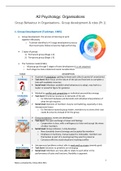
1. Group Development (Tuckman, 1965)
• Group development- the process of learning to work
together effectively
o Tuckman identified a 4-5 stage development process
that most teams follow to become high performing
• 2 types of groups:
1) Permanent group (Stage 1-4)
2) Temporary group (Stage 1-5)
• The Tuckman model (1965)
o All groups go through 5 stages of team development in a set sequence
o Each stage has task-related and social considerations
STAGE DESCRIPTION
1 ➢ A period of orientation- getting to know each other (a period of uncertainty)
FORMING ➢ Task level: Main focus on the nature of the job and how best to complete a
task with available resources
➢ Social level: Members establish what behaviours to adopt, may look to a
leader or powerful figure for guidance
2 ➢ Marked by conflict and competition as individual personalities emerge
STORMING ➢ Task level: Emotional resistance to demands of the job
o Ex: Mismatch between job demands and individual interpretation of
what the job requires
➢ Social level: Opinions of members may be contradicting, especially on key
interpersonal issues
o Ex: Resistance towards group leader, members try to stress their own
needs & concerns instead of for the group
3 ➢ Group acceptance, norms are developed
NORMING ➢ Task level: The open exchange of views and feelings
o Cooperation is clear, with a willingness to listen and accept the views
of other members
➢ Social level: Group cohesion / unity develops
o New standards (norms) emerge and accepted by members
o Emphasis on harmony, mutual support is noticeable- members see
themselves as part of a sound group they want to preserve
o Conscious effort to avoid situations involving conflict
4 ➢ Interpersonal problems solved, able to work well as a team towards goals
PERFORMING ➢ Task level: Solutions to problems are emerging
➢ Social level: Members are now able to relate to each other in the
performance of tasks and functions, flexibility is apparent
1
Notes compiled by: Chew Wen Min
, 5 ➢ The winding down of group activities
ADJOURNMENT o Most team goals have been accomplished
➢ Mixed emotions
o Happiness that task is completed
o Regret at terminating the existence of the group with the loss of
comradeship developed
Evaluation (Group Development):
• The model sates that to have effective group performance, all stages must be completed in a
linear order…
o Not practical- Some groups may skip some stages
▪ Ex: Skipping the storming stage and go straight to norming
o Irl, multiple stages can occur simultaneously
▪ Ex: a new member comes, messes up the linear progression the group was on
• The model does not consider the factor of time in determining whether there will be a
successful progression:
o Too little time = Issues may not be adequately resolved at a particular stage
▪ Unresolved issues suppressed may resurface in later stages
• Other factors, like company culture/ethos, may influence group behaviour
o Ex: In some countries it is practice to respect the seniors, so disagreements by juniors
cannot be brough up upfront in the storming stage
o Examples of ethos:
▪ Achievement oriented- Individualistic culture, value own goals, not teamwork
▪ Help oriented- An emphasis on helping colleagues grow, seeking to understand
Thus, staying in certain stages for a while may not just be due to work factors- also other
factors such as time, ethos, etc.
2. Team Roles (Belbin, 1981)
• Examined how people work together in
teams, suggests that effective teams need
to have certain roles fulfilled
• Proposed 9 different roles in a team
o Each role has certain strengths, but
also “allowable weaknesses” that
can be made up by other members
• Although there are 9 team roles, it is not necessary to have 9 people to be effective
o Individuals usually have more than 1 preferred team role, so will often occupy more
than 1 role
2
Notes compiled by: Chew Wen Min


