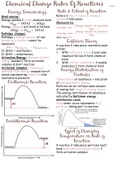
Chemical Change Rates Of Reactions
Energy Terminology Rate & Extent of Reaction
Bond energy: Refers 2 time it takes 4 chemical
Energy needed 2 break chemical bond. change 2 take place.
Cl2(g) + 243 kJ → 2Cl(g) Measured by:
Change amount of reactants
Energy released w/e bond is formed. Average rate =
time
2Cl(g) → Cl2(g) + 243 kJ Change amount of products
Enthalpy changes: Average rate =
time
Enthalpy = energy content of sub Unit: 𝑚𝑜𝑙. 𝑠 −1
locked up in bonds – cannot be Collision Theory
measured.
4 reaction 2 take place reactants must
ΔH = HPRODUCTS - HREACTANTS
collide:
If ΔH<0 = exothermic.
1. With sufficient force 2 overcome
If ΔH>0 = endothermic.
repulsion forces & form chemical
Activation Energy: Minimum Kinetic
bond.
energy needed 2 form activated
2. With correct orientation 2 enable
complex & start reaction.
molecules 2 form chemical bond.
Activated Complex: Temporary,
unstable, high energy composition of Energy Distribution of
atoms representing transition btw Particles
reactants & products. Temperature of substance = indication
Exothermic Reaction of average kinetic energy.
Particles do not all have same amount
of energy but range of energy values.
The energy distribution of substance
indicated by Boltzman energy
distribution curve.
Area under curve represents # of
particles taking part in reaction.
Endothermic Reaction
Effect of Changing
Temperature on Rate of
Reaction
4 reaction 2 take place particles must
have sufficient activation energy 2
form activated complex.
Energy Terminology Rate & Extent of Reaction
Bond energy: Refers 2 time it takes 4 chemical
Energy needed 2 break chemical bond. change 2 take place.
Cl2(g) + 243 kJ → 2Cl(g) Measured by:
Change amount of reactants
Energy released w/e bond is formed. Average rate =
time
2Cl(g) → Cl2(g) + 243 kJ Change amount of products
Enthalpy changes: Average rate =
time
Enthalpy = energy content of sub Unit: 𝑚𝑜𝑙. 𝑠 −1
locked up in bonds – cannot be Collision Theory
measured.
4 reaction 2 take place reactants must
ΔH = HPRODUCTS - HREACTANTS
collide:
If ΔH<0 = exothermic.
1. With sufficient force 2 overcome
If ΔH>0 = endothermic.
repulsion forces & form chemical
Activation Energy: Minimum Kinetic
bond.
energy needed 2 form activated
2. With correct orientation 2 enable
complex & start reaction.
molecules 2 form chemical bond.
Activated Complex: Temporary,
unstable, high energy composition of Energy Distribution of
atoms representing transition btw Particles
reactants & products. Temperature of substance = indication
Exothermic Reaction of average kinetic energy.
Particles do not all have same amount
of energy but range of energy values.
The energy distribution of substance
indicated by Boltzman energy
distribution curve.
Area under curve represents # of
particles taking part in reaction.
Endothermic Reaction
Effect of Changing
Temperature on Rate of
Reaction
4 reaction 2 take place particles must
have sufficient activation energy 2
form activated complex.