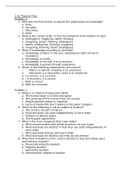
2.3C Practice Test
Problem 1
1. Who was the first thinker to inquire the justification of knowledge?
a. Plato
b. Socrates
c. Descartes
d. Kuhn
2. What is the correct order, in the line metaphor (from bottom to top)?
a. Intelligence, imagining, belief, thinking
b. Imagining, belief, thinking, intelligence
c. Belief, intelligence, thinking, imagining
d. Imagining, thinking, belief, intelligence
3. What is knowledge according to Aristotle?
a. Knowledge is latent in the soul, awaiting the right stimuli to
recollect it
b. Knowledge is innate
c. Knowledge is not real, it is a construct
d. Knowledge is gained through experience
4. Which of the following statement(s) are correct?
i. Plato is a nativist, Aristotle is an empiricist
ii. Descartes is a rationalist, Locke is an empiricist
a. I is correct, ii is incorrect
b. I is incorrect, ii is correct
c. Both a correct
d. Both are incorrect
Problem 2
5. What is a criticism of Descartes Myth?
a. The human body is in time and space
b. The workings of the human mind are private
c. People operate based on impulses
d. Facts of mental life don’t belong to the given category
6. Which of the following is not an aspect of dualism?
a. The mind is not part of nature
b. Mind and body can exist independently of each other
c. Problem of absent qualia
d. The thought experiment
7. What is the main viewpoint that Lowe holds?
a. Mind communicates with whole structure not just a part
b. Mind and body are distinct in that they can exist independently of
each other
c. Mind and body interact with each other
d. Mind and body are distinct, but they do not interact
8. What kind of dualism is this: mind is distinct in that two things exist
and interact causally?
a. Physicalist property dualism
b. Property dualism
c. Substance dualism
d. Interactionist substance dualism
Problem 1
1. Who was the first thinker to inquire the justification of knowledge?
a. Plato
b. Socrates
c. Descartes
d. Kuhn
2. What is the correct order, in the line metaphor (from bottom to top)?
a. Intelligence, imagining, belief, thinking
b. Imagining, belief, thinking, intelligence
c. Belief, intelligence, thinking, imagining
d. Imagining, thinking, belief, intelligence
3. What is knowledge according to Aristotle?
a. Knowledge is latent in the soul, awaiting the right stimuli to
recollect it
b. Knowledge is innate
c. Knowledge is not real, it is a construct
d. Knowledge is gained through experience
4. Which of the following statement(s) are correct?
i. Plato is a nativist, Aristotle is an empiricist
ii. Descartes is a rationalist, Locke is an empiricist
a. I is correct, ii is incorrect
b. I is incorrect, ii is correct
c. Both a correct
d. Both are incorrect
Problem 2
5. What is a criticism of Descartes Myth?
a. The human body is in time and space
b. The workings of the human mind are private
c. People operate based on impulses
d. Facts of mental life don’t belong to the given category
6. Which of the following is not an aspect of dualism?
a. The mind is not part of nature
b. Mind and body can exist independently of each other
c. Problem of absent qualia
d. The thought experiment
7. What is the main viewpoint that Lowe holds?
a. Mind communicates with whole structure not just a part
b. Mind and body are distinct in that they can exist independently of
each other
c. Mind and body interact with each other
d. Mind and body are distinct, but they do not interact
8. What kind of dualism is this: mind is distinct in that two things exist
and interact causally?
a. Physicalist property dualism
b. Property dualism
c. Substance dualism
d. Interactionist substance dualism