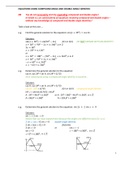
EQUATIONS USING COMPOUND ANGLE AND DOUBLE ANGLE IDENITIES
NB You do not necessarily start by expanding compound and double angles!
In Grade 11, we solved plenty of equations involving compound and double angles –
without any knowledge of compound and double angle identities!
Take a look at this one…..
e.g. Find the general solution to the equation: sin(𝑥 + 300 ) = cos 2𝑥
Solution:
sin(𝑥 + 300 ) = sin(900 − 2𝑥) (Q I or Q II) DO NOT EXPAND WITH AN IDENTITY!
𝑥 + 300 = 900 − 2𝑥 + 𝑛. 3600 , 𝑛 ∈ 𝑍
3𝑥 = 600
𝑥 = 200 + 𝑛. 1200
or
𝑥 + 300 = 1800 − (900 − 2𝑥) + 𝑛. 3600 , 𝑛 ∈ 𝑍
𝑥 + 300 = 900 + 2𝑥 + 𝑛. 3600
−𝑥 = 600 + 𝑛. 3600
𝑥 = −60 + 𝑛. 3600
e.g. Determine the general solution to the equation:
cos A. cos 240 + sin A. sin 240 = 0,715
Here reducing by using a compound angle identity is essential…
Solution:
cos A. cos 240 + sin A. sin 240 = 0,715
cos (A - 240) = 0,715 (Q I or Q IV) compound angle identity
ref = arccos (0,715) = 44,4 0
A - 240 = 44,40 + n.3600 or A - 240 = 3600 - 44,40 + n.3600, n
A = 68,40 + n.3600 A = 339,60 + n.3600
e.g. Determine the general solution to the equation: sin 2𝑥 + 2 sin 𝑥 = 0
Solution:
sin 2x + 2 sin x = 0
Notice that we must expand here because the angles are different sizes (2𝑥 vs 𝑥)
2 sin x. cos x +2 sin x = 0 double angle identity
2 sin x (cos x +1) = 0 factorise
2 sin x = 0 or cos x = -1
sin x = 0 x = 1800 + n.3600 , n
x = 00 + n.1800 , n
(0;1) (360;1)
(90;1)
1
(270;0)
(360;0) (90;0)
(180;0)
(180;-1)
-1 (270;-1)
1
NB You do not necessarily start by expanding compound and double angles!
In Grade 11, we solved plenty of equations involving compound and double angles –
without any knowledge of compound and double angle identities!
Take a look at this one…..
e.g. Find the general solution to the equation: sin(𝑥 + 300 ) = cos 2𝑥
Solution:
sin(𝑥 + 300 ) = sin(900 − 2𝑥) (Q I or Q II) DO NOT EXPAND WITH AN IDENTITY!
𝑥 + 300 = 900 − 2𝑥 + 𝑛. 3600 , 𝑛 ∈ 𝑍
3𝑥 = 600
𝑥 = 200 + 𝑛. 1200
or
𝑥 + 300 = 1800 − (900 − 2𝑥) + 𝑛. 3600 , 𝑛 ∈ 𝑍
𝑥 + 300 = 900 + 2𝑥 + 𝑛. 3600
−𝑥 = 600 + 𝑛. 3600
𝑥 = −60 + 𝑛. 3600
e.g. Determine the general solution to the equation:
cos A. cos 240 + sin A. sin 240 = 0,715
Here reducing by using a compound angle identity is essential…
Solution:
cos A. cos 240 + sin A. sin 240 = 0,715
cos (A - 240) = 0,715 (Q I or Q IV) compound angle identity
ref = arccos (0,715) = 44,4 0
A - 240 = 44,40 + n.3600 or A - 240 = 3600 - 44,40 + n.3600, n
A = 68,40 + n.3600 A = 339,60 + n.3600
e.g. Determine the general solution to the equation: sin 2𝑥 + 2 sin 𝑥 = 0
Solution:
sin 2x + 2 sin x = 0
Notice that we must expand here because the angles are different sizes (2𝑥 vs 𝑥)
2 sin x. cos x +2 sin x = 0 double angle identity
2 sin x (cos x +1) = 0 factorise
2 sin x = 0 or cos x = -1
sin x = 0 x = 1800 + n.3600 , n
x = 00 + n.1800 , n
(0;1) (360;1)
(90;1)
1
(270;0)
(360;0) (90;0)
(180;0)
(180;-1)
-1 (270;-1)
1