CALCULUS
Why calculus?
In the ancient world counting was primarily done using small pebbles, these pebbles eventually
became fixed to some wires inside a frame, this became known as an abacus. These stones were
known as calculi (pl) or calculus (sing.)…this Latin word is the root from which we get the words
calculation and calculator.
Up until just prior to the 1600s the word “calculus” was tantamount to mathematics itself, except
that by this point in time calculus as we know it today hadn’t even been invented yet. That is just
how powerful the branch we now know as calculus is; that not long after its formal invention
calculus stole math’s name from it… and everything else became known as merely “precalculus”.
Algebra, geometry, analytical geometry, trigonometry are all “just” precalculus.
In the real world very little is stagnant, still or unchanging. All of precalculus had that flaw in
common, that they perfectly modelled unchanging systems, but become less practical under
fluctuating conditions. Calculus on the other hand concerns itself with CHANGE and rates of change.
So if calculus is that important, how have we gotten away so long without using it?
Ah, but we have used it!
In Mathematics we have dealt extensively with the notion of gradients, defined as the rate of
change of 𝑦 with respect to a given change in 𝑥. A gradient tells us how rapidly, and in which
direction our 𝑦 values change for a given change in 𝑥.
In Physical sciences you have dealt with calculus concepts when dealing with; velocity as the rate of
∆𝑣
change of displacement, 𝑣⃗ ∆𝑥
and acceleration as the rate of change of velocity, 𝑎⃗ .
= ∆𝑡 ∆𝑡
=
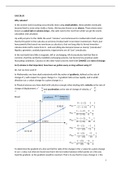
Recall 𝑔𝑟𝑎𝑑𝑖𝑒𝑛𝑡: 𝑚 = 𝑐ℎ𝑎𝑛𝑔𝑒 𝑖𝑛 𝑦
𝑐ℎ𝑎𝑛𝑔𝑒 𝑖𝑛 𝑥
𝑦
0 − (−2) 2 1
D (8;5) 𝑚𝐴𝐵 = = =
−2 − (−6) 4 2
1 − (−2) 3 1
𝑚𝐴𝐶 = = =
0 − (−6) 6 2
5 − (−2) 7 1
𝑚𝐴𝐷 = = =
B (-2;0) C (0;1) 8 − (−6) 14 2
𝑥
0 − (1) −1 1
𝑚𝐵𝐶 = = =
−2 − (0) −2 2
A (-6;-2)
0 − (5) −5 1
𝑚𝐵𝐷 = = =
−2 − (8) −10 2
1 − (5) −4 1
𝑚𝐶𝐷 = = =
0 − (8) −8 2
To determine the gradient of a line we find the ratio of the change in the 𝑦-value for a given change
in our 𝑥 value, but what we found was that it did not matter between which points on a line you
took the gradient, as the gradient would be constant. That is to say that for every change in 𝑥 the
1
Why calculus?
In the ancient world counting was primarily done using small pebbles, these pebbles eventually
became fixed to some wires inside a frame, this became known as an abacus. These stones were
known as calculi (pl) or calculus (sing.)…this Latin word is the root from which we get the words
calculation and calculator.
Up until just prior to the 1600s the word “calculus” was tantamount to mathematics itself, except
that by this point in time calculus as we know it today hadn’t even been invented yet. That is just
how powerful the branch we now know as calculus is; that not long after its formal invention
calculus stole math’s name from it… and everything else became known as merely “precalculus”.
Algebra, geometry, analytical geometry, trigonometry are all “just” precalculus.
In the real world very little is stagnant, still or unchanging. All of precalculus had that flaw in
common, that they perfectly modelled unchanging systems, but become less practical under
fluctuating conditions. Calculus on the other hand concerns itself with CHANGE and rates of change.
So if calculus is that important, how have we gotten away so long without using it?
Ah, but we have used it!
In Mathematics we have dealt extensively with the notion of gradients, defined as the rate of
change of 𝑦 with respect to a given change in 𝑥. A gradient tells us how rapidly, and in which
direction our 𝑦 values change for a given change in 𝑥.
In Physical sciences you have dealt with calculus concepts when dealing with; velocity as the rate of
∆𝑣
change of displacement, 𝑣⃗ ∆𝑥
and acceleration as the rate of change of velocity, 𝑎⃗ .
= ∆𝑡 ∆𝑡
=
Recall 𝑔𝑟𝑎𝑑𝑖𝑒𝑛𝑡: 𝑚 = 𝑐ℎ𝑎𝑛𝑔𝑒 𝑖𝑛 𝑦
𝑐ℎ𝑎𝑛𝑔𝑒 𝑖𝑛 𝑥
𝑦
0 − (−2) 2 1
D (8;5) 𝑚𝐴𝐵 = = =
−2 − (−6) 4 2
1 − (−2) 3 1
𝑚𝐴𝐶 = = =
0 − (−6) 6 2
5 − (−2) 7 1
𝑚𝐴𝐷 = = =
B (-2;0) C (0;1) 8 − (−6) 14 2
𝑥
0 − (1) −1 1
𝑚𝐵𝐶 = = =
−2 − (0) −2 2
A (-6;-2)
0 − (5) −5 1
𝑚𝐵𝐷 = = =
−2 − (8) −10 2
1 − (5) −4 1
𝑚𝐶𝐷 = = =
0 − (8) −8 2
To determine the gradient of a line we find the ratio of the change in the 𝑦-value for a given change
in our 𝑥 value, but what we found was that it did not matter between which points on a line you
took the gradient, as the gradient would be constant. That is to say that for every change in 𝑥 the
1