Factorisation of Cubic Polynomials:
As mentioned before our goal is to be able to Sketch the graph of a cubic function. To do
that we said that we needed to be able to factorise our cubic function to determine the
𝑥 −intercepts of the graph.
Factorising Cubic polynomials requires a few more steps than factorising Quadratic
polynomials. Here are 2 possible methods that can be used in order to factorise Cubic
polynomials.
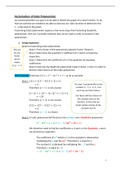
1. Using inspection:
Steps for factorising Cubic polynomials
This can Step 1: Find a factor of the polynomial using the Factor Theorem.
be any Step 2: Determine the quadratic’s coefficient of x2 and its constant by
factor inspection.
which Step 3: Determine the coefficient of x in the quadratic by equating
makes coefficients.
𝑓(𝑥) = 0
Step 4: Factorise the Quadratic polynomial made in Step1, 2 and 3 in order to
find the other factors of the Cubic polynomial.
Work Example: Factorise 𝑓(𝑥) = 𝑥 3 − 4𝑥 2 + 𝑥 + 6 as far as possible.
Step 1: 𝑓(1) = (1)3 − 4(1)2 + (1) + 6
=4 For step 1 we generally try the
Therefore (𝑥— 1) is not a factor. numbers 1, -1, 2, -2, 3, -3 to
see if we can find a factor.
𝑓(−2) = (−2)3 − 4(−2)2 + (−2) + 6
= −20 Our factor will be a factor of
the constant term in the
Therefore (𝑥 + 2) is not a factor.
function. In this case our
𝑓(2) = (2)3 − 4(2)2 + (2) + 6 factor will be a factor of the
=0 constant term 6.
Therefore (𝒙— 𝟐) is a factor.
Step 2: A Cubic polynomial will factorise into a Linear and a Quadratic polynomial.
𝒙𝟑 − 𝟒𝒙𝟐 + 𝒙 + 𝟔 = (𝒙 − 𝟐)(𝒂𝒙𝟐 + 𝒃𝒙 + 𝒄)
We therefore need to find the coefficients a, b and c in the Quadratic. a and c
can be done by inspection.
The coefficient of 𝒙𝟑 (which is 1 in this example) is obtained by
multiplying the 𝒙 and the 𝒂𝒙𝟐. Therefore 𝑎 is equal to 1.
The constant 6 is obtained by multiplying the −𝟐 and the 𝒄.
Therefore 𝑐 is equal to −3.
∴ 𝒙𝟑 − 𝟒𝒙𝟐 + 𝒙 + 𝟔 = (𝒙 − 𝟐)(𝒙𝟐 + 𝒃𝒙 − 𝟑)
1
As mentioned before our goal is to be able to Sketch the graph of a cubic function. To do
that we said that we needed to be able to factorise our cubic function to determine the
𝑥 −intercepts of the graph.
Factorising Cubic polynomials requires a few more steps than factorising Quadratic
polynomials. Here are 2 possible methods that can be used in order to factorise Cubic
polynomials.
1. Using inspection:
Steps for factorising Cubic polynomials
This can Step 1: Find a factor of the polynomial using the Factor Theorem.
be any Step 2: Determine the quadratic’s coefficient of x2 and its constant by
factor inspection.
which Step 3: Determine the coefficient of x in the quadratic by equating
makes coefficients.
𝑓(𝑥) = 0
Step 4: Factorise the Quadratic polynomial made in Step1, 2 and 3 in order to
find the other factors of the Cubic polynomial.
Work Example: Factorise 𝑓(𝑥) = 𝑥 3 − 4𝑥 2 + 𝑥 + 6 as far as possible.
Step 1: 𝑓(1) = (1)3 − 4(1)2 + (1) + 6
=4 For step 1 we generally try the
Therefore (𝑥— 1) is not a factor. numbers 1, -1, 2, -2, 3, -3 to
see if we can find a factor.
𝑓(−2) = (−2)3 − 4(−2)2 + (−2) + 6
= −20 Our factor will be a factor of
the constant term in the
Therefore (𝑥 + 2) is not a factor.
function. In this case our
𝑓(2) = (2)3 − 4(2)2 + (2) + 6 factor will be a factor of the
=0 constant term 6.
Therefore (𝒙— 𝟐) is a factor.
Step 2: A Cubic polynomial will factorise into a Linear and a Quadratic polynomial.
𝒙𝟑 − 𝟒𝒙𝟐 + 𝒙 + 𝟔 = (𝒙 − 𝟐)(𝒂𝒙𝟐 + 𝒃𝒙 + 𝒄)
We therefore need to find the coefficients a, b and c in the Quadratic. a and c
can be done by inspection.
The coefficient of 𝒙𝟑 (which is 1 in this example) is obtained by
multiplying the 𝒙 and the 𝒂𝒙𝟐. Therefore 𝑎 is equal to 1.
The constant 6 is obtained by multiplying the −𝟐 and the 𝒄.
Therefore 𝑐 is equal to −3.
∴ 𝒙𝟑 − 𝟒𝒙𝟐 + 𝒙 + 𝟔 = (𝒙 − 𝟐)(𝒙𝟐 + 𝒃𝒙 − 𝟑)
1