Graph analysis and interpretation
When presented with graph related questions apart from being asked to sketch the graph (last
lesson), or determine the equation of the graph (next lesson), you are expected to be able to make
commentary about the behaviours of the function.
These behaviours occur over intervals (positive/negative, increasing/decreasing, concave
up/concave down etc) or at specific points (local minimum/maximum points)
Positive/Negative:
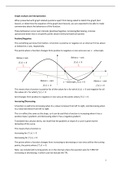
This something we know from before. A function is positive or negative on an interval if it lies above
or below the 𝑥-axis, respectively.
The points where a function changes from positive to negative or vice versa are our 𝑥 −intercepts.
Below 𝑥-axis Below 𝑥 −axis
𝑓(𝑥) < 0 𝑓(𝑥) < 0
Above 𝑥 −axis Above 𝑥 −axis
𝑥 −intercepts: 𝑓(𝑥) = 0
𝑓(𝑥) > 0 𝑓(𝑥) > 0
This means that a function is positive for all the values for x for which 𝑓(𝑥) > 0 and negative for all
the values of 𝑥 for which 𝑓(𝑥) < 0.
And changes from positive to negative or vice versa at the points where 𝑓(𝑥) = 0.
Increasing/Decreasing:
A function is said to be increasing when its y value increases from left to right, and decreasing when
its y value decreases from left to right.
This is in effect the same as the slope, so it can be said that a function is increasing when it has a
positive slope / gradient, and decreasing when it has a negative gradient.
Translated into calculus terms, we recall that the gradient or slope of a curve is given by the
derivative of the curve.
This means that a function is:
Increasing for 𝑓 ′ (𝑥) > 0
Decreasing for 𝑓 ′ (𝑥) < 0.
The points where a function changes from increasing to decreasing or vice versa will be the turning
points, the points where 𝑓 ′ (𝑥) = 0.
Note: we include both turning points on in the interval unless the question asks for STRICTLY
increasing or decreasing, in which case we exclude the TPs.
1
, 𝑓 ′ (𝑥) > 0 ∴ 𝑖𝑛𝑐𝑟𝑒𝑎𝑠𝑖𝑛𝑔 𝑓 ′ (𝑥) < 0 ∴ 𝑑𝑒𝑐𝑟𝑒𝑎𝑠𝑖𝑛𝑔 𝑓 ′ (𝑥) > 0 ∴ 𝑖𝑛𝑐𝑟𝑒𝑎𝑠𝑖𝑛𝑔
𝑆𝑡𝑎𝑡𝑖𝑜𝑛𝑎𝑟𝑦 𝑝𝑜𝑖𝑛𝑡𝑠:
𝑓 ′ (𝑥) = 0
Concave up/concave down
A function is said to be concave up when the function lies above its tangent lines, and concave down
when the function lies below the tangent lines
Recall:
A graph is A graph is
CONCAVE UP CONCAVE DOWN
when all of its when all of its
tangent lines are tangent lines are
below the curve. above the curve.
(Arms up) (Arms down)
A function is concave up when 𝑓 ′′ (𝑥) > 0 and is said to be concave down when 𝑓 ′′ (𝑥) < 0.
The points where a graph shifts from concave up to down or vice versa are the points where
𝑓 ′′ (𝑥) = 0, AKA the point/s of inflection.
𝑓′′(𝑥) > 0 ∴ 𝑐𝑜𝑛𝑐𝑎𝑣𝑒 𝑢𝑝
POI: 𝑓 ′′ (𝑥) = 0
𝑓 ′′ (𝑥) < 0 ∴ 𝑐𝑜𝑛𝑐𝑎𝑣𝑒 𝑑𝑜𝑤𝑛
2
When presented with graph related questions apart from being asked to sketch the graph (last
lesson), or determine the equation of the graph (next lesson), you are expected to be able to make
commentary about the behaviours of the function.
These behaviours occur over intervals (positive/negative, increasing/decreasing, concave
up/concave down etc) or at specific points (local minimum/maximum points)
Positive/Negative:
This something we know from before. A function is positive or negative on an interval if it lies above
or below the 𝑥-axis, respectively.
The points where a function changes from positive to negative or vice versa are our 𝑥 −intercepts.
Below 𝑥-axis Below 𝑥 −axis
𝑓(𝑥) < 0 𝑓(𝑥) < 0
Above 𝑥 −axis Above 𝑥 −axis
𝑥 −intercepts: 𝑓(𝑥) = 0
𝑓(𝑥) > 0 𝑓(𝑥) > 0
This means that a function is positive for all the values for x for which 𝑓(𝑥) > 0 and negative for all
the values of 𝑥 for which 𝑓(𝑥) < 0.
And changes from positive to negative or vice versa at the points where 𝑓(𝑥) = 0.
Increasing/Decreasing:
A function is said to be increasing when its y value increases from left to right, and decreasing when
its y value decreases from left to right.
This is in effect the same as the slope, so it can be said that a function is increasing when it has a
positive slope / gradient, and decreasing when it has a negative gradient.
Translated into calculus terms, we recall that the gradient or slope of a curve is given by the
derivative of the curve.
This means that a function is:
Increasing for 𝑓 ′ (𝑥) > 0
Decreasing for 𝑓 ′ (𝑥) < 0.
The points where a function changes from increasing to decreasing or vice versa will be the turning
points, the points where 𝑓 ′ (𝑥) = 0.
Note: we include both turning points on in the interval unless the question asks for STRICTLY
increasing or decreasing, in which case we exclude the TPs.
1
, 𝑓 ′ (𝑥) > 0 ∴ 𝑖𝑛𝑐𝑟𝑒𝑎𝑠𝑖𝑛𝑔 𝑓 ′ (𝑥) < 0 ∴ 𝑑𝑒𝑐𝑟𝑒𝑎𝑠𝑖𝑛𝑔 𝑓 ′ (𝑥) > 0 ∴ 𝑖𝑛𝑐𝑟𝑒𝑎𝑠𝑖𝑛𝑔
𝑆𝑡𝑎𝑡𝑖𝑜𝑛𝑎𝑟𝑦 𝑝𝑜𝑖𝑛𝑡𝑠:
𝑓 ′ (𝑥) = 0
Concave up/concave down
A function is said to be concave up when the function lies above its tangent lines, and concave down
when the function lies below the tangent lines
Recall:
A graph is A graph is
CONCAVE UP CONCAVE DOWN
when all of its when all of its
tangent lines are tangent lines are
below the curve. above the curve.
(Arms up) (Arms down)
A function is concave up when 𝑓 ′′ (𝑥) > 0 and is said to be concave down when 𝑓 ′′ (𝑥) < 0.
The points where a graph shifts from concave up to down or vice versa are the points where
𝑓 ′′ (𝑥) = 0, AKA the point/s of inflection.
𝑓′′(𝑥) > 0 ∴ 𝑐𝑜𝑛𝑐𝑎𝑣𝑒 𝑢𝑝
POI: 𝑓 ′′ (𝑥) = 0
𝑓 ′′ (𝑥) < 0 ∴ 𝑐𝑜𝑛𝑐𝑎𝑣𝑒 𝑑𝑜𝑤𝑛
2