
Chapter 7: Operational Systems
Principles
An organization must have information systems that support the routine, day-to-day activities
that occur in the normal course of business and help a company add value to its products and
services.
Traditional transaction processing systems support the various business functions of
organizations that have not yet implemented enterprise resource planning systems.
Electronic and mobile commerce allow transactions to be made by the customer, with less need
for sales staff, and open up new opportunities for conducting business.
A company that implements an enterprise resource planning system is creating a highly
integrated set of systems, which can lead to many business benefits.
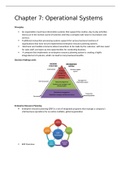
Decision Making Levels
Enterprise Resource Planning
Enterprise resource planning (ERP) is a set of integrated programs that manage a company’s
vital business operations for an entire multisite, global organization
ERP Overview
, o 1970s: ERP systems evolved from materials requirement planning (MRP) systems
MRPs tied together production planning, inventory control, and purchasing
business functions for manufacturing organizations
o Late 1980s-early 1990s: recognition that legacy transaction processing systems lacked
necessary integration for information sharing
Y2K provided impetus to upgrade systems
Advantage and Disadvantages of ERP
o Advantages
Improved access to data for operational decision making
Elimination of costly, inflexible legacy systems
Improvement of work processes based on best practices
Upgrade of technology infrastructure
o Disadvantages
Expense and time in implementation
Difficulty implementing change
Difficulty integrating with other systems
Risks in using one vendor
Risk of implementation failure
ERP for Small- and Medium – Sized Enterprise (SMEs)
o Many SMEs elect to implement open-source ERP systems. With open source software
anyone can see and modify the source code to customize it to meet their needs.
Transaction Processing Systems
Transaction processing systems (TPSs)
o Process detailed data necessary to update records about fundamental business
operations
o Include order entry, inventory control, payroll, accounts payable, accounts receivable,
general ledger, etc.
o Provide data for other business processes
Management information system/decision support system (MIS/DSS)
Special-purpose information systems
Traditional Transaction Processing methods
o Batch processing system –
Computerized processing in which business transactions are accumulated over a
period of time and prepared for processing as a single unit or batch
o Online transaction processing (OLTP)
Computerized processing in which each transaction is processed immediately
Traditional Transaction Processing Objectives
o Organizations expect their TPS to:
Process data generated by and about transactions
Maintain a high degree of accuracy and integrity
Avoid processing fraudulent transactions
Produce timely user responses and reports
Principles
An organization must have information systems that support the routine, day-to-day activities
that occur in the normal course of business and help a company add value to its products and
services.
Traditional transaction processing systems support the various business functions of
organizations that have not yet implemented enterprise resource planning systems.
Electronic and mobile commerce allow transactions to be made by the customer, with less need
for sales staff, and open up new opportunities for conducting business.
A company that implements an enterprise resource planning system is creating a highly
integrated set of systems, which can lead to many business benefits.
Decision Making Levels
Enterprise Resource Planning
Enterprise resource planning (ERP) is a set of integrated programs that manage a company’s
vital business operations for an entire multisite, global organization
ERP Overview
, o 1970s: ERP systems evolved from materials requirement planning (MRP) systems
MRPs tied together production planning, inventory control, and purchasing
business functions for manufacturing organizations
o Late 1980s-early 1990s: recognition that legacy transaction processing systems lacked
necessary integration for information sharing
Y2K provided impetus to upgrade systems
Advantage and Disadvantages of ERP
o Advantages
Improved access to data for operational decision making
Elimination of costly, inflexible legacy systems
Improvement of work processes based on best practices
Upgrade of technology infrastructure
o Disadvantages
Expense and time in implementation
Difficulty implementing change
Difficulty integrating with other systems
Risks in using one vendor
Risk of implementation failure
ERP for Small- and Medium – Sized Enterprise (SMEs)
o Many SMEs elect to implement open-source ERP systems. With open source software
anyone can see and modify the source code to customize it to meet their needs.
Transaction Processing Systems
Transaction processing systems (TPSs)
o Process detailed data necessary to update records about fundamental business
operations
o Include order entry, inventory control, payroll, accounts payable, accounts receivable,
general ledger, etc.
o Provide data for other business processes
Management information system/decision support system (MIS/DSS)
Special-purpose information systems
Traditional Transaction Processing methods
o Batch processing system –
Computerized processing in which business transactions are accumulated over a
period of time and prepared for processing as a single unit or batch
o Online transaction processing (OLTP)
Computerized processing in which each transaction is processed immediately
Traditional Transaction Processing Objectives
o Organizations expect their TPS to:
Process data generated by and about transactions
Maintain a high degree of accuracy and integrity
Avoid processing fraudulent transactions
Produce timely user responses and reports



