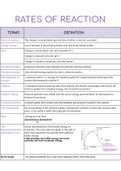
RATES OF REACTION
TERMS DEFINITION
Rates of reaction The change in concentration per unit time of either a reactant or product
Energy change occurs because of bonds being broken and new bonds being formed.
Unit change in concentration over time (mol•dm-3•s-1)
Change in mass per unit time (g•s-1)
Change in number of moles per unit time (mol•s-1)
Activated complex temporary transition state between the reactants and the products
Activation energy the minimum energy required to start a chemical reaction.
Enthalpy/heat of a measure of the total energy of a chemical system for a given pressure and is given the
reaction symbol ∆H [measured in kJ•mol-1]
Catalyst- a substance that increases the rate of the reaction but remains unchanged at the end of the
reaction. [lowers the activation energy, rate of reaction increases]
Collision Theory Reactant particles must collide with the correct energy and orientation for the reactant to
change into products.
A chemical system a closed system that contains only the reactants and products involved in the reaction.
The environment the surroundings of the chemical system, including the container in which the reaction takes
place, or the water in which the molecules are dissolved.
Rate change per unit time:
∆[products] or ∆[reactants]
∆t
The shows the distribution of the kinetic energy of
Maxwell-boltzmann molecules. The area under the graph to the right of
Distribution Curve the EA line represents the particles with sufficient
kinetic energy
Little particles have little energy and most
particles will have moderate energy
Bond length the distance between the nuclei of two adjacent atoms when they bond
TERMS DEFINITION
Rates of reaction The change in concentration per unit time of either a reactant or product
Energy change occurs because of bonds being broken and new bonds being formed.
Unit change in concentration over time (mol•dm-3•s-1)
Change in mass per unit time (g•s-1)
Change in number of moles per unit time (mol•s-1)
Activated complex temporary transition state between the reactants and the products
Activation energy the minimum energy required to start a chemical reaction.
Enthalpy/heat of a measure of the total energy of a chemical system for a given pressure and is given the
reaction symbol ∆H [measured in kJ•mol-1]
Catalyst- a substance that increases the rate of the reaction but remains unchanged at the end of the
reaction. [lowers the activation energy, rate of reaction increases]
Collision Theory Reactant particles must collide with the correct energy and orientation for the reactant to
change into products.
A chemical system a closed system that contains only the reactants and products involved in the reaction.
The environment the surroundings of the chemical system, including the container in which the reaction takes
place, or the water in which the molecules are dissolved.
Rate change per unit time:
∆[products] or ∆[reactants]
∆t
The shows the distribution of the kinetic energy of
Maxwell-boltzmann molecules. The area under the graph to the right of
Distribution Curve the EA line represents the particles with sufficient
kinetic energy
Little particles have little energy and most
particles will have moderate energy
Bond length the distance between the nuclei of two adjacent atoms when they bond