
ACID AND BASE
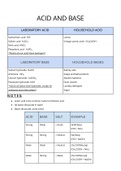
LABORATORY ACID HOUSEHOLD ACID
hydrochloric acid- HCl+ Lemon
Sulfuric acid- H2SO4 Vinegar (acetic acid) ~CH3COOH~
Nitric acid- HNO3
Phosphoric acid - H3PO4
*Notice all our acids have hydrogen*
LABORATORY BASE HOUSEHOLD BASES
Sodium hydroxide- NaOH Baking soda
Ammonia - NH3 Soaps and bath products
Calcium hydroxide- Ca(OH)2 Alkaline batteries
Potassium hydroxide- KOH Drain cleaner
*notice all bases have hydroxide, except for Laundry detergent
ammonia and a few others* Sugar
N O T E S:
● Acetic acid is the common name for Ethanoic acid
● All bases dissociate in water
● Bases dissociate, acids ionize
ACID BASE SALT EXAMPLE
Strong Weak = Acidic NH4Cℓ(aq)
(HCℓ + NH3)
Strong Strong = Neutral NaCℓ(aq)
(HCℓ + NaOH)
Weak Weak = Neutral CH3COONH4(aq)
(CH3COOH + NH3)
Weak Strong = Alkali CH3COONa (aq)
(CH3COOH + NaOH)
, TERMS DEFINITION
Amphoteric act as an acid in one reaction, or a base in another reaction, such as ammonia (NH3), zinc oxide
(ZnO), and beryllium hydroxide (Be(OH)2) are amphoteric.
Ampholyte a substance that can act as either acid or base e.g Water and ammonia
(amphiprotic) Acts as a base/acid in the presence of an acid/base
Amphoric a substance can donate a proton in one reaction, or accept a proton in another reaction e.g water
Hydrolysis of ionization of salt in water. Splitting of any compound by reacting with water
salts The pH of the salt solution is determined by the strength of the acid and base that is used to form
the salt
Disassociation is the breaking apart of a molecule to form smaller molecules or ions, usually In a reversible
manner. And gives off heat when dissociation happens
In the case of disassociation, water doesn’t undergo change unlike ionization where water turns
into H3O
Monoprotic An acid that releases only one H+ ion per molecule of acid (e.g HCl)
Diprotic An acid that can release two H+ ions per molecule of acid (eng H2SO4)
Polyprotic Any acid that can donate more than one proton(H+) ion of acid
Reaction Rate Increases as the strength of the acid/base increases
Stronger acid = high concentration of ions = greater rate of reaction
Conductivity Increases as the strength of the acid/base increases
Stronger acid = high concentration of H+ = greater conductivity
LOWRY-BRØNSTED ACIDS AND BASES
Acid a proton (H+) donor (gives away) Base a proton (H+) acceptor (collects)
ARRHENIUS ACIDS AND BASES
LABORATORY ACID HOUSEHOLD ACID
hydrochloric acid- HCl+ Lemon
Sulfuric acid- H2SO4 Vinegar (acetic acid) ~CH3COOH~
Nitric acid- HNO3
Phosphoric acid - H3PO4
*Notice all our acids have hydrogen*
LABORATORY BASE HOUSEHOLD BASES
Sodium hydroxide- NaOH Baking soda
Ammonia - NH3 Soaps and bath products
Calcium hydroxide- Ca(OH)2 Alkaline batteries
Potassium hydroxide- KOH Drain cleaner
*notice all bases have hydroxide, except for Laundry detergent
ammonia and a few others* Sugar
N O T E S:
● Acetic acid is the common name for Ethanoic acid
● All bases dissociate in water
● Bases dissociate, acids ionize
ACID BASE SALT EXAMPLE
Strong Weak = Acidic NH4Cℓ(aq)
(HCℓ + NH3)
Strong Strong = Neutral NaCℓ(aq)
(HCℓ + NaOH)
Weak Weak = Neutral CH3COONH4(aq)
(CH3COOH + NH3)
Weak Strong = Alkali CH3COONa (aq)
(CH3COOH + NaOH)
, TERMS DEFINITION
Amphoteric act as an acid in one reaction, or a base in another reaction, such as ammonia (NH3), zinc oxide
(ZnO), and beryllium hydroxide (Be(OH)2) are amphoteric.
Ampholyte a substance that can act as either acid or base e.g Water and ammonia
(amphiprotic) Acts as a base/acid in the presence of an acid/base
Amphoric a substance can donate a proton in one reaction, or accept a proton in another reaction e.g water
Hydrolysis of ionization of salt in water. Splitting of any compound by reacting with water
salts The pH of the salt solution is determined by the strength of the acid and base that is used to form
the salt
Disassociation is the breaking apart of a molecule to form smaller molecules or ions, usually In a reversible
manner. And gives off heat when dissociation happens
In the case of disassociation, water doesn’t undergo change unlike ionization where water turns
into H3O
Monoprotic An acid that releases only one H+ ion per molecule of acid (e.g HCl)
Diprotic An acid that can release two H+ ions per molecule of acid (eng H2SO4)
Polyprotic Any acid that can donate more than one proton(H+) ion of acid
Reaction Rate Increases as the strength of the acid/base increases
Stronger acid = high concentration of ions = greater rate of reaction
Conductivity Increases as the strength of the acid/base increases
Stronger acid = high concentration of H+ = greater conductivity
LOWRY-BRØNSTED ACIDS AND BASES
Acid a proton (H+) donor (gives away) Base a proton (H+) acceptor (collects)
ARRHENIUS ACIDS AND BASES


