

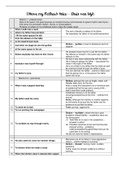
I Have my Father’s Voice – Chris van Wyk
· Stanza 1 – present tense
· Style of the poem: the poet focusses on emotion/humour and chooses to ignore rhythm and rhyme –
free verse (no consistent rhythm, rhyme, or lyrical pattern)
· Purpose: to reflect on his childhood and to make the reader laugh
1 When I walk into a room
· The son is literally a replica of his father
2 where my father has just been
· He resembles his father in his build/mannerisms
3 I fill the same spaces he did
4 from the elbows on the table ·
5 to the head thrown back ·
· Diction – ‘guffaw: a loud or boisterous burst of
6 and when we laugh we aim the guffaw
laughter
7 at the same space in the air. ·
· He already knows that he is just like his father
8 Before anybody has told me this I know · He reflects on himself in the same way his father
reflects on him
· He has a very close relationship with his father
· He is trying to please his father – has placed his
9 because I see myself through value in the eyes of his father
· He is so similar to his father that he might as well
be viewing himself through his father’s eyes
· The son admires his father – wants to make sure
10 my father’s eyes. that the person he is, is the person his father
wants him to be
· Stanza 2-4 – past tense
· Diction: portrays the son as fragile, weak, soft
· Reader feels sorry for the boy
11 When I was a pigeon-toed boy · Poet is using this expression as a humorous wat
of explaining that he was just a young child –
hadn’t learned to walk properly
· Childhood memory is of his father
shouting/complaining all the time – ordered him
around
12 My father used his voice
· Ironic: although the memory is mostly negative,
he still wants to be just like his father and he
knows he is just like his father
13 To send me to bed · Tone: grumpy, aggressive
14 To run and buy the newspaper ·
· Diction – ‘scribble’: shows the boy’s poor
academic interest/ability – academics were not
his strong point
(1) Took little to no care in his academics –
showed no effort
15 To scribble my way through matric.
(2) Possible reference to the fact that the poet
enjoyed writing – scribbling
notes/anecdotes/thoughts/ideas that can be
used later in his writing
· He did not meet his father’s expectations
·
· Memories are of his father’s more aggressive
16 He also used his voice for harsher things:
nature – violent instead of nurturing
· Diction – ‘bluster’: strong, harsh, sudden,
explosive
17 To bluster when we made a noise
· Father loses his temper suddenly & without
warning
18 When the kitchen wasn’t cleaned after supper ·
· Stanza 1 – present tense
· Style of the poem: the poet focusses on emotion/humour and chooses to ignore rhythm and rhyme –
free verse (no consistent rhythm, rhyme, or lyrical pattern)
· Purpose: to reflect on his childhood and to make the reader laugh
1 When I walk into a room
· The son is literally a replica of his father
2 where my father has just been
· He resembles his father in his build/mannerisms
3 I fill the same spaces he did
4 from the elbows on the table ·
5 to the head thrown back ·
· Diction – ‘guffaw: a loud or boisterous burst of
6 and when we laugh we aim the guffaw
laughter
7 at the same space in the air. ·
· He already knows that he is just like his father
8 Before anybody has told me this I know · He reflects on himself in the same way his father
reflects on him
· He has a very close relationship with his father
· He is trying to please his father – has placed his
9 because I see myself through value in the eyes of his father
· He is so similar to his father that he might as well
be viewing himself through his father’s eyes
· The son admires his father – wants to make sure
10 my father’s eyes. that the person he is, is the person his father
wants him to be
· Stanza 2-4 – past tense
· Diction: portrays the son as fragile, weak, soft
· Reader feels sorry for the boy
11 When I was a pigeon-toed boy · Poet is using this expression as a humorous wat
of explaining that he was just a young child –
hadn’t learned to walk properly
· Childhood memory is of his father
shouting/complaining all the time – ordered him
around
12 My father used his voice
· Ironic: although the memory is mostly negative,
he still wants to be just like his father and he
knows he is just like his father
13 To send me to bed · Tone: grumpy, aggressive
14 To run and buy the newspaper ·
· Diction – ‘scribble’: shows the boy’s poor
academic interest/ability – academics were not
his strong point
(1) Took little to no care in his academics –
showed no effort
15 To scribble my way through matric.
(2) Possible reference to the fact that the poet
enjoyed writing – scribbling
notes/anecdotes/thoughts/ideas that can be
used later in his writing
· He did not meet his father’s expectations
·
· Memories are of his father’s more aggressive
16 He also used his voice for harsher things:
nature – violent instead of nurturing
· Diction – ‘bluster’: strong, harsh, sudden,
explosive
17 To bluster when we made a noise
· Father loses his temper suddenly & without
warning
18 When the kitchen wasn’t cleaned after supper ·


