

Population Ecology (IEB) - LIFE SCIENCE PAPER II
POPULATION SIZE:
- Factors
- Natality: birth rate (births per 1000 people a year)
- Morality: death rate (deaths per 1000 people per year)
- Immigration: move into
- Emigration: move out of
- Carrying Capacity
- The population density that the environment can support, when
carrying capacity is reached, births and deaths balance each other out
- Limiting Factors
- Regulate growth of population and build up environmental resistance -
total number of factors that stop a population from reducing at its max
rate
- Density independent factors (natural factors)
- Physical factors and catastrophic events
- Density dependent factors
- Greater effect when overcrowded
- Compete for resources, easily found by predators,
spread disease and parasites more readily
- Stable and Unstable population
- Stable populations
- Fluctuate around carrying capacity
- Numbers decrease when its size exceeds the carrying capacity
but increases again when the numbers fall below the carrying
capacity
- Unstable population
- Numbers exceed the environments carrying capacity
- Causes the habitat to deteriorate rapidly (lowering the
carrying capacity)
- Habitat eventually stops being able to support population
(leading to population decline and even extinction)
- Population growth forms
1
, - Geometric (J shaped)
- Unstable
- Increases exponentially, douballing at regular intervals
- Stops suddenly when environmental conditions unfavorable
- Population crash is extinction phase
- *lag at start
- Then exponential growth
- At top conditions become unfavorable
- After extinction phase favorable conditions return
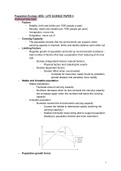
- Logistic growth form (s shaped)
- Stable
- Few individuals to new area where there is enough food and
predation and disease are not too severe
- Lag phase (A)
- Slow to accumulate sexuality and maturity
- Accelerating growth phase (A)
- Since no resistance (birth>death)
- Decelerating growth phase (A)
- Due to environmental resistance (birth<death)
- Equilibrium phase (B)
- Stabilizes
- Extinction phase still possible in case of a disaster or
disease
- Methods of estimating population size
2
POPULATION SIZE:
- Factors
- Natality: birth rate (births per 1000 people a year)
- Morality: death rate (deaths per 1000 people per year)
- Immigration: move into
- Emigration: move out of
- Carrying Capacity
- The population density that the environment can support, when
carrying capacity is reached, births and deaths balance each other out
- Limiting Factors
- Regulate growth of population and build up environmental resistance -
total number of factors that stop a population from reducing at its max
rate
- Density independent factors (natural factors)
- Physical factors and catastrophic events
- Density dependent factors
- Greater effect when overcrowded
- Compete for resources, easily found by predators,
spread disease and parasites more readily
- Stable and Unstable population
- Stable populations
- Fluctuate around carrying capacity
- Numbers decrease when its size exceeds the carrying capacity
but increases again when the numbers fall below the carrying
capacity
- Unstable population
- Numbers exceed the environments carrying capacity
- Causes the habitat to deteriorate rapidly (lowering the
carrying capacity)
- Habitat eventually stops being able to support population
(leading to population decline and even extinction)
- Population growth forms
1
, - Geometric (J shaped)
- Unstable
- Increases exponentially, douballing at regular intervals
- Stops suddenly when environmental conditions unfavorable
- Population crash is extinction phase
- *lag at start
- Then exponential growth
- At top conditions become unfavorable
- After extinction phase favorable conditions return
- Logistic growth form (s shaped)
- Stable
- Few individuals to new area where there is enough food and
predation and disease are not too severe
- Lag phase (A)
- Slow to accumulate sexuality and maturity
- Accelerating growth phase (A)
- Since no resistance (birth>death)
- Decelerating growth phase (A)
- Due to environmental resistance (birth<death)
- Equilibrium phase (B)
- Stabilizes
- Extinction phase still possible in case of a disaster or
disease
- Methods of estimating population size
2



