Sport Science
Levers
Force Summation
Movement (A,L,G)
Motion & Momentum
Planes of Motion
Spin
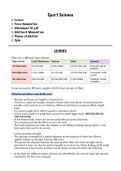
LEVERS
There are 3 different types of levers:
Type of lever Load/ Resistance Fulcrum E ort Example
1st Class lever On one side In the middle On the other side Crow bar, pair of
scissors
2nd class Lever In the middle On one side On the other side Nutcracker, bottle
opener
3rd class lever One one side On the other side In the middle Tweezers, human
mandible
Levers are used to lift heavy weights with the least amount of effort.
What levers does your body use?
- Muscles and bones act together to form levers
- A lever is a rigid rod (usually a length of bone) that turns about a fixed point/pivot,
usually a joint and serves as a fulcrum. (Elbow joint fulcrum, humerus effort, weight
load)
- It is used to apply force (effort) against a resistance (load)
- Levers can be used so a small force can move a much bigger load - MECHANICAL
ADVANTAGE.
- In the human body, bones are leavers and joints are pivots/fulcrums.
- Your muscles provide the effort to move the load
- The load/resistance are often the weights we are lifting or hitting (tennis ball) or even
body parts that need to be moved.
- A lever provides strength
- The amount of strength of a muscle depends on the position of where the effort is
applied relative to the joint it moves (fulcrum)
- The greater the distance between the joint and the effort, the more strength can be
generated. Levers can also be used to magnify movement. Eg. When kicking a ball, small
contractions of leg muscles produce a much larger movement at the end of the leg.
- In the body the different classes of levers are identified by the way the joint and muscles
attached to the bone are arranged.
ff
, Examples of each lever
Class 1 Lever on the humanEbody:
Pivot/fulcrum ort Resistance/load Explanation
Nod your head Where your skull The neck muscles Weight of the head When the neck
meets the top of at the back of the muscles relax, your
your spine skull head nods forward.
For this lever, the
pivot lies between
the e ort and the
load.
Class 2 Lever Pivot/fulcrum E ort Resistance/load Explanation
Stand on tip toes Toe joints Calf muscles and Body weight The load is
Achilles’ tendon between the pivot
when the calf and the e ort.
muscle contracts
The e ort force
needed is less than
the load force, so
there is mechanical
advantage
IT TAKES LESS
EFFORT TO LIFT
SOMETHING
HEAVY
Class 3 Lever Pivot/fulcrum E ort Resistance/load Explanation
Bend your arm in a The elbow Bicep muscles Weights Many muscles and
bicep curl bone combinations
in our bodies are of
the class 3 lever
type.
Maximising lever length to improve performance:
- The longer the lever the greater the velocity (speed) and force that can be imparted on
an object eg. A squash ball can be hit harder when the elbow joint is fully extended
rather than fixed and the use of the racket lengthens the lever even more. Longer levers
create greater speed and force at the end of the lever arm which is an advantage when
throwing or hitting/striking (baseball, tennis, soccer)
- The player will shorten the lever arm length by bending their elbow, allowing force to be
generated and the racket swung with more speed.
- As the ball is hit, the elbow extends to increase the length of the lever and allow the
racket head to travel at full speed.
- This allows the ball to leave the racket head with more speed
- Fulcrum = shoulder
- Force = Anterior Deltoid
- Resistance = Racket head and Ball
Longer levers generate the greatest velocity (speed) at the end.
ff ffff ff
Levers
Force Summation
Movement (A,L,G)
Motion & Momentum
Planes of Motion
Spin
LEVERS
There are 3 different types of levers:
Type of lever Load/ Resistance Fulcrum E ort Example
1st Class lever On one side In the middle On the other side Crow bar, pair of
scissors
2nd class Lever In the middle On one side On the other side Nutcracker, bottle
opener
3rd class lever One one side On the other side In the middle Tweezers, human
mandible
Levers are used to lift heavy weights with the least amount of effort.
What levers does your body use?
- Muscles and bones act together to form levers
- A lever is a rigid rod (usually a length of bone) that turns about a fixed point/pivot,
usually a joint and serves as a fulcrum. (Elbow joint fulcrum, humerus effort, weight
load)
- It is used to apply force (effort) against a resistance (load)
- Levers can be used so a small force can move a much bigger load - MECHANICAL
ADVANTAGE.
- In the human body, bones are leavers and joints are pivots/fulcrums.
- Your muscles provide the effort to move the load
- The load/resistance are often the weights we are lifting or hitting (tennis ball) or even
body parts that need to be moved.
- A lever provides strength
- The amount of strength of a muscle depends on the position of where the effort is
applied relative to the joint it moves (fulcrum)
- The greater the distance between the joint and the effort, the more strength can be
generated. Levers can also be used to magnify movement. Eg. When kicking a ball, small
contractions of leg muscles produce a much larger movement at the end of the leg.
- In the body the different classes of levers are identified by the way the joint and muscles
attached to the bone are arranged.
ff
, Examples of each lever
Class 1 Lever on the humanEbody:
Pivot/fulcrum ort Resistance/load Explanation
Nod your head Where your skull The neck muscles Weight of the head When the neck
meets the top of at the back of the muscles relax, your
your spine skull head nods forward.
For this lever, the
pivot lies between
the e ort and the
load.
Class 2 Lever Pivot/fulcrum E ort Resistance/load Explanation
Stand on tip toes Toe joints Calf muscles and Body weight The load is
Achilles’ tendon between the pivot
when the calf and the e ort.
muscle contracts
The e ort force
needed is less than
the load force, so
there is mechanical
advantage
IT TAKES LESS
EFFORT TO LIFT
SOMETHING
HEAVY
Class 3 Lever Pivot/fulcrum E ort Resistance/load Explanation
Bend your arm in a The elbow Bicep muscles Weights Many muscles and
bicep curl bone combinations
in our bodies are of
the class 3 lever
type.
Maximising lever length to improve performance:
- The longer the lever the greater the velocity (speed) and force that can be imparted on
an object eg. A squash ball can be hit harder when the elbow joint is fully extended
rather than fixed and the use of the racket lengthens the lever even more. Longer levers
create greater speed and force at the end of the lever arm which is an advantage when
throwing or hitting/striking (baseball, tennis, soccer)
- The player will shorten the lever arm length by bending their elbow, allowing force to be
generated and the racket swung with more speed.
- As the ball is hit, the elbow extends to increase the length of the lever and allow the
racket head to travel at full speed.
- This allows the ball to leave the racket head with more speed
- Fulcrum = shoulder
- Force = Anterior Deltoid
- Resistance = Racket head and Ball
Longer levers generate the greatest velocity (speed) at the end.
ff ffff ff