

One-Way ANOVA (Analysis of Variance)
We have been introduced to the t-test, which is suitable when we have two independent
groups. But, let us say we want to conduct an experiment to see how best to improve job
satisfaction in an organisation. Let us say we randomly assign employees into one of four
treatment groups. Maybe some of them watch a PowerPoint aimed at motivating
employees. Others receive ongoing coaching, the third group may attend a day-long
workshop, and the fourth group may go on a weekend away or a teambuilding weekend
away.
In this example, we have one dependent variable, which is job satisfaction. But our
independent variable (i.e., group) has four levels or four different treatments. In a situation
like this, we cannot conduct a t-test because we have more than two groups.
• A researcher wishes to conduct an experiment to see how best to improve Job
Satisfaction in an organisation. She randomly assigns employees into one of four
treatment groups:
• Group 1: Watch a PowerPoint aimed at motivating employees
• Group 2: Receive ongoing coaching
• Group 3: Attend a day-long workshop
• Group 4: Go on a weekend away
• IV: Group, with 4 levels DV: Job Satisfaction
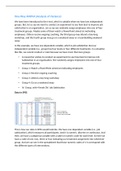
Data in SPSS
This is how our data in SPSS would look like. We have one dependent variable (i.e., job
satisfaction), which measures all participants. And it is numeric, discrete or continuous. And
then, we have a categorical variable with a label or numeric code for each level. So here we
have a code of one, two, three or four indicating our treatment assignment into whichever
group. And we can see in the spreadsheet that those numeric codes of 1-4 correspond with
the different types of interventions.
,Effects of four types of Interventions on Job Satisfaction: Descriptive Statistics
In this research study, we want to see the effect of these four types of interventions on job
satisfaction. We would first look at the descriptive statistics for all these groups and get the
mean job satisfaction values. As you can see from the plot of mean values where we have
on the Y-axis our four groups: the PowerPoint, the coaching, the daylong workshop or the
weekend retreat, and from this plot, you can see that the means are different. And you can
see that the weekend retreat appears to have the highest mean job satisfaction level.
The next question we should be asking ourselves is that are those mean differences actually
reflecting different populations? Or are those mean differences we are seeing happening
due to chance? Now, we are going to perform a hypothesis test to be able to answer these
questions.
Why not compare groups with multiple independent samples t-tests?
• Every time you conduct a t-test, there is a chance that you will make a Type I error.
This error is usually 5% or less. (i.e., p < 0.05). Remember, a Type I error is the risk
you are prepared to take. You are wrongly rejecting the null hypothesis of “no
effect”.
• By running two t-tests on the same data, you will have increased your chance of
making a Type I error to 10%. [i.e., = 1- (0.95*0.95)], and so it goes on.
• This is an unacceptable creeping up of risk….a common problem in statistics. • An
alternate test is required – the ANOVA. The ANOVA carefully controls for this risk.
• ANOVA is short for Analysis Of Variance.
• All ANOVAs compare more than two mean scores with each other; they are tests for
the difference in mean scores and extend the t-test to more than 2 groups.
What does the ANOVA tell us?
• Null hypothesis
Like a t-test, ANOVA tests the null hypothesis that the means are the same
• Experimental / Alternate Hypothesis
, The means differ
• ANOVA is an omnibus test
It tests for an overall difference between groups
It tells us that the group means are different
It doesn’t tell us exactly which means differ
• For this reason, ANOVA is often referred to as a 2-step Process
STEP 1: Run the Omnibus Test to see if there is a mean difference
STEP 2: IF there is a mean difference, follow up with more tests to see exactly which
means differ
What is important to remember is that the ANOVA is called an omnibus test. This is an old
English word for a huge bus that used to carry a bunch of people. So ANOVA is a bundling
test, and it tests for an overall difference between groups. It tells us that the group means
are different somewhere, but it does not tell us exactly where the means differ. An ANOVA
will tell us that somewhere, at least two of those four groups are different from each
other. We don’t know which of the groups are different. We don’t know if the PowerPoint
Group differs from the workshop group or if the weekend away group is different from the
Workshop group.
That is why it is called an omnibus test because it tells us that overall, somewhere in the
‘bus’, there is a pair-wise difference, even though we do not know where it is. And for this
reason, we have to investigate further and try to understand where the difference is. And it
is for this reason why the ANOVA is often referred to as a 2-step process. In Step 1, we run
the omnibus test to see if there is a mean difference, and if there is a mean difference, we
follow up with more tests in Step 2 to see exactly which means differ.
“One-Way ANOVA”
• We call it “One-Way” because we have just one IV (group) with more than 2 levels.
• You can expand ANOVAS to have more than one IV, i.e. 2-way, 3-way ANOVAS…that
comes later.
IV: “Group” with 4 levels
DV: Job Satisfaction
One-Way ANOVA
Omnibus (Step 1)
We have been introduced to the t-test, which is suitable when we have two independent
groups. But, let us say we want to conduct an experiment to see how best to improve job
satisfaction in an organisation. Let us say we randomly assign employees into one of four
treatment groups. Maybe some of them watch a PowerPoint aimed at motivating
employees. Others receive ongoing coaching, the third group may attend a day-long
workshop, and the fourth group may go on a weekend away or a teambuilding weekend
away.
In this example, we have one dependent variable, which is job satisfaction. But our
independent variable (i.e., group) has four levels or four different treatments. In a situation
like this, we cannot conduct a t-test because we have more than two groups.
• A researcher wishes to conduct an experiment to see how best to improve Job
Satisfaction in an organisation. She randomly assigns employees into one of four
treatment groups:
• Group 1: Watch a PowerPoint aimed at motivating employees
• Group 2: Receive ongoing coaching
• Group 3: Attend a day-long workshop
• Group 4: Go on a weekend away
• IV: Group, with 4 levels DV: Job Satisfaction
Data in SPSS
This is how our data in SPSS would look like. We have one dependent variable (i.e., job
satisfaction), which measures all participants. And it is numeric, discrete or continuous. And
then, we have a categorical variable with a label or numeric code for each level. So here we
have a code of one, two, three or four indicating our treatment assignment into whichever
group. And we can see in the spreadsheet that those numeric codes of 1-4 correspond with
the different types of interventions.
,Effects of four types of Interventions on Job Satisfaction: Descriptive Statistics
In this research study, we want to see the effect of these four types of interventions on job
satisfaction. We would first look at the descriptive statistics for all these groups and get the
mean job satisfaction values. As you can see from the plot of mean values where we have
on the Y-axis our four groups: the PowerPoint, the coaching, the daylong workshop or the
weekend retreat, and from this plot, you can see that the means are different. And you can
see that the weekend retreat appears to have the highest mean job satisfaction level.
The next question we should be asking ourselves is that are those mean differences actually
reflecting different populations? Or are those mean differences we are seeing happening
due to chance? Now, we are going to perform a hypothesis test to be able to answer these
questions.
Why not compare groups with multiple independent samples t-tests?
• Every time you conduct a t-test, there is a chance that you will make a Type I error.
This error is usually 5% or less. (i.e., p < 0.05). Remember, a Type I error is the risk
you are prepared to take. You are wrongly rejecting the null hypothesis of “no
effect”.
• By running two t-tests on the same data, you will have increased your chance of
making a Type I error to 10%. [i.e., = 1- (0.95*0.95)], and so it goes on.
• This is an unacceptable creeping up of risk….a common problem in statistics. • An
alternate test is required – the ANOVA. The ANOVA carefully controls for this risk.
• ANOVA is short for Analysis Of Variance.
• All ANOVAs compare more than two mean scores with each other; they are tests for
the difference in mean scores and extend the t-test to more than 2 groups.
What does the ANOVA tell us?
• Null hypothesis
Like a t-test, ANOVA tests the null hypothesis that the means are the same
• Experimental / Alternate Hypothesis
, The means differ
• ANOVA is an omnibus test
It tests for an overall difference between groups
It tells us that the group means are different
It doesn’t tell us exactly which means differ
• For this reason, ANOVA is often referred to as a 2-step Process
STEP 1: Run the Omnibus Test to see if there is a mean difference
STEP 2: IF there is a mean difference, follow up with more tests to see exactly which
means differ
What is important to remember is that the ANOVA is called an omnibus test. This is an old
English word for a huge bus that used to carry a bunch of people. So ANOVA is a bundling
test, and it tests for an overall difference between groups. It tells us that the group means
are different somewhere, but it does not tell us exactly where the means differ. An ANOVA
will tell us that somewhere, at least two of those four groups are different from each
other. We don’t know which of the groups are different. We don’t know if the PowerPoint
Group differs from the workshop group or if the weekend away group is different from the
Workshop group.
That is why it is called an omnibus test because it tells us that overall, somewhere in the
‘bus’, there is a pair-wise difference, even though we do not know where it is. And for this
reason, we have to investigate further and try to understand where the difference is. And it
is for this reason why the ANOVA is often referred to as a 2-step process. In Step 1, we run
the omnibus test to see if there is a mean difference, and if there is a mean difference, we
follow up with more tests in Step 2 to see exactly which means differ.
“One-Way ANOVA”
• We call it “One-Way” because we have just one IV (group) with more than 2 levels.
• You can expand ANOVAS to have more than one IV, i.e. 2-way, 3-way ANOVAS…that
comes later.
IV: “Group” with 4 levels
DV: Job Satisfaction
One-Way ANOVA
Omnibus (Step 1)



