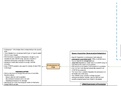
- Protospacer = The foreign DNA corresponding to the spacer
DNA
- This is flanked by a conserved motif (Type I & Type II) called Spacer Acquisition (Immunization/Adaptation)
PAM (2-5 bp in length)
- PAM involved in acquisition (integration), though it is not - Specific fragments or protospacers (with adjacent
inserted into the CRISPR array, and also involved in protospacer-associated motif; PAM) of dsDNA from a
interference/immunity (cleavage of foreign DNA) virus or plasmid are recognised and
- Mutations in PAM allow viruses to escape CRISPR acquired(integrated) at leader end of a CRISPR array on
immunity host DNA by the action of Cas proteins
- Each CRISPR system is very specific in terms of what PAM Protospacers &
- PAM serves as recognition motif required for acquisition.
it will target PAM
- Cas 1 & Cas 2 are required (universally present in all
CRISPR/Cas systems)
Importance of PAM: - The Cas 1/Cas 2 complex integrates the protospacer at
- PAM is only found on foreign DNA and not on host DNA, the leader end of the array
therefore allows: - The CRISPR array consists of unique spacers;
- Spacer selection and acquisition interspaced between repeats; spacers with the most
- Discrimination between self & non-self recently acquired spacer are closest to the leader.
- Targeting protospacer for cleavage
- Mismatches at 3?end of protospacer and/or in PAM allow
foreign DNA to escape cRNA Expression & Processing
DNA
- This is flanked by a conserved motif (Type I & Type II) called Spacer Acquisition (Immunization/Adaptation)
PAM (2-5 bp in length)
- PAM involved in acquisition (integration), though it is not - Specific fragments or protospacers (with adjacent
inserted into the CRISPR array, and also involved in protospacer-associated motif; PAM) of dsDNA from a
interference/immunity (cleavage of foreign DNA) virus or plasmid are recognised and
- Mutations in PAM allow viruses to escape CRISPR acquired(integrated) at leader end of a CRISPR array on
immunity host DNA by the action of Cas proteins
- Each CRISPR system is very specific in terms of what PAM Protospacers &
- PAM serves as recognition motif required for acquisition.
it will target PAM
- Cas 1 & Cas 2 are required (universally present in all
CRISPR/Cas systems)
Importance of PAM: - The Cas 1/Cas 2 complex integrates the protospacer at
- PAM is only found on foreign DNA and not on host DNA, the leader end of the array
therefore allows: - The CRISPR array consists of unique spacers;
- Spacer selection and acquisition interspaced between repeats; spacers with the most
- Discrimination between self & non-self recently acquired spacer are closest to the leader.
- Targeting protospacer for cleavage
- Mismatches at 3?end of protospacer and/or in PAM allow
foreign DNA to escape cRNA Expression & Processing