PLANT DIVERSIT
(topic 2 pg. 30
All plants belonging to Kingdom Plantae have the same following
characteristics
- eukaryotic cell
- cellulose cell wall
- multicellular plant bodie
- most plants have chloroplast
Within the kingdom plantae four groups or divisions can be
distinguished
1. Bryophytes: mosse
2. Pteridophytes: fern
3. Gymnosperms: conifer
4. Angiosperms: flowering plant
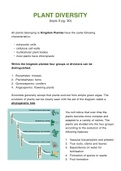
Scientists generally accept that plants evolved from simple green algae. The
evolution of plants can be clearly seen with the aid of the diagram called a
phylogenetic tree:
You will notice that over time the
plants become more complex and
adapted to a variety of niches. The
plants are divided into the four groups
according to the evolution of the
following features
1. Vascular tissue(xylem and phloem
2. True roots, stems and leave
3. Dependence on water for
fertilisatio
4. Formation of spores or seed
5. Fruit formation
n
s
:
)
s
:
s
s
s
s
s
s
s
)
Y
(topic 2 pg. 30
All plants belonging to Kingdom Plantae have the same following
characteristics
- eukaryotic cell
- cellulose cell wall
- multicellular plant bodie
- most plants have chloroplast
Within the kingdom plantae four groups or divisions can be
distinguished
1. Bryophytes: mosse
2. Pteridophytes: fern
3. Gymnosperms: conifer
4. Angiosperms: flowering plant
Scientists generally accept that plants evolved from simple green algae. The
evolution of plants can be clearly seen with the aid of the diagram called a
phylogenetic tree:
You will notice that over time the
plants become more complex and
adapted to a variety of niches. The
plants are divided into the four groups
according to the evolution of the
following features
1. Vascular tissue(xylem and phloem
2. True roots, stems and leave
3. Dependence on water for
fertilisatio
4. Formation of spores or seed
5. Fruit formation
n
s
:
)
s
:
s
s
s
s
s
s
s
)
Y