CO-ORDINATION
The way in which receptors pick up stimuli and the messages passed on to the
effectors to bring out co-ordinated activities.
In this way the internal environment is regulated and homeostasis is maintained
despite changes in the external environment.
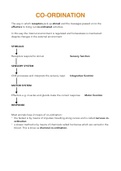
STIMULUS
Receptors respond to stimuli Sensory function
SENSORY SYSTEM
CNS processes and interprets the sensory input Integrative function
MOTOR SYSTEM
Effectors e.g. muscles and glands make the correct response Motor function
RESPONSE
Most animals have 2 means of co-ordination:
- the fastest is by means of impulses travelling along nerves and is called nervous co-
ordination
- a slower method is by means of chemicals called hormones which are carried in the
blood. This is know as chemical co-ordination.
The way in which receptors pick up stimuli and the messages passed on to the
effectors to bring out co-ordinated activities.
In this way the internal environment is regulated and homeostasis is maintained
despite changes in the external environment.
STIMULUS
Receptors respond to stimuli Sensory function
SENSORY SYSTEM
CNS processes and interprets the sensory input Integrative function
MOTOR SYSTEM
Effectors e.g. muscles and glands make the correct response Motor function
RESPONSE
Most animals have 2 means of co-ordination:
- the fastest is by means of impulses travelling along nerves and is called nervous co-
ordination
- a slower method is by means of chemicals called hormones which are carried in the
blood. This is know as chemical co-ordination.