REPRODUCTION IN FLOWERING PLANTS
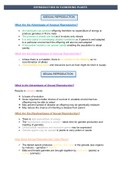
ASEXUAL REPRODUCTION
What Are the Advantages of Asexual Reproduction?
• All individuals can produce offspring therefore no expenditure of energy to
produce gametes or find a mate
• The process is simple and fast as it involves only mitosis
• It is very useful in unchanging (stable) conditions i.e. if parent is well adapted
to a particular environment the offspring will also be well adapted
• A favourable mutation can spread rapidly enabling the population to adapt
quickly
What Are the Disadvantages of Asexual Reproduction?
o Unless there is a mutation, there is no variation in the offspring as no
recombination of alleles
o Overcrowding may occur and resources such as food might be short in supply
SEXUAL REPRODUCTION
What is the Advantages of Sexual Reproduction?
Results in variation which:
v Is basis of evolution
v Gives organisms better chance of survival in unstable environment as
offspring may be able to adapt
v May prevent spread of disease as offspring may be genetically resistant
v May reduce the chance of inheriting a disease from parent
What Are the Disadvantages of Sexual Reproduction?
Ø There is high expenditure of energy
Ø The reproduction process is slower – takes time for gamete production and
meeting of gametes
Ø Unfavourable mutations and recessive genes may be expressed
Ø Outside agents may be needed in plants to carry pollen or seeds
How Does Sexual Reproduction Take Place?
ü The diploid parent produces gametes (sex cells) in the gonads (sex organs)
by meiosis – gametes = haploid
ü Male and female gametes are brought together by pollination (plants) or
mating (animals)
, REPRODUCTION IN FLOWERING PLANTS
ü The gamete nuclei then fuse, a process known as fertilisation
ü The new cell, the zygote = diploid as has two sets chromosomes
ü The zygote grows by mitotic cell division in new individual
The gametes:
- The female gamete is quite large and not motile in which the male gamete is small
and motile in animals
- In animals, the male gamete = sperm and the female = ovum (egg)
- In plants, male gamete = nucleus in pollen grain and female = egg cell in embryo
sac
ANGIOSPERM REPRODUCTION
What is an angiosperm?
They are plants with flowers which produce their ovules enclosed in an ovary, not naked on a cone scale
What is a flower?
It is the organ of sexual reproduction, contains reproductive organs and often will attract pollinators
ASEXUAL REPRODUCTION
What Are the Advantages of Asexual Reproduction?
• All individuals can produce offspring therefore no expenditure of energy to
produce gametes or find a mate
• The process is simple and fast as it involves only mitosis
• It is very useful in unchanging (stable) conditions i.e. if parent is well adapted
to a particular environment the offspring will also be well adapted
• A favourable mutation can spread rapidly enabling the population to adapt
quickly
What Are the Disadvantages of Asexual Reproduction?
o Unless there is a mutation, there is no variation in the offspring as no
recombination of alleles
o Overcrowding may occur and resources such as food might be short in supply
SEXUAL REPRODUCTION
What is the Advantages of Sexual Reproduction?
Results in variation which:
v Is basis of evolution
v Gives organisms better chance of survival in unstable environment as
offspring may be able to adapt
v May prevent spread of disease as offspring may be genetically resistant
v May reduce the chance of inheriting a disease from parent
What Are the Disadvantages of Sexual Reproduction?
Ø There is high expenditure of energy
Ø The reproduction process is slower – takes time for gamete production and
meeting of gametes
Ø Unfavourable mutations and recessive genes may be expressed
Ø Outside agents may be needed in plants to carry pollen or seeds
How Does Sexual Reproduction Take Place?
ü The diploid parent produces gametes (sex cells) in the gonads (sex organs)
by meiosis – gametes = haploid
ü Male and female gametes are brought together by pollination (plants) or
mating (animals)
, REPRODUCTION IN FLOWERING PLANTS
ü The gamete nuclei then fuse, a process known as fertilisation
ü The new cell, the zygote = diploid as has two sets chromosomes
ü The zygote grows by mitotic cell division in new individual
The gametes:
- The female gamete is quite large and not motile in which the male gamete is small
and motile in animals
- In animals, the male gamete = sperm and the female = ovum (egg)
- In plants, male gamete = nucleus in pollen grain and female = egg cell in embryo
sac
ANGIOSPERM REPRODUCTION
What is an angiosperm?
They are plants with flowers which produce their ovules enclosed in an ovary, not naked on a cone scale
What is a flower?
It is the organ of sexual reproduction, contains reproductive organs and often will attract pollinators