

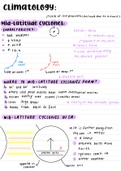
Climatology:
M cells of low pressure ( formed due to a front )
Mid-latitude cyclones:
>
CHARACTERISTICS :
up
cold air -_
dense
'
-
bad weather r
= air molecules closer
temp p greatest at the poles
-
- A wind * Coriolis force :
A rain ↳ winds deflected along
-
c the pressure
gradient
°
cold warm
front c front
or
↳ cold air moves 1st ↳ warm air moves 1st
* pressure belt
WHERE TO MID -
LATITUDE CYCLONES FORM ?
↳ 40° and 60° latitude
↳ Where cold polar masses meet warm subtropical masses
↳ occurs mainly over oceans / coastal areas
↳ cover large areas * family of mid-latitude
cyclones
↳ moves from west to East
MID -
LATITUDE CYCLONES IN SA :
→ SA is further from
away
the sun in winter
:b temp
i.
pressure belts move
✗ north
pressure belts ✓A
:
cyclones reach
i. winter weather
opposite in / earths axis
summer
, 7
> ,
low as 970hPa
pas ,
>
stronger
what are isobars ? n winds
840
↳ LP= Winward -
go <
* isobaric interval
,
HP =P inwards •so * isobaric pressure
<
5900
↳ no atmospheric pressure
i. no winds
LP -
wedge / ridge
HP -
trough
elongated isobars
CONDITIONS FOR FORMATION :
* polar front
transition zone
↳ pressure
gradient
=
* Front __
2 air masses
L C
meet
^
mid-latitude
cell
µoÑ polar
✓
poÑ cell
Westerlies
y easterlies
* name wind from * jet streams :
m¥yy where it comes ↳ air pressure disturbances
↳ coastal shape
W E
↳ mountain shape
*÷÷ >
due to disturbances in atmosphere
, STAGES OF DEVELOPMENT :
* clockwise am
rises : moisture condenses
stroqnger
winds
qshrinks
I 0
0
1.
polar front
↳ denser : sinks bend deepens
r v
cumulonimbus cold sector
clouds
5.
Degeneration stage ↳ rain wedges beneath
↳ cold air $ Wind at earths surface
↳ LP isobars
$ even out
disappears .
pressure ✗ 1
temperature
CROSS SECTION :
M cells of low pressure ( formed due to a front )
Mid-latitude cyclones:
>
CHARACTERISTICS :
up
cold air -_
dense
'
-
bad weather r
= air molecules closer
temp p greatest at the poles
-
- A wind * Coriolis force :
A rain ↳ winds deflected along
-
c the pressure
gradient
°
cold warm
front c front
or
↳ cold air moves 1st ↳ warm air moves 1st
* pressure belt
WHERE TO MID -
LATITUDE CYCLONES FORM ?
↳ 40° and 60° latitude
↳ Where cold polar masses meet warm subtropical masses
↳ occurs mainly over oceans / coastal areas
↳ cover large areas * family of mid-latitude
cyclones
↳ moves from west to East
MID -
LATITUDE CYCLONES IN SA :
→ SA is further from
away
the sun in winter
:b temp
i.
pressure belts move
✗ north
pressure belts ✓A
:
cyclones reach
i. winter weather
opposite in / earths axis
summer
, 7
> ,
low as 970hPa
pas ,
>
stronger
what are isobars ? n winds
840
↳ LP= Winward -
go <
* isobaric interval
,
HP =P inwards •so * isobaric pressure
<
5900
↳ no atmospheric pressure
i. no winds
LP -
wedge / ridge
HP -
trough
elongated isobars
CONDITIONS FOR FORMATION :
* polar front
transition zone
↳ pressure
gradient
=
* Front __
2 air masses
L C
meet
^
mid-latitude
cell
µoÑ polar
✓
poÑ cell
Westerlies
y easterlies
* name wind from * jet streams :
m¥yy where it comes ↳ air pressure disturbances
↳ coastal shape
W E
↳ mountain shape
*÷÷ >
due to disturbances in atmosphere
, STAGES OF DEVELOPMENT :
* clockwise am
rises : moisture condenses
stroqnger
winds
qshrinks
I 0
0
1.
polar front
↳ denser : sinks bend deepens
r v
cumulonimbus cold sector
clouds
5.
Degeneration stage ↳ rain wedges beneath
↳ cold air $ Wind at earths surface
↳ LP isobars
$ even out
disappears .
pressure ✗ 1
temperature
CROSS SECTION :


