
1
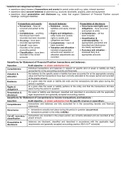
Assertions are categorised as follows :
• assertions about classes of transactions and events for period under audit e.g. sales, interest received
• assertions about account balances at year-end e.g. accounts receivable, property, plant and equipment
• assertions about presentation and disclosure e.g. notes that support Statement of Financial Position account
headings, contingent liabilities
Transactions and events : Account balances : Presentation & disclosure :
• Occurrence – have all • Existence – assets, • Occurrence and rights and
occurred and pertain to the liabilities and equity interest obligations – have occurred
entity exist and pertain to entity
• Completeness – anything • Rights and obligations – • Completeness – all has
that should have been entity holds and controls been included
recorded has been recorded rights to assets and • Classification &
• Accuracy - have been obligations are theirs understandability – is
recorded appropriately • Completeness – have all appropriately presented and
• Cut-off - have been been recorded described and disclosures
recorded in the correct • Valuation and allocation – are clearly expressed
accounting period included at appropriate • Accuracy and valuation –
• Classification - have been amounts and valuation or disclosed fairly & at
recorded in the correct allocation adjustments are appropriate amounts.
accounts recorded
Assertions for Statement of Financial Position transactions and balances :
Assertion Audit objective - to obtain satisfaction that :
Completeness individual transactions and balances in respect of specific kind of asset or liability are fully
accounted for in the accounting records and financials
Valuation & the balance for the specific asset or liability has been accounted for at the appropriate carrying
allocation value and that the transactions have been correctly allocated to the proper period and recorded
at the proper amount
Existence at a given date the asset or liability did exist and the transactions did take place during the
period in question
Rights & at a given date the asset or liability pertains to the entity and that the transactions did take
obligations place during the period in question
Presentation & the asset or liability was disclosed, classified and described in accordance with the applicable
disclosure legal requirements and generally accepted accounting practice
Assertions for Statement of Comprehensive Income transactions and balances :
Assertion Audit objective - to obtain satisfaction that the specific revenue or expenditure :
Completeness transactions and balances are fully accounted for in the accounting records and financial
statements
Occurrence • transactions actually took place during the period in question (occurrence)
• transactions pertain to the entity (validity)
Cut-off / accuracy / transactions are recorded in the proper period, are correctly allocated and are recorded at the
classification proper amount
Presentation & balances are disclosed, classified and described in accordance with the applicable legal
th
disclosure requirements and generally accepted accounting practice (ISA’s & 4 schedule)
, 2
Procedures used by auditor to obtain audit evidence :
Analysis of objectives Procedures of auditor
Completeness :
All transactions were recorded at the time when they - check date on the supporting documentation
took place
All transactions have been reported in the accounting - check sequential numbering of transactions
records
Occurrence :
- investigate existence of valid documents
Transactions reordered in records did actually take - compare entries in accounting records with supporting
place documents
- check that transactions have been authorised
Transactions recorded in the accounting records - check supporting document to ensure that entity was party in
pertain to the entity the transaction
Existence :
- perform physical inspection of assets and compare it with the
Assets and liabilities did actually exist on given date accounting record
- examine supporting documentation
rd
- obtain supporting evidence from 3 parties
Accuracy / cut-off / classification :
All transactions have been recorded at the proper - compare the amount from supporting documents with the
amount amount in the accounting records
All transactions have been correctly allocated - compare the allocation with the particulars in the supporting
documents
All transactions have been recorded in the correct - compare the date of the transaction with the date on the
financial period supporting documentation
Valuation :
rd
Assets and liabilities have been recorded at an - obtain external valuation or confirmation from 3 parties
appropriate carrying value
Assess value by physical inspection - compare value by referring to supporting documentation
Assess the reasonable of the amounts claimed for
reduction / increase or write-off of assets
Rights and obligations :
- examine supporting documentation
Assets and liabilities pertain to the entity at a given
rd
date - obtain evidence from 3 parties in support of rights or
obligations
- obtain sufficient information to make sure that the state of
affairs was applicable at given date
Presentation and disclosure :
Items in financials have been correctly disclosed, - examine financials and obtain satisfaction that there has
classified and described been proper disclosure, classification and description in
terms of the Companies Act and generally accepted
accounting practice
, 3
APPLICATION CONTROLS
Framework for application controls in computerised environment =
• masterfile amendments
• input, processing and output
• validity, accuracy and completeness
• prevention, detection and correction.
Ideal to have distinctive input, processing and output phases with manual controls combined with program controls, but if
fewer people involved and if no real distinction between these phases then must place more reliance on :
• access controls and programmed controls rather then manual controls
• preventative rather then detective and corrective controls
Vital that the information that is being processed is valid, accurate and complete.
Application = set of procedures and programmes that satisfy all users associated with a specific task.
Application controls = controls over input, processing and output of financial information relating to specific application,
that ensures that the information is valid, accurate and complete. Consist of both automated (computerised) and manual
controls.
Transaction files = files uses to store all details of an individual transaction
Masterfiles = files used to store only standing information (debtor’s names, addresses and credit limits) and latest balances.
Masterfile amendments = changes to standing data on masterfiles – MUST be tightly controlled
Objective of controls in computerised accounting environment is generally centered around the validity, accuracy and
completeness of data and information processed by and stored on the system.
Validity = ensures that the transactions and data :
• aren’t fictitious or fraudulent and
• are in accordance with activities which have been properly authorised by management
Accuracy = minimising errors to ensure that data and transactions are correctly captured, processed and allocated
Completeness – ensuring data and transactions are not omitted or incomplete
Terms relating to the stage at which controls are implemented to achieve the objectives explained above :
• prevention = controls designed to identify errors and problems in source data and how it is captured BEFORE it is
accepted for input, processing and output by the system
• detection = controls which identify errors and problems with data that has been entered onto the system (i.e. errors that
weren’t caught by prevention controls). Detection is worthless unless problems are followed up on and resolved
• correction = controls that are implemented to resolved errors and problems which have been identified using detection
controls.
, 4
AUDIT OF BALANCES IN THE FINANCIALS (verification)
Company Auditor
Generates ledger balance Checks opening balances in the ledger
Company Auditor
Generates trail balance Recalculates arithmetical correctness of ledger balances and
makes sure the balance agrees with the amount in the TB
Company Auditor
Generates balances in the private ledger Compares list of balance with balances in the private ledger
Company Auditor
Reconciles total of the list of balances with the Compares total of the list of balances with balance of control
control account in the general ledger account and checks that the control account recon is correct.
Investigates any abnormalities that may occur in the account
balances by applying CAAT’s
Company Auditor
Applies cut-off procedures Checks correct cut-off procedures were applied
Company Auditor
Accounts for financial information according to Tests compliance with stated accounting policy
stated accounting policies
Company Auditor
Compares tangibles with accounting records Conducts physical inspection of tangible assets and compares
with the account records
Auditor
Other procedures : o examines subsequent events after Statement of Financial
Position date
o does ratio analyses
o obtains appropriate representations from management
o carries out specific procedures to obtain external audit
evidence
o applies CAAT’s
Company Auditor
Drafts financial statements Checks disclosure in financial statements
Assertions are categorised as follows :
• assertions about classes of transactions and events for period under audit e.g. sales, interest received
• assertions about account balances at year-end e.g. accounts receivable, property, plant and equipment
• assertions about presentation and disclosure e.g. notes that support Statement of Financial Position account
headings, contingent liabilities
Transactions and events : Account balances : Presentation & disclosure :
• Occurrence – have all • Existence – assets, • Occurrence and rights and
occurred and pertain to the liabilities and equity interest obligations – have occurred
entity exist and pertain to entity
• Completeness – anything • Rights and obligations – • Completeness – all has
that should have been entity holds and controls been included
recorded has been recorded rights to assets and • Classification &
• Accuracy - have been obligations are theirs understandability – is
recorded appropriately • Completeness – have all appropriately presented and
• Cut-off - have been been recorded described and disclosures
recorded in the correct • Valuation and allocation – are clearly expressed
accounting period included at appropriate • Accuracy and valuation –
• Classification - have been amounts and valuation or disclosed fairly & at
recorded in the correct allocation adjustments are appropriate amounts.
accounts recorded
Assertions for Statement of Financial Position transactions and balances :
Assertion Audit objective - to obtain satisfaction that :
Completeness individual transactions and balances in respect of specific kind of asset or liability are fully
accounted for in the accounting records and financials
Valuation & the balance for the specific asset or liability has been accounted for at the appropriate carrying
allocation value and that the transactions have been correctly allocated to the proper period and recorded
at the proper amount
Existence at a given date the asset or liability did exist and the transactions did take place during the
period in question
Rights & at a given date the asset or liability pertains to the entity and that the transactions did take
obligations place during the period in question
Presentation & the asset or liability was disclosed, classified and described in accordance with the applicable
disclosure legal requirements and generally accepted accounting practice
Assertions for Statement of Comprehensive Income transactions and balances :
Assertion Audit objective - to obtain satisfaction that the specific revenue or expenditure :
Completeness transactions and balances are fully accounted for in the accounting records and financial
statements
Occurrence • transactions actually took place during the period in question (occurrence)
• transactions pertain to the entity (validity)
Cut-off / accuracy / transactions are recorded in the proper period, are correctly allocated and are recorded at the
classification proper amount
Presentation & balances are disclosed, classified and described in accordance with the applicable legal
th
disclosure requirements and generally accepted accounting practice (ISA’s & 4 schedule)
, 2
Procedures used by auditor to obtain audit evidence :
Analysis of objectives Procedures of auditor
Completeness :
All transactions were recorded at the time when they - check date on the supporting documentation
took place
All transactions have been reported in the accounting - check sequential numbering of transactions
records
Occurrence :
- investigate existence of valid documents
Transactions reordered in records did actually take - compare entries in accounting records with supporting
place documents
- check that transactions have been authorised
Transactions recorded in the accounting records - check supporting document to ensure that entity was party in
pertain to the entity the transaction
Existence :
- perform physical inspection of assets and compare it with the
Assets and liabilities did actually exist on given date accounting record
- examine supporting documentation
rd
- obtain supporting evidence from 3 parties
Accuracy / cut-off / classification :
All transactions have been recorded at the proper - compare the amount from supporting documents with the
amount amount in the accounting records
All transactions have been correctly allocated - compare the allocation with the particulars in the supporting
documents
All transactions have been recorded in the correct - compare the date of the transaction with the date on the
financial period supporting documentation
Valuation :
rd
Assets and liabilities have been recorded at an - obtain external valuation or confirmation from 3 parties
appropriate carrying value
Assess value by physical inspection - compare value by referring to supporting documentation
Assess the reasonable of the amounts claimed for
reduction / increase or write-off of assets
Rights and obligations :
- examine supporting documentation
Assets and liabilities pertain to the entity at a given
rd
date - obtain evidence from 3 parties in support of rights or
obligations
- obtain sufficient information to make sure that the state of
affairs was applicable at given date
Presentation and disclosure :
Items in financials have been correctly disclosed, - examine financials and obtain satisfaction that there has
classified and described been proper disclosure, classification and description in
terms of the Companies Act and generally accepted
accounting practice
, 3
APPLICATION CONTROLS
Framework for application controls in computerised environment =
• masterfile amendments
• input, processing and output
• validity, accuracy and completeness
• prevention, detection and correction.
Ideal to have distinctive input, processing and output phases with manual controls combined with program controls, but if
fewer people involved and if no real distinction between these phases then must place more reliance on :
• access controls and programmed controls rather then manual controls
• preventative rather then detective and corrective controls
Vital that the information that is being processed is valid, accurate and complete.
Application = set of procedures and programmes that satisfy all users associated with a specific task.
Application controls = controls over input, processing and output of financial information relating to specific application,
that ensures that the information is valid, accurate and complete. Consist of both automated (computerised) and manual
controls.
Transaction files = files uses to store all details of an individual transaction
Masterfiles = files used to store only standing information (debtor’s names, addresses and credit limits) and latest balances.
Masterfile amendments = changes to standing data on masterfiles – MUST be tightly controlled
Objective of controls in computerised accounting environment is generally centered around the validity, accuracy and
completeness of data and information processed by and stored on the system.
Validity = ensures that the transactions and data :
• aren’t fictitious or fraudulent and
• are in accordance with activities which have been properly authorised by management
Accuracy = minimising errors to ensure that data and transactions are correctly captured, processed and allocated
Completeness – ensuring data and transactions are not omitted or incomplete
Terms relating to the stage at which controls are implemented to achieve the objectives explained above :
• prevention = controls designed to identify errors and problems in source data and how it is captured BEFORE it is
accepted for input, processing and output by the system
• detection = controls which identify errors and problems with data that has been entered onto the system (i.e. errors that
weren’t caught by prevention controls). Detection is worthless unless problems are followed up on and resolved
• correction = controls that are implemented to resolved errors and problems which have been identified using detection
controls.
, 4
AUDIT OF BALANCES IN THE FINANCIALS (verification)
Company Auditor
Generates ledger balance Checks opening balances in the ledger
Company Auditor
Generates trail balance Recalculates arithmetical correctness of ledger balances and
makes sure the balance agrees with the amount in the TB
Company Auditor
Generates balances in the private ledger Compares list of balance with balances in the private ledger
Company Auditor
Reconciles total of the list of balances with the Compares total of the list of balances with balance of control
control account in the general ledger account and checks that the control account recon is correct.
Investigates any abnormalities that may occur in the account
balances by applying CAAT’s
Company Auditor
Applies cut-off procedures Checks correct cut-off procedures were applied
Company Auditor
Accounts for financial information according to Tests compliance with stated accounting policy
stated accounting policies
Company Auditor
Compares tangibles with accounting records Conducts physical inspection of tangible assets and compares
with the account records
Auditor
Other procedures : o examines subsequent events after Statement of Financial
Position date
o does ratio analyses
o obtains appropriate representations from management
o carries out specific procedures to obtain external audit
evidence
o applies CAAT’s
Company Auditor
Drafts financial statements Checks disclosure in financial statements


