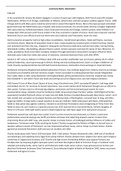
Summary MNG3702_ Strategic Implementation_ Study Notes.
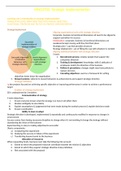
MNG3702_ Strategic Implementation_ Exam Notes. Aligning organizational units with strategic direction Corporate, business & functional dimensions all need to be aligned & support eachother for success Mobilization: corporate, business & functional dimensions are awakened & kept moving until they find their place Strategic plan = cup that provides structure Strategy deployment = act of filling the cup with whatever is needed Aligning individual behavior with strategic direction 5 tools: 1. Recruitment process: employ people that support the companies direction 2. Training & development: knowledge, skills & attitudes of employees match the direction of the business 3. Policies & procedures: changes might need new policies to replace old ones 4. Cascading objectives: used as a framework for setting objectives lower down the organization 5. Reward systems: tailored to reward behaviors & achievements and support strategic direction Strategic initiatives ↘ key projects focused on achieving specific objective or improving performance in order to achieve a performance target Enablers of strategy deployment SD is underpinned by 3 enablers: Communication of strategy 4 main objectives: I. Ensure everyone knows what the strategy is & how it will affect them II. Resolve ambiguity & uncertainty III. Explain assumptions & judgements that were made during the analysis process & explain decisions made IV. Ensure coordination Ability to learn & adapt Strategic direction is developed, implemented & repeatedly and continuously modified in response to changes in environment Success comes from having necessary discipline to change when it’s not working & change the strategy without abandoning the vision of the business Experimenting is a key to making adjustments successful 3basic components: a) Conducting the experiment b) Studying the success or failure of the experiment c) Transferring lessons learnt to the business Allocation of resources When requesting funds, business must take the following into account: o Extent to which the proposed resources contribute towards the mission & objectives o Extent to which they support strategic direction & key initiatives o Risk associated with the proposal Successful implementation of strategic iniatives Successful alignment of organisational units with strategic direction Successful alignment of individual behaviour with strategic direction ORGANISATIONAL CULTURE AND LEADERSHIP IN STRATEGY IMPLEMENTATION Organizational culture ↘ collection of values & norms shared by people & groups who work together Culture can be conceived by different layers: o Values: Beliefs, traits & behavioral norms that management has determined should guide the pursuit of its vision & mission o Beliefs: reflect someone’s sense of what ought to be & can typically be discerned in how people talk about issues o Behaviors: day-to-day ways the business operates o Taken-for-granted assumption: when a solution to a problem works repeatedly & gets taken for granted *pg198* example! OC serves important functions in an organisation that include serving: the vision and strategy of the organisation the means through which to attain strategic objectives an individual’s role orientation quality assurance common language and effective communication the means for corrective actions and interventions. Strategic leadership Leaders of organisations play a critical role in ensuring that their organisations pre-emptively and successfully adapt to dynamic and changing environments. Leadership occurs at all levels of an organisation, but toplevel executives are ultimately responsible for the success & sustainability of the organisation. Leaders: people able to influence others and who possess managerial authority. Leadership is about influencing the behaviour of other people. To be successful, top-level executives need to demonstrate strategic leadership (think strategically; be emotionally intelligent; have a range of behaviours at their disposal and have the wisdom to apply the right combination of behaviours at the right time) Good strategic leaders have the following characteristics: Vision, eloquence, consistency Articulation of the business model Commitment Being well informed Willingness to delegate and empower Smart use of power Emotional intelligence The following six principles allow for better understanding of the skills required to be a strategic leader and how these skills can be mastered in a way that allows strategic leaders to think strategically and navigate the unknown effectively. I. Strategic leaders are future orientated and anticipate change A leader needs to look beyond the present and anticipate change to help them see opportunities before competitors do. Effective leaders are constantly scanning the environment and are focused on uncovering opportunities inside and outside the organization. They consider the complex and unpredictable nature of the future and develop broader networks to gain insights into the perspective of customers, competitors and partners. Leaders know the importance of formalizing the collection, analysis, interpretation and dissemination of market and business intelligence (learning skills can be developed to identify and take advantage of opportunities). Active participation and leadership is required to find out what works and recognize achievements of performers and reward those who come up with innovative ideas and practices. II. Strategic leaders get things done Strategic leaders implement the best solutions to make a difference, they talk about what they might do and do it. Actions are based on careful reflection and examination of a problem through many lenses. III. Strategic leaders open new horizons To uncover possibilities beyond the mundane and open new horizons and directions for their firms, strategic leaders are expected to look beyond the obvious to see patterns, interpret different events and synthesize various outputs to gain new insight. These leaders will work with all stakeholders and understand how their work interweaves with that of their colleagues and relevant stakeholders to create opportunities for innovative practice. Opening new horizons means helping others see beyond established orthodox means and experimenting with new, exciting and more effective ways of meeting customer needs. IV. Strategic leaders reach out to stakeholders Strategic leaders value the input of stakeholders and understand their importance when it comes to implementing new strategies so they use proactive communication and frequent engagements to build trust and get their support. They are sensitive to different cultures and cross-cultural issues, and respectfully confront issues and have perspectives that may differ from dominant thinking. Strategic leaders need to be skilled at managing conflict positively and at framing dynamic relationships in ways that are productive. V. Strategic leaders are fit to lead Strategic leaders are confronted by various obstacles and environmental changes that pose threats and risks for the firm. These changes create increased levels of anxiety and stress so to deal with this they need to be flexible, reliable and resourceful. Being fit to lead is also about being mentally prepared to exploit opportunities which arise expectantly, to cope with uncertainty and make things happen with limited resources. Strategic leaders need to manage their physical and mental wellbeing. VI. Strategic leaders do the ‘next’ right thing and learn from experiences Strategic thinkers need to insist on multiple options and should not get locked into simplistic yes/no choices. They recognize the importance of balancing precision with speed, consider the tradeoff involved and take both short and long term goals into account. Successful leaders recognize the importance of organizational learning and consider lessons learned from both successful and unsuccessful goals to be important for future decisions. ORGANISATIONAL STRUCTURE AND STRATEGY IMPLEMENTATION Organisational design: process of deciding how an organisation should create, use and combine organisational structure, control systems & organisational culture to pursue its business model and long-term objectives. Organisational structure: the means through which a company assigns employees to specific tasks and roles and specifies how these tasks and roles are linked together to increase efficiency, quality, innovation & responsiveness . The purpose of organisational structure is to coordinate & integrate the efforts of employees at all levels − corporate, business and functional – and across an organisation’s functions and business units so that all levels work together in a way that allows the organisation to achieve its long-term objectives. Structures traditionally adopted by organisations, depending on their specific requirements: Simple organisational structure- includes an owner & a few employees, in which management tasks, responsibilities and communication are highly informal. Functional organisation structure- necessary to have different people handling different tasks (marketing, finance, operations), thus working in functional groups which are relatively more formal and require formal planning, organisation, coordination and control. Divisional structures- occur when an organisation diversifies its product or service lines, and serves a number of geographic areas and heterogeneous customer groups, resulting in functional structures becoming inadequate. Matrix organisational structures- characterised by dual channels of authority, performance responsibility, evaluation and control, and are largely adopted by large, project-oriented organisations. POLICIES, SYSTEMS AND PROCEDURES IN STRATEGY IMPLEMENTATION Policies: specific guidelines, methods, procedures, rules, forms and administrative practices established to support and encourage work toward stated goals Policies are characterised by setting boundaries, constraints and limits on all kinds of administrative actions. They clarify what can and cannot be done in pursuit of an organisation’s objectives, simplify decision-making, and promote delegation of decision-making to appropriate managerial levels. Policies can either assist or block good strategy implementation. RESOURCES AND CAPABILITIES IN STRATEGY IMPLEMENTATION An organisation’s strategy will require either to exploit existing capabilities, or to explore and develop new capabilities, or to do both. A new strategy will undoubtedly require additional resources and capabilities − or a reallocation of current resources from existing low-opportunity activities to new, potentially high-opportunity activities and strategic priority areas. Planning and budgeting for additional resources and capabilities must occur early in or concurrently with the strategy formulation process. Resources and capabilities Resources Resources are grouped into 5 categories: A. Financial capital: organizations ability to generate funds, internally or through loans & investments B. Physical capital: operational & manufacturing equipment, location & access to raw materials C. Human capital: knowledge, management & employee insight, intellect, relationships, training & experience D. Organizational capital: reporting structure & management, planning, coordinating, controlling & networks E. Technological capital: ICT systems Tangible resources These are physical, observable, quantifiable assets, equipment, money, structures, technology & patents. Can also be any of the above 5 Intangible resources Are subsets of the strategic resources of an organization & includes knowledge, intellectual-human-structural-customerorganisational-innovation & process capital 3 types: 1. Human resources – knowledge, trust, managerial capabilities 2. Innovation resources – ideas, scientific capabilities, capacity to innovate 3. Reputational resources – brand name, reputation, perceptions, reliability The human resources are the source of knowledge& this can be a valuable contributor to CA and uniqueness. But some knowledge is public (private knowledge is valuable) Can be explicit or tacit ↘ can be taught and conveyed with ease ↘ gained through experience, insight and intuition & is difficult to share Capabilities ↘ Organization specific clusters of activities developed through complex interactions between tangible & intangible resources over time & reflect what an organization excels at compared to others (what can be done very well) Characteristics: ●valuable across various products & markets ● embedded in routines ● tactic Dynamic capabilities: geared towards effecting & driving organizational change – essentially strategic & define the firm’s path of evolution & development (absorptive capacity – ability to acquire, assimilate & use external info) Carefully developed capabilities form the basis of competitive advantage & are primary differentiators of organizations from their competitors Core competencies Distinctive capabilities ↘ Capabilities that distinguish an organization from others in the industry & form the basis of its competitive advantage, strategy & performance Involves the combination of various resources & capabilities and development takes place over a long period of time and is a process of accumulation & learning how to use a unique combination of resources & capabilities Their complex coordination, integration & harmonization across production skills, technologies & capabilities make core competencies hard to imitate Marketing & branding capabilities Marketing budget (FR) Marketing experts (HR) Brand (Intell. property) Tangible & Intangible resources Core competencies Strategy differentiation/low cost Competitive advantage Value creation Excellent profitability Cababilities Appraising the value of resources Value (V) ↘ implies the ability of the firm to transform a resource into a P/S at a lower cost or with a higher value to the consumer Capabilities are valuable when they enable an organization to implement a strategy that improves efficiency & effectiveness It must either ↑ efficiency of inputs/outputs or ↑ a firms revenue OR ↑ effectiveness Rarity (R) ↘ valuable resource that a firm owns that other firms do not – generally not available in the open market Inimitability (I) ↘ are valuable, unique & complex resources (reputation, networks, knowledge, corporate culture, skills, and client trust) Imitation by competitors is prevented if: they do not understand the reason for the success they do not have the same unique historical conditions the cause of effectiveness is uncertain due to social complexity Organization (O) The firm’s structure & systems should be suitable for a specific competitive advantage If a firm cannot be geared to exploit a resource – it will have little value The resource-based view ↘ a model for analyzing the internal strengths & weaknesses of the organization in terms of resources and linking them to the opportunities in the external environment It determines where the firm can build CA, superior performance & customer value NB considerations for assessment are: strategic direction as conveyed in the vision, mission, purpose & values key internal stakeholders (managers-experience, strength, management style) owners operational issues (issues, assets, location) type & level of employees & culture of the organization Resources & capabilities are determined by the value chain activities of the organization, including: o supply chain & operational management o financial management o research development o people management o marketing management o intangible resources (reputation, patents, brand names, networks) Some limitations have been identified: it has not yet been tested & proved empirically it doesn’t address how to ↑ profitability OR develop further CA lack of future orientation & ability to differentiate between valuable and less valuable resources result in lack of predictability Identification of capabilities & core competencies to create value Identifying & assessing will enable the organization to determine the following: how the components of its value chain add worth to its performance how resources & capabilities contribute to CA how good its financial performance is compared to competitors how customers & employees benefit from it 5 stages of strategy formulation & resource based view of strategy are as follows: 1. Identify & class the firms resources 2. Identify the capabilities of the firm 3. Appraise the rent generating potential 4. Select a strategy that exploits the resources 5. Identify the resource gaps Classification of capabilities & core competencies according to the functional areas of an organization Example: Marketing function: brand management, reputation for quality Sales function: customer service, sales promotions Corporate functions: financial control, management development, international management Management info function: linking a comprehensive, integrated management info system with decision making Operations function: continuous improvement in manufacturing & speed of response Research & development function: innovative new product development Classification of capabilities & core competencies through value chain analysis The main aim function of an organization is to add value successfully in the process of producing P/S Activities are divided into 5 primary & 4 support categories Primary activities Capabilities Inbound logistics Receiving, storing & distributing inputs for manufacturing Purchasing, material & inventory control Operations Activities that transform inputs into final products Design & product development, quality control, assembly Outbound logistics Collecting, storing & distributing of P/S to customers Distribution coord, processes of warehousing, dealer relationships Marketing & sales Marketing, sales, purchasing of P/S of a firm Innovative promo’s & advertising, motivated sales force Customer service Everything involved in improving & maintaining product value Parts, warranty, servicing, quantity & training of employees Support activities Capabilities Admin & infrastructure Support the value chain, general management, planning, information systems, legal issues, quality management Risk management & integration of value chain HR management Appointment, development & retention of employees, compensation & training Training, skills development, recruitment, retention Procurement Purchasing Inventory & database management Technology development All technology related to operations & management Integrated management info systems, technology-managed design & manufacturing Contribution of resources & capabilities towards CA CA exists when a firm is more profitable than its competition – this is done in 2 ways: 1. Produce P/S that are superior is value allowing them to charge premium prices or retain customers for longer 2. Produce P/S at a lower cost enabling a much higher profit margin For differentiators, CA is achieved through combining resources, capabilities & core competencies to produce high quality P/S These positions can be achieved through different capabilities: Ability to produce high quality products: when the there is a higher brand value or more reliable & durable Ability to innovate: spend more than competitors on research & development (can be technology, design, marketing admin, operational systems, techniques) Responsiveness to customers: customer response must be superior to competition Efficiency: transforming inputs into outputs | efficiency = output/input Product efficiencies can be achieved through: Economies of scale Economies of learning Designing products for more economical production Reducing unnecessary costs Leveraging location advantages Sustainable CA This is determined by the durability of the relevant resources & capabilities and how inimitable they are Durability: length of time over which a capability is relevant & can contribute to CA of a firm Capturing the value generated by resources & capabilities Appropriability: if a firm cannot capture sufficient value to justify its investment in developing unique resources & capabilities, it will not be able to achieve CA Resources & capabilities are valuable when they enable firms to deliver P/S to customers at a price they’re willing to pay Their value is indirectly determined by: External environment Changes in the external environment Differences in resources of organisations Value – lower level production costs than rivals OR increased revenue For resources and capabilities to be the basis of CA as well as ensuring superior profitability: following are NB: R&C must be inherently valuable R&C should enable the firm to address market segments R&C should enable the firm to identify & address any unmet needs of the customer THE IMPORTANCE OF STRATEGIC CONTROL Managers choose and implement strategies to pursue the organisation’s vision and strategic objectives, and in doing so create value for customers and profit for the organisation. Strategic control allows management to monitor and evaluate whether their strategy is performing as intended, whether it needs to be improved and, if so, how it can be improved. Strategic control: management efforts to track a strategy as it is being implemented, detect problems or changes in its underlying premises, and make necessary adjustments Strategies are future-oriented, only to be accomplished several years into a distant and relatively uncertain future. It is therefore essential that management systematically monitor, review, evaluate and control the implementation of the strategy as well as its performance over time. An effective strategic control process involves the following four steps: 1. establishing standards and targets 2. creating, measuring and monitoring systems 3. comparing actual performance against targets 4. evaluating results and taking corrective action where necessary. For effective strategic control, all aspects of the strategic management process need to be evaluated in terms of the managerial decisions on which the strategic decisions were based. These include assumptions regarding mission; longterm objectives; the outcomes of internal and external analyses that may call for review; changing environmental conditions as well as changing internal conditions regarding the organisation’s strengths and weaknesses. Types of strategic change o adaption: change lodged within the current business model & within the current culture - aim to realign strategy o reconstruction: does not fundamentally alter the culture but may involve disruption o revolution: requires rapid & major strategic and cultural transformation o evolution: requires cultural change but happens over time & is most difficult Context in which change occurs An effective strategic leader will recognize when change is needed and in most forms change occurs to align the culture of the firm with the strategies. Clear considerations of contextual elements need to precede the formulation of management strategies which will deal with change This includes: Time (how quickly is change needed) Scope (how much change is required) Preservation (what resources and characteristics need to be maintained) Diversity (how homogeneous are staff groups and divisions within the firm) Capability (what is the managerial and personal capability to implement change) Capacity (what change resources are available) Readiness (how ready is the workforce for change) Power (what power does the change leader have to impose change) THE REASONS FOR IMPLEMENTATION FAILURE Successful strategy implementation: implementation that (1) achieves the desired outcomes (strategic objectives), (2) completes all strategic initiatives successfully & (3) is acceptable to all stakeholders (does not entail doubtful means) Implementation failure accordingly means that a new strategy was formulated but was not implemented, or was implemented in such a way that the implementation was incomplete, strategic objectives were not attained, or the implementation was unacceptable to key stakeholders. Strategy implementation failure may start with the strategy formulation process. If strategic objectives are too complex or poorly understood, lack consistency and do not provide clear future direction to members of the organisation that have to implement them, it is unlikely that implementation will be successful. Apart from deficiencies in any one of the above attributes, poor or ineffective alignment is regarded as a major reason for implementation failure. Implementation failure can thus result from poor change management and the resulting misalignment of the various elements of the organisation. The Icarus Paradox: organisations dwell on past successes, losing sight of and not adapting to changing market realities and changed requirements for competitive advantage to cope with new realities, which leads to failure The dire consequences of misalignment could include the following: New programmes running the risk of failure Employee commitment to quality deteriorating Individual objectives taking precedence over organisational objectives Morale and productivity that diminish over time Why change programmes fail Death by planning- executives spend most of their time on planning, teams are constituted to examine the problems where meetings become debates and result in paralysis & the focus is on discourse instead of actual delivery of change Loss of focus- change can take time over many years then initiatives are seen as rituals & change program was never clearly communicated Reinterpretation- existing paradigm is so strong that change initiatives are reinterpreted according to old paradigm to fit within the expected norms of behavior & conduct Disconnectedness- organisational members affected by change may not see the change as relevant to their realities Behavioral compliance- some people comply with change despite not buying into the change programme Misreading scrutiny & resistance- some people resist change but if concerns are ignored it could increase resistance Broken agreements & violations of trust- if leaders fail to honour undertakings, they will lose trust & respect and ↑resistance Learning unit 2: Strategy implementation as change management ORGANISATIONAL ARCHITECTURE *pg219* read through The McKinsey 7–S framework At the heart of this framework is the idea that there are seven key sub-systems in the organisation that all have to be in balance and consistent with each other. No one sub-system is more important than the other. Certain subsystems can be regarded as “hard” (strategy, structure, systems), while the rest, categorised as “sof
Written for
- Institution
- University of South Africa
- Course
- MNG3702 - Strategic Implementation And Control IIIB (MNG3702)
Document information
- Uploaded on
- October 7, 2021
- Number of pages
- 27
- Written in
- 2021/2022
- Type
- Summary
Subjects
-
mng3702
-
strategic implementation
-
mng3702 strategic implementation
-
mng3702 strategic implementation study notes

Document also available in package deal