9. LEGAL EDUCATION
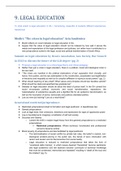
To what extent is legal ediucation in SA = humanising, respectful of students different experiences,
hierarchical
Modiri: “The crises in legal education” Acta Academica
Modiri reflects on recent debates on legal education in SA.
Argues that the value of legal education should not be indexed by how well it serves the
needs and expectations of the legal profession and judiciary, but rather how it contributes to a
new jurisprudence suited to the legal, social and political transformation of South Africa.
Summit on legal education by Dean’s Association, Law Society, Bar Council
in 2013 to discuss the future of the LLB degree (pg. 2)
Proposes a legal education on a critical legal theory and critical pedagogy
Rather than just a crisis in legal education, there is a political, moral and ideological crisis in
the law itself.
“’The crises are manifest in the political implications of law’ separation from morality, and
hence, from justice, and its own participation in the construction, perpetuation and legitimation
of hierarchy and inequality as well as its complicit affiliation to injurious social powers” (pg. 2).
What should teaching of law entail? What values and principles should law faculties uphold?
What should the ideal post-apartheid law graduate be?
Debates on legal education should be about the ideal of justice itself. In the SA context this
would encompass political, economic and social transformation, reparations, the
materialisation of substantive equality and a dignified life for all, epistemic decolonisation, as
well as the inculcation of active, democratic and publicly orientated politics.
Law as mere job training? Law as a meal-ticket?
General and restricted jurisprudence
Restricted jurisprudence linked to formalism and legal positivism depoliticises law
Geneal jurisprudence
Look at legal texts, their omissions, distortions and repressions for signs of oppressive power
Law is foundational to imaginary constitution of self and society
Douzinas and Gearey
o Lament the shift in modern legal theory from this general jurisprudence to a restricted
jurisprudence.
Restricted jurisprudence: Where technical, functionalist and professional
concerns became central.
Moral poverty of jurisprudence and law facilitated by legal positivism.
o The technicalisation of social conflict by private law rules, the belief in neutral, non-
ideological problem-solving in the public law, the denial of law’s imbrication with
racism and sexism and its disconnection from social reality.
o Legal education is reduced to restricted jurisprudence that takes the form of
“vocational skills training”, in which issues deemed “theoretical” become peripheral,
and legal academics and law teachers became “purveyors of technical knowledge
that must be condensed, memorised and repeated” resulting in “death of the soul and
the intellect” (pg. 5).
, o General jurisprudence (pg. 5)
o NB: Pg. 6
“Legal education in post-apartheid South Africa remains firmly in the grip of restricted
jurisprudence – focusing as it doeson the black-letter law with little to no reference to the
wider historical and social context in which law operates and is experienced. The majority of
law courses focus exclusively on law as an exercise in technical rule-application and they as
structured around what the legal rules and principles currently are; in which cases they were
decided or from which legislation or other source of law they are derived and what, if any,
exceptions are applicable to them. … - all with the aim of reasserting and maintaining the
coherence, determinacy and predictability of law and legal rules” (pg. 5).
Law teachers in South Africa (pg. 6)
Legalist and formal, subjects don’t concern issues of social justice and transformation, belief
in law’s neutrality and stability.
Crises and critique
Education is about newness
Critique and critical thinking is integral in legal education – rather than just affirming and
confirming rules and the “correct” application over and over again.
“Critique, in this sense, is non-optional in restoring the moral health, and the balance of justice
and democracy, of any given polity” (pg. 7).
Stakeholders at the LLB summit failed to interrogate substantive issues, the jurisprudential
foundations of post-apartheid law, the substantive content of the courses taught in law
schools as well as the ideological and political perspective that informs them.
Critical legal education
Responding to and acknowledging the crises and tragedies of colonialism and apartheid.
Interrogation of the consciousness, wisdom and knowledge of law.
“The teaching of law, like the law itself can never be a neutral or value-free exercise […] The
very act of ‘definition’ – whether one is defining law or designing a course – involves a
demarcation, an establishing of boundaries between the inside and the outside; the central
and the marginal; the relevant and the irrelevant. Such demarcation itself necessarily issues
from choices and perspectives which are not natural or immutable, but ideological and
cultural” (pg. 9).
o If you do not know where the laws come from (the context), do you then really know
the law?
Knowing the law’s conscience.
o Lecturers aren’t neutral
Legal education in SA currently conforms to black-letter model of teaching, focusing mainly on
law as rules and law as procedure.
Critical legal education does not merely confirm the supremacy of the constitution – NB (pg.
10-11).
More complex, multidimensional picture of law and its inextricable relation to society, politics,
morality, history, ideology, power and community.
Critical legal theories (pg. 11)
“What is important for a critical legal education is not so much the content and the
development of these theoretical traditions and perspectives, but the method/angle they
employ. Each of these theories proceeds, in some way, from a rejection of a view of law in the
To what extent is legal ediucation in SA = humanising, respectful of students different experiences,
hierarchical
Modiri: “The crises in legal education” Acta Academica
Modiri reflects on recent debates on legal education in SA.
Argues that the value of legal education should not be indexed by how well it serves the
needs and expectations of the legal profession and judiciary, but rather how it contributes to a
new jurisprudence suited to the legal, social and political transformation of South Africa.
Summit on legal education by Dean’s Association, Law Society, Bar Council
in 2013 to discuss the future of the LLB degree (pg. 2)
Proposes a legal education on a critical legal theory and critical pedagogy
Rather than just a crisis in legal education, there is a political, moral and ideological crisis in
the law itself.
“’The crises are manifest in the political implications of law’ separation from morality, and
hence, from justice, and its own participation in the construction, perpetuation and legitimation
of hierarchy and inequality as well as its complicit affiliation to injurious social powers” (pg. 2).
What should teaching of law entail? What values and principles should law faculties uphold?
What should the ideal post-apartheid law graduate be?
Debates on legal education should be about the ideal of justice itself. In the SA context this
would encompass political, economic and social transformation, reparations, the
materialisation of substantive equality and a dignified life for all, epistemic decolonisation, as
well as the inculcation of active, democratic and publicly orientated politics.
Law as mere job training? Law as a meal-ticket?
General and restricted jurisprudence
Restricted jurisprudence linked to formalism and legal positivism depoliticises law
Geneal jurisprudence
Look at legal texts, their omissions, distortions and repressions for signs of oppressive power
Law is foundational to imaginary constitution of self and society
Douzinas and Gearey
o Lament the shift in modern legal theory from this general jurisprudence to a restricted
jurisprudence.
Restricted jurisprudence: Where technical, functionalist and professional
concerns became central.
Moral poverty of jurisprudence and law facilitated by legal positivism.
o The technicalisation of social conflict by private law rules, the belief in neutral, non-
ideological problem-solving in the public law, the denial of law’s imbrication with
racism and sexism and its disconnection from social reality.
o Legal education is reduced to restricted jurisprudence that takes the form of
“vocational skills training”, in which issues deemed “theoretical” become peripheral,
and legal academics and law teachers became “purveyors of technical knowledge
that must be condensed, memorised and repeated” resulting in “death of the soul and
the intellect” (pg. 5).
, o General jurisprudence (pg. 5)
o NB: Pg. 6
“Legal education in post-apartheid South Africa remains firmly in the grip of restricted
jurisprudence – focusing as it doeson the black-letter law with little to no reference to the
wider historical and social context in which law operates and is experienced. The majority of
law courses focus exclusively on law as an exercise in technical rule-application and they as
structured around what the legal rules and principles currently are; in which cases they were
decided or from which legislation or other source of law they are derived and what, if any,
exceptions are applicable to them. … - all with the aim of reasserting and maintaining the
coherence, determinacy and predictability of law and legal rules” (pg. 5).
Law teachers in South Africa (pg. 6)
Legalist and formal, subjects don’t concern issues of social justice and transformation, belief
in law’s neutrality and stability.
Crises and critique
Education is about newness
Critique and critical thinking is integral in legal education – rather than just affirming and
confirming rules and the “correct” application over and over again.
“Critique, in this sense, is non-optional in restoring the moral health, and the balance of justice
and democracy, of any given polity” (pg. 7).
Stakeholders at the LLB summit failed to interrogate substantive issues, the jurisprudential
foundations of post-apartheid law, the substantive content of the courses taught in law
schools as well as the ideological and political perspective that informs them.
Critical legal education
Responding to and acknowledging the crises and tragedies of colonialism and apartheid.
Interrogation of the consciousness, wisdom and knowledge of law.
“The teaching of law, like the law itself can never be a neutral or value-free exercise […] The
very act of ‘definition’ – whether one is defining law or designing a course – involves a
demarcation, an establishing of boundaries between the inside and the outside; the central
and the marginal; the relevant and the irrelevant. Such demarcation itself necessarily issues
from choices and perspectives which are not natural or immutable, but ideological and
cultural” (pg. 9).
o If you do not know where the laws come from (the context), do you then really know
the law?
Knowing the law’s conscience.
o Lecturers aren’t neutral
Legal education in SA currently conforms to black-letter model of teaching, focusing mainly on
law as rules and law as procedure.
Critical legal education does not merely confirm the supremacy of the constitution – NB (pg.
10-11).
More complex, multidimensional picture of law and its inextricable relation to society, politics,
morality, history, ideology, power and community.
Critical legal theories (pg. 11)
“What is important for a critical legal education is not so much the content and the
development of these theoretical traditions and perspectives, but the method/angle they
employ. Each of these theories proceeds, in some way, from a rejection of a view of law in the