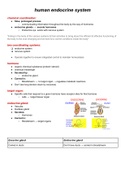
human endocrine system
chemical coordination:
● Slow, prolonged process
○ communicating information throughout the body by the way of hormones
● endocrine glands → secrete hormones
○ Endocrine sys. works with nervous system
*linking in the body of the various systems & their activities to bring about the efficient & effective functioning of
the body to the ever-changing environment & to control conditions inside the body*
two coordinating systems:
❏ endocrine system
❏ nervous system
● Operate together to ensure integrated control to maintain homeostasis
hormone
● organic chemical substance (protein/ steroid)
● chemical messenger
● Secreted by:
○ endocrine gland
● Carried in:
○ Bloodstream → to target organ → regulates metabolic reactions
● Don’t last long (broken down by enzymes)
target organ:
● Specific cells that respond to a given hormone have receptor sites for that hormone
○ cells → target tissue/ organ
endocrine gland:
● Vascular
● Ductless gland
● Secretes:
○ Hormones
● Carried in:
○ Bloodstream → target organs
Exocrine gland Endocrine gland
Carried in ducts Don’t have ducts → carried in bloodstream
, Eg. salivary glands, liver, pancreas Eg. adrenal glands
hypothalamus
● Part of brain
● Situated:
○ Above pit. Gland
● Secretes:
○ ADH (antidiuretic hormone)
○ Oxytocin
● Hormones stored in posterior lobe of pituitary gland
role of ADH
● Detects an incr. in osmolarity (low water levels) of blood
● hypo responds → releases ADH
● Helps conserve water = if body dehydrated
● Controls am. of water absorbed back into blood by kidneys
● targets:
○ Kidney tubules
example:
■ Lots of sweating → little water & lots of solutes in blood → no need to
conserve water
○ Incr. ADH → more water reabsorbed into blood in kidneys
○ Conc. urine
○ Less water lost
■ Drinking lots of water → too much water in blood → excrete excess water
○ Decr. ADH → less water reabsorbed into blood → more excreted
○ Dilute urine
diabetes insipidus:
● Under secretion of ADH
○ Releases large am. of dilute urine
○ Less water reabsorbed into blood
oxytocin
● targets:
○ Urine muscles → stim. uterus contractions
○ Mammary glands → breastfeeding (let down reflex) → milk