Chapter 1: Introduction to
Information Systems
Defining information system
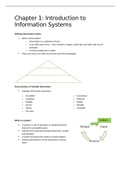
What is information?
o Information is a collection of facts
o It can take many forms – text, numbers, images, audio clips and video clips are all
examples
o A closely related term is data
These two terms are often incorrectly used interchangeably
Kn
ow
led
geation
Inform
Data
Characteristics of Valuable Information
Valuable information should be…
o Accessible o Economical
o Complete o Relevant
o Flexible o Simple
o Secure o Reliable
o Timely o Verifiable
o Accurate
What is a system? Feedback
A system is a set of elements or components that
interact to accomplish goals.
Output Input
Systems have input processing mechanisms, output
and feedback
A system processes the inputs to create outputs.
System performance can be measured in various
Process
ways:
, o Efficiency
o Effectiveness
A system performance standard is specific objective of the system.
Manual and Computerized Information Systems
An information system can be
o Manual (e.g., paper-based)
o Computerized
A computer-based information system (CBIS) is a single set of hardware, software,
databases, telecommunications, people, and procedures that are configured to collect,
manipulate, store, and process data into information.
Computer-based Information System (Contd.)
Hardware – physical components of a CBIS
Software – the set of ‘instructions’ that tell the hardware what to do:
o Operating systems – control the operations of hardware
o Application software – supports the completion of tasks
Database – collection of related information
Telecommunication – supports communication between people and devices on a network
People – individuals that use / affected by the CBIS
Procedures – rules & policies that guide the use of CBIS
Business Information Systems
Enterprise Systems: Transaction Processing Systems and Enterprise Resource Planning
Enterprise systems help organisations perform and integrate important tasks, such as paying
employees and suppliers, controlling inventory, sending out invoices and ordering supplies.
, Transaction Processing Systems- any business-related exchange, such as, payments to
employees, sales to customers and payments to suppliers.
Enterprise Resource Planning- a set of integrated programs capable of managing a company’s
vital business operations for an entire multisite, global organisation.
MIS and DSS
Management Information Systems (MIS)
o An organised collection of people, procedure, software, databases and devices that
provides routine information to managers and decision makers.
o Focuses on operational efficiency.
Decision Support Systems (DSS)
o An organised collection of people, procedure, software, databases and devices used to
support problem- specific decision making.
o Focus of a DSS is on making effective decisions
Knowledge Management, Artificial Intelligence, Expert Systems and Virtual Reality
Knowledge Management Systems (KMSs) an organised collection of people, procedure,
software, data bases and device to create store share and use the organisation’s knowledge and
experience.
Artificial Intelligence (AI) The ability of computer systems to mimic or duplicate the functions or
characteristic of the human brain or intelligence.
Learning systems
o Robotics is an area of AI in which machines take over complex, dangerous, routine or
boring tasks
o Visual systems allow robots and other devices to ‘see’, store and process visual images.
Expert Systems- a system that gives a computer the ability to make suggestions and act like
expert in a particular field or hardware and software that stores knowledge and makes
inferences like a human expert.
Virtual Reality – the simulation of a real or imagined environment that can be experienced
visually in 3 dimensions.
Systems Development
Systems development is the activity of creating or modifying business systems
Systems Investigation and Analysis
o The first two steps of systems development are systems investigation and analysis
o The goal of systems investigation is to gain a clear understanding of the problem to be
solved or opportunity to be addressed.
Systems Design, Implementation and maintenance and review
o Systems design determines how the new system will work to meet the business needs
defined during systems analysis
o Systems implementation involves creating or acquiring the various system components
(hardware, software, databases) defined in the design step, assembling them and
putting the new system into operation.
Information Systems
Defining information system
What is information?
o Information is a collection of facts
o It can take many forms – text, numbers, images, audio clips and video clips are all
examples
o A closely related term is data
These two terms are often incorrectly used interchangeably
Kn
ow
led
geation
Inform
Data
Characteristics of Valuable Information
Valuable information should be…
o Accessible o Economical
o Complete o Relevant
o Flexible o Simple
o Secure o Reliable
o Timely o Verifiable
o Accurate
What is a system? Feedback
A system is a set of elements or components that
interact to accomplish goals.
Output Input
Systems have input processing mechanisms, output
and feedback
A system processes the inputs to create outputs.
System performance can be measured in various
Process
ways:
, o Efficiency
o Effectiveness
A system performance standard is specific objective of the system.
Manual and Computerized Information Systems
An information system can be
o Manual (e.g., paper-based)
o Computerized
A computer-based information system (CBIS) is a single set of hardware, software,
databases, telecommunications, people, and procedures that are configured to collect,
manipulate, store, and process data into information.
Computer-based Information System (Contd.)
Hardware – physical components of a CBIS
Software – the set of ‘instructions’ that tell the hardware what to do:
o Operating systems – control the operations of hardware
o Application software – supports the completion of tasks
Database – collection of related information
Telecommunication – supports communication between people and devices on a network
People – individuals that use / affected by the CBIS
Procedures – rules & policies that guide the use of CBIS
Business Information Systems
Enterprise Systems: Transaction Processing Systems and Enterprise Resource Planning
Enterprise systems help organisations perform and integrate important tasks, such as paying
employees and suppliers, controlling inventory, sending out invoices and ordering supplies.
, Transaction Processing Systems- any business-related exchange, such as, payments to
employees, sales to customers and payments to suppliers.
Enterprise Resource Planning- a set of integrated programs capable of managing a company’s
vital business operations for an entire multisite, global organisation.
MIS and DSS
Management Information Systems (MIS)
o An organised collection of people, procedure, software, databases and devices that
provides routine information to managers and decision makers.
o Focuses on operational efficiency.
Decision Support Systems (DSS)
o An organised collection of people, procedure, software, databases and devices used to
support problem- specific decision making.
o Focus of a DSS is on making effective decisions
Knowledge Management, Artificial Intelligence, Expert Systems and Virtual Reality
Knowledge Management Systems (KMSs) an organised collection of people, procedure,
software, data bases and device to create store share and use the organisation’s knowledge and
experience.
Artificial Intelligence (AI) The ability of computer systems to mimic or duplicate the functions or
characteristic of the human brain or intelligence.
Learning systems
o Robotics is an area of AI in which machines take over complex, dangerous, routine or
boring tasks
o Visual systems allow robots and other devices to ‘see’, store and process visual images.
Expert Systems- a system that gives a computer the ability to make suggestions and act like
expert in a particular field or hardware and software that stores knowledge and makes
inferences like a human expert.
Virtual Reality – the simulation of a real or imagined environment that can be experienced
visually in 3 dimensions.
Systems Development
Systems development is the activity of creating or modifying business systems
Systems Investigation and Analysis
o The first two steps of systems development are systems investigation and analysis
o The goal of systems investigation is to gain a clear understanding of the problem to be
solved or opportunity to be addressed.
Systems Design, Implementation and maintenance and review
o Systems design determines how the new system will work to meet the business needs
defined during systems analysis
o Systems implementation involves creating or acquiring the various system components
(hardware, software, databases) defined in the design step, assembling them and
putting the new system into operation.