

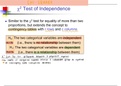
2 Test of Independence
Similar to the 2 test for equality of more than two
proportions, but extends the concept to
contingency tables with r rows and c columns
H0: The two categorical variables are independent
(i.e., there is no relationship between them)
H1: The two categorical variables are dependent
(i.e., there is a relationship between them)
, 2 Test of Independence
(continued)
The Chi-square test statistic is:
2
( fo fe )2
χ STAT
all cells
fe
where:
fo = observed frequency in a particular cell of the r x c table
fe = expected frequency in a particular cell if H0 is true
χ 2STAT for the r x c case has (r - 1)(c - 1) degreesof freedom
(Assumed: each cell in the contingency table has expected
frequency of at least 1)
Similar to the 2 test for equality of more than two
proportions, but extends the concept to
contingency tables with r rows and c columns
H0: The two categorical variables are independent
(i.e., there is no relationship between them)
H1: The two categorical variables are dependent
(i.e., there is a relationship between them)
, 2 Test of Independence
(continued)
The Chi-square test statistic is:
2
( fo fe )2
χ STAT
all cells
fe
where:
fo = observed frequency in a particular cell of the r x c table
fe = expected frequency in a particular cell if H0 is true
χ 2STAT for the r x c case has (r - 1)(c - 1) degreesof freedom
(Assumed: each cell in the contingency table has expected
frequency of at least 1)


