
GROUP STATEMENTS
FINANCIAL ACCOUNTING 321 DEPARTMENT OF
Group statements: Revision 2020
ACCOUNTING BACKGROUND
Consolidated and separate financial statements
UP
M Pollock
Entity can expand its business is two ways:
GROUP STATEMENTS i) The company can grow itself in size; production &
activities
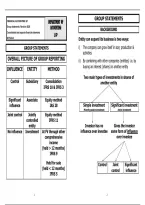
OVERALL PICTURE OF GROUP REPORTING ii) By combining with other companies (entities) i.e. by
buying an interest (shares) in another entity
INFLUENCE ENTITY METHOD
Two main types of investments in shares of
Control Subsidiary Consolidation another entity
IFRS 10 & IFRS 3
Significant Associate Equity method
influence IAS 28 Simple investment Significant investment
Minority passive investment Active investment
Joint control Jointly Equity method
controlled IFRS 11
entity Investor has no Gives the investor
No influence Investment At FV through other influence over investee some form of influence
comprehensive over investee
income
(held > 12 months)
IFRS 9
Held for sale Control Joint Significant
(held < 12 months) control influence
IFRS 5
1 2
, GROUP STATEMENTS
GROUP STATEMENTS
PARENT/SUBSIDIARY RELATIONSHIP
PARENT/SUBSIDIARY RELATIONSHIP
A business combination is defined as: a transaction
or other event in which an acquirer obtains control of A parent shall prepare consolidated financial statements
one or more businesses. using uniform accounting policies for like transactions
and other events in similar circumstances. (IFRS 10.19).
CONTROL: Consolidated financial statements are the financial
An investor controls an investee when it is exposed, or statements of a group in which the assets, liabilities,
has rights, to variable returns from its involvement with equity, income, expenses and cash flows of the parent
the investee and has the ability to affect those returns and its subsidiaries are presented as those of a single
through its power over the investee. (IFRS 10.6) economic entity.
Subsidiaries may NOT be excluded from group financial
DEFINITION of CONTROL (IFRS 10.7) statements, except if the parent no longer has control.
An investor controls an investee if and only if the
When parent does not have to prepare consolidated
investor has all the following:
financial statements:
Power over the investee; Refer Par 1.4, (p. 13) & IFRS 10 par 4
Exposure, or rights, to variable returns from its
involvement with the investee; and FOR TEST PURPOSES (and the next two pages):
The ability to use its power over the investee to If a co (A) owns > 50% of the equity shares of another
affect the amount of the investor’s returns. co (B), it can be assumed that A controls B and that B is
therefore a subsidiary of A, except if question contains
Subsidiary - An entity that is under the control information that states something to the contrary
of another entity.
Also assume in a question that each ordinary share
carries 1 vote, except if question states something to the
contrary
3 4


