

PYC3701
CHAPTER 5 – ATTITUDES
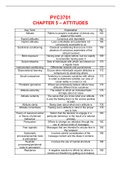
Key Term Explanation Pg.
Attitude Refers to people’s evaluation of almost any 163
aspect of the world
Explicit attitudes Conscious and reportable 164
Implicit attitudes Less controllable and potentially not 164
consciously accessible to us
Subliminal conditioning Classical conditioning that occurs in the 169
absence of conscious awareness of the
stimuli involved
Mere exposure Having seen an object before, but too rapidly 169
to remember having seen it
Social networks Sets of individuals with whom we interact on 170
a regular basis
Instrumental conditioning Differential rewards and punishments 170
Observational learning Occurs when individuals acquire attitudes or 172
behaviours by observing others
Social comparison Tendency to compare ourselves with others 172
in order to determine whether our view of
social reality is correct or not
Pluralistic ignorance Where we erroneously believe others have 176
attitudes different than ourselves
Attitude extremity The extent to which an individual feels 176
strongly about an issue
Attitude certainty The sense that you know what your attitude 176
is and the feeling that it is the correct position
to hold
Attitude clarity Being clear about what one’s attitude is 178
Attitude correctness Feeling one’s attitude is valid or the proper 178
one to hole
Theory of reasoned action Notion that the decision to engage in a 180
or theory of planned particular behaviour is the result of a rational
behaviour process
Persuasion Efforts to change our attitudes through the 182
use of various kinds of messages
Fear appeals Messages that are intended to arouse fear in 185
the recipient
Systematic Involves careful consideration of the 186
processing/central route message content and the ideas it contains
to persuasion
Heuristic Involves the use of mental shortcuts 186
processing/peripheral
route to persuasion
Reactance A negative reaction to efforts by others to 189
reduce our freedom by getting us to believe
, or do what they want
Forewarning Effects of advanced knowledge 190
Cognitive dissonance An unpleasant state that occurs when we 193
notice that our attitudes and our behaviour
are inconsistent
Less-leads-to-more effect Less reasons or rewards for an action often 194
leads to greater attitude change
Self-affirmation Restoring positive self-evaluations that are 195
threatened by the dissonance
Selective avoidance The tendency to overlook or disregard 198
information that contradicts our existing views
Cultural tightness-versus 199
looseness
Introduction
Attitude can refer to people’s evaluation of almost any aspect of the world
Some attitudes appear to be quite stable and resistant to change, while others
are unstable and show considerable variability depending on the situation
When others with whom we identify appear to strongly endorse an attitude
position, it leads us to want to be more similar to them and results in the
expression of more attitude certainty as well
Explicit and implicit attitudes
Assessing implicit attitudes – Implicit Association Test (IAT)
o Based on the fact that we may associate various social objects more or
less readily with positive or negative descriptive words
o Criticism – assesses commonly known connections between social
groups and various attributes, even though the respondent might not
actually endorse the validity of those connections
Attitudes often influence our behaviour
Attitude Formation: How Attitudes Develop
Social learning – many of our views are acquired by interacting with others, or
simply observing their behaviour
Classical Conditioning:
Basic principle of psychology
o When a stimulus that is capable of evoking a response – the
unconditioned stimulus – regularly precedes another neutral stimulus,
the one that occurs first can become a signal for the second –
conditioned stimulus
Classical conditioning can affect attitudes via 2 pathways: the direct routh and
the indirect route
Attitudes can be influenced by subliminal conditioning – definition in table
Mere exposure (definition in table) can result in attitude formation
Even when we can remember being exposed to info, its mere repetition
creates a sense of familiarity and results in more positive attitudes
o Illusion of truth effect
CHAPTER 5 – ATTITUDES
Key Term Explanation Pg.
Attitude Refers to people’s evaluation of almost any 163
aspect of the world
Explicit attitudes Conscious and reportable 164
Implicit attitudes Less controllable and potentially not 164
consciously accessible to us
Subliminal conditioning Classical conditioning that occurs in the 169
absence of conscious awareness of the
stimuli involved
Mere exposure Having seen an object before, but too rapidly 169
to remember having seen it
Social networks Sets of individuals with whom we interact on 170
a regular basis
Instrumental conditioning Differential rewards and punishments 170
Observational learning Occurs when individuals acquire attitudes or 172
behaviours by observing others
Social comparison Tendency to compare ourselves with others 172
in order to determine whether our view of
social reality is correct or not
Pluralistic ignorance Where we erroneously believe others have 176
attitudes different than ourselves
Attitude extremity The extent to which an individual feels 176
strongly about an issue
Attitude certainty The sense that you know what your attitude 176
is and the feeling that it is the correct position
to hold
Attitude clarity Being clear about what one’s attitude is 178
Attitude correctness Feeling one’s attitude is valid or the proper 178
one to hole
Theory of reasoned action Notion that the decision to engage in a 180
or theory of planned particular behaviour is the result of a rational
behaviour process
Persuasion Efforts to change our attitudes through the 182
use of various kinds of messages
Fear appeals Messages that are intended to arouse fear in 185
the recipient
Systematic Involves careful consideration of the 186
processing/central route message content and the ideas it contains
to persuasion
Heuristic Involves the use of mental shortcuts 186
processing/peripheral
route to persuasion
Reactance A negative reaction to efforts by others to 189
reduce our freedom by getting us to believe
, or do what they want
Forewarning Effects of advanced knowledge 190
Cognitive dissonance An unpleasant state that occurs when we 193
notice that our attitudes and our behaviour
are inconsistent
Less-leads-to-more effect Less reasons or rewards for an action often 194
leads to greater attitude change
Self-affirmation Restoring positive self-evaluations that are 195
threatened by the dissonance
Selective avoidance The tendency to overlook or disregard 198
information that contradicts our existing views
Cultural tightness-versus 199
looseness
Introduction
Attitude can refer to people’s evaluation of almost any aspect of the world
Some attitudes appear to be quite stable and resistant to change, while others
are unstable and show considerable variability depending on the situation
When others with whom we identify appear to strongly endorse an attitude
position, it leads us to want to be more similar to them and results in the
expression of more attitude certainty as well
Explicit and implicit attitudes
Assessing implicit attitudes – Implicit Association Test (IAT)
o Based on the fact that we may associate various social objects more or
less readily with positive or negative descriptive words
o Criticism – assesses commonly known connections between social
groups and various attributes, even though the respondent might not
actually endorse the validity of those connections
Attitudes often influence our behaviour
Attitude Formation: How Attitudes Develop
Social learning – many of our views are acquired by interacting with others, or
simply observing their behaviour
Classical Conditioning:
Basic principle of psychology
o When a stimulus that is capable of evoking a response – the
unconditioned stimulus – regularly precedes another neutral stimulus,
the one that occurs first can become a signal for the second –
conditioned stimulus
Classical conditioning can affect attitudes via 2 pathways: the direct routh and
the indirect route
Attitudes can be influenced by subliminal conditioning – definition in table
Mere exposure (definition in table) can result in attitude formation
Even when we can remember being exposed to info, its mere repetition
creates a sense of familiarity and results in more positive attitudes
o Illusion of truth effect


