

PYC3701
CHAPTER 6 – CAUSES AND CURES OF
STEREOTYPING, PREJUDICE AND
DISCRIMINATION
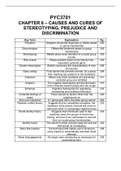
Key Term Explanation Pg.
Prejudice Negative emotional responses or dislike based 202
on group membership
Discrimination Differential treatment based on group 203
membership
Stereotyping Beliefs about what members of a social group 203
are like
Risk averse Weigh possible losses more heavily than 204
equivalent potential gains
Gender stereotypes Beliefs concerning the characteristics of men 208
and women
Glass ceiling Final barrier that prevents women, as a group, 209
from reaching top positions in the workplace
Tokenism Where only a few members of a previously 211
excluded group are admitted
Singlism The negative stereotyping and discrimination 215
that is directed toward people who are single
Schemas Cognitive frameworks for organising, 216
interpreting and recalling information
Incidental feelings of Those caused by factors other than the 220
anger outgroup per se
Zero-sum outcomes If 1 group gets them, the other group cannot 222
Realistic conflict theory Suggests that as competition escalates, the 222
members of the groups involved will come to
view each other in increasingly negative terms
Social identity theory Suggests that individuals seek to feel 224
positively about the groups to which they
belong, and part of our self-esteem is derived
from our social group memberships
Identity fusion The extent to which a person sees the self and 224
their group as overlapping
Bona fide pipeline The technique that makes use of priming to 228
study implicit or automatically activated racial
attitudes
Moral disengagement No longer seen sanctioning as necessary for 230
perpetrating harm
, Everyone comes face to face with prejudice
o Definition in table
o Such experiences can come about either because we are the target of
it, we observe others’ prejudicial treatment of members on another
group or when we recognise it in ourselves and realise our actions
o May be perceived by its perpetrators or it can be seen as entirely
illegitimate
Discrimination
o Definition in table
o All forms are not perceived nor responded to by its targets
Stereotyping
o Definition in table
How Members of Different Groups Perceive Inequality
Whether discrimination is perceived to be legitimate or not and the extent to
which progress toward its reduction has been made depends on whether one
is a member of the group experiencing it or perpetrating the discrimination
Risk averse – definition in table
o Potential losses having greater psychological impact than potential
gains
The Nature and Origins of Stereotyping
Stereotypes – cognitive component of attitudes
Prejudice – affective component
Discrimination – behavioural component
Some groups are characterised by negative stereotypes and this leads to a
general feeling of hostility, which then results in a conscious intention to
discriminate against members of the targeted group
Stereotyping: Beliefs About Social Groups
Stereotypes about groups are the beliefs and expectations that we have
concerning what members of those groups are like
Gender stereotypes
o Definition in table
o Positive side for women
Kind
Nurturant
Considerate
o Negative side
Weak
Dependent
Overly emotional
o Glass ceiling – definition in table
o Women are most likely to be sabotaged when men are experiencing
threat and women behave in a stereotype-inconsistent manner
o Glass cliff effect – women are more likely to be appointed to leadership
positions following a crisis and when there is a greater risk of failure
CHAPTER 6 – CAUSES AND CURES OF
STEREOTYPING, PREJUDICE AND
DISCRIMINATION
Key Term Explanation Pg.
Prejudice Negative emotional responses or dislike based 202
on group membership
Discrimination Differential treatment based on group 203
membership
Stereotyping Beliefs about what members of a social group 203
are like
Risk averse Weigh possible losses more heavily than 204
equivalent potential gains
Gender stereotypes Beliefs concerning the characteristics of men 208
and women
Glass ceiling Final barrier that prevents women, as a group, 209
from reaching top positions in the workplace
Tokenism Where only a few members of a previously 211
excluded group are admitted
Singlism The negative stereotyping and discrimination 215
that is directed toward people who are single
Schemas Cognitive frameworks for organising, 216
interpreting and recalling information
Incidental feelings of Those caused by factors other than the 220
anger outgroup per se
Zero-sum outcomes If 1 group gets them, the other group cannot 222
Realistic conflict theory Suggests that as competition escalates, the 222
members of the groups involved will come to
view each other in increasingly negative terms
Social identity theory Suggests that individuals seek to feel 224
positively about the groups to which they
belong, and part of our self-esteem is derived
from our social group memberships
Identity fusion The extent to which a person sees the self and 224
their group as overlapping
Bona fide pipeline The technique that makes use of priming to 228
study implicit or automatically activated racial
attitudes
Moral disengagement No longer seen sanctioning as necessary for 230
perpetrating harm
, Everyone comes face to face with prejudice
o Definition in table
o Such experiences can come about either because we are the target of
it, we observe others’ prejudicial treatment of members on another
group or when we recognise it in ourselves and realise our actions
o May be perceived by its perpetrators or it can be seen as entirely
illegitimate
Discrimination
o Definition in table
o All forms are not perceived nor responded to by its targets
Stereotyping
o Definition in table
How Members of Different Groups Perceive Inequality
Whether discrimination is perceived to be legitimate or not and the extent to
which progress toward its reduction has been made depends on whether one
is a member of the group experiencing it or perpetrating the discrimination
Risk averse – definition in table
o Potential losses having greater psychological impact than potential
gains
The Nature and Origins of Stereotyping
Stereotypes – cognitive component of attitudes
Prejudice – affective component
Discrimination – behavioural component
Some groups are characterised by negative stereotypes and this leads to a
general feeling of hostility, which then results in a conscious intention to
discriminate against members of the targeted group
Stereotyping: Beliefs About Social Groups
Stereotypes about groups are the beliefs and expectations that we have
concerning what members of those groups are like
Gender stereotypes
o Definition in table
o Positive side for women
Kind
Nurturant
Considerate
o Negative side
Weak
Dependent
Overly emotional
o Glass ceiling – definition in table
o Women are most likely to be sabotaged when men are experiencing
threat and women behave in a stereotype-inconsistent manner
o Glass cliff effect – women are more likely to be appointed to leadership
positions following a crisis and when there is a greater risk of failure


