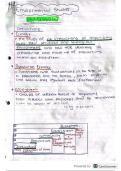
Environmental Studies
DEFINITIONS:
individual – single organism capable of independent existence
population – group of individuals; same species – live in same area + breed freely
community – group of different populations – live together + interact in a defined
area
ecosystem – organisms live in an area + interact with each other + physical
environment
ecological niches – resources + conditions necessary for survival of each species
population size – num individual organisms in pop
Population parameters:
grows ~ birth rate/ immigration/ natality (plants) exceeds ‘’
declines ~ death rate/ emigration exceeds ‘’
remains stable ~ birth + immigration = death + emigration
population size fluctuates seasonally + annually, depending on resources avail
population ecology ~ fluctuations in size of population + factors
closed population (e.g., fish in small pond) = only parameters will be births or deaths
How is population regulated?
individuals enter area, no food shortage/ no predator = individuals increase
exponentially
as numbers increase: more demand = resources; causes environmental resistance
cause birth rate/ immigration – decrease + mortality/ emigration increase
stabilizes population – particular number: called carrying capacity
environmental resistance = total num of factors that stop a population from repro at its max
rate
carrying capacity = popul density the environment can support
- stable popul: decreases when at carrying capacity – increases when below ‘’
- unstable popul: far exceeds carrying capacity
Limiting factors: factors that regulate growth popul
Density independent factors (natural factors): - physical factors (rainfall, temp)
- catastrophic factors (earthquake,
flood)
Density dependent factors ( greater effect popul high)
- compete resources, found by
predators, disease spreads readily
, the limiting factors collectively build up environmental resistance
Sampling methods:
Direct method/ census: involves counting every single individual in a popul
only used = 1. organisms large enough to be seen 2. area not large 3. slow moving (snails) 4.
stationary (plants)
Indirect method: (N) population = num in sample x size of whole habit
size of quadrat
Mark- capture method: P = M (total marked animals) x C (animals in 2nd sample)
R (total marked animals 2nd sample)
Importance random sampling: ensures results from sample should approximate what would
been obtained if entire popul had been measured
reliable results: 1. short time pass 1st/2nd sample 2. sampling repeated multiple times 3.
marking not damage movement/ behaviour.
Predator- prey relationship
interaction where predator kills + eats another species the prey
lion-zebra: (adaption - speed of movements) 1. faster lions catch/ eat prey more
easily than slower lions = they survive + reproduce + make up more of popul
2. faster zebras escape lions = they survive + reproduce + gradually fast zebras make
up more of popul
shark-fish: sharks prey on sick/ slow fish, by preying on fish popul prevents them
increasing rapidly + becoming too dominant
Food web – interconnected set of all food chains in an ecosystem
- all organisms help to keep
ecosystems healthy and balanced
Social organisation – useful as it improves the survival of an individual as resources are
divided among group
easier to: avoid predators, hunt collectively to find food, find mates
Competition
Species compete with each other for resources: light, space, food, shelter, water and
this results = specialisation for particular modes of life
organisms adaptions that enable individuals of diff species to coexist
Survival is determined by the
Interspecific competition: individuals diff species
successful access to
resources
DEFINITIONS:
individual – single organism capable of independent existence
population – group of individuals; same species – live in same area + breed freely
community – group of different populations – live together + interact in a defined
area
ecosystem – organisms live in an area + interact with each other + physical
environment
ecological niches – resources + conditions necessary for survival of each species
population size – num individual organisms in pop
Population parameters:
grows ~ birth rate/ immigration/ natality (plants) exceeds ‘’
declines ~ death rate/ emigration exceeds ‘’
remains stable ~ birth + immigration = death + emigration
population size fluctuates seasonally + annually, depending on resources avail
population ecology ~ fluctuations in size of population + factors
closed population (e.g., fish in small pond) = only parameters will be births or deaths
How is population regulated?
individuals enter area, no food shortage/ no predator = individuals increase
exponentially
as numbers increase: more demand = resources; causes environmental resistance
cause birth rate/ immigration – decrease + mortality/ emigration increase
stabilizes population – particular number: called carrying capacity
environmental resistance = total num of factors that stop a population from repro at its max
rate
carrying capacity = popul density the environment can support
- stable popul: decreases when at carrying capacity – increases when below ‘’
- unstable popul: far exceeds carrying capacity
Limiting factors: factors that regulate growth popul
Density independent factors (natural factors): - physical factors (rainfall, temp)
- catastrophic factors (earthquake,
flood)
Density dependent factors ( greater effect popul high)
- compete resources, found by
predators, disease spreads readily
, the limiting factors collectively build up environmental resistance
Sampling methods:
Direct method/ census: involves counting every single individual in a popul
only used = 1. organisms large enough to be seen 2. area not large 3. slow moving (snails) 4.
stationary (plants)
Indirect method: (N) population = num in sample x size of whole habit
size of quadrat
Mark- capture method: P = M (total marked animals) x C (animals in 2nd sample)
R (total marked animals 2nd sample)
Importance random sampling: ensures results from sample should approximate what would
been obtained if entire popul had been measured
reliable results: 1. short time pass 1st/2nd sample 2. sampling repeated multiple times 3.
marking not damage movement/ behaviour.
Predator- prey relationship
interaction where predator kills + eats another species the prey
lion-zebra: (adaption - speed of movements) 1. faster lions catch/ eat prey more
easily than slower lions = they survive + reproduce + make up more of popul
2. faster zebras escape lions = they survive + reproduce + gradually fast zebras make
up more of popul
shark-fish: sharks prey on sick/ slow fish, by preying on fish popul prevents them
increasing rapidly + becoming too dominant
Food web – interconnected set of all food chains in an ecosystem
- all organisms help to keep
ecosystems healthy and balanced
Social organisation – useful as it improves the survival of an individual as resources are
divided among group
easier to: avoid predators, hunt collectively to find food, find mates
Competition
Species compete with each other for resources: light, space, food, shelter, water and
this results = specialisation for particular modes of life
organisms adaptions that enable individuals of diff species to coexist
Survival is determined by the
Interspecific competition: individuals diff species
successful access to
resources