

RSC2601 – Chapter 7
Data Collection
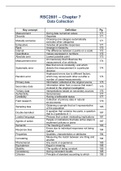
Key concept Definition Pg.
Measurement Giving data numerical values 171
Discrete Separate 171
Choosing one category automatically
Mutually exclusive 171
excludes other categories
Exhaustive Includes all possible responses 171
Rank Arrange in hierarchy 172
Interval The difference between 2 points on a scale 172
Quantitative Values expressed in numbers 172
Absolute zero Lowest possible point 173
An inaccuracy that influences the
Measurement error 174
measurement of an attribute
Bias that occurs constantly, and which
Systematic error distorts the measurement in a particular 174
direction
Haphazard errors due to different factors,
Random error which may cancel each other out after a 174
number of cases/measurements
Primary data Information collected at the original source 175
Information taken from a source that wasn’t
Secondary data 175
involved in the original investigation
Tertiary data Interpretations based on secondary sources 176
Authenticity Genuineness 177
Credibility Having a believable status 177
Collection of primary data in natural
Field research 179
environments
Obtaining a sample that isn’t representative
Sampling bias 185
of the population
A question that contains two parts, a question
Double-barrelled 187
that is 2 questions in 1
Loaded language Phrases that contain misleading implications 187
People or institutions that take active steps to
Agents of action 187
implement policies or plans
Semantic The meaning of words 193
Errors due to individual responses not being
Response bias 194
truthful
Properties Qualities, characteristics or attributes 194
Measuring the match between one thing and
Correlating 194
another
Phenomenon Any event or experience 195
Equivalence Equal in meaning 195
Stability The quality of being constant 195
Consistency Giving consistent results 195
Criterion Principle of standard according to which 196
, something is judged
Problem, area, field or discipline being
Domain 197
researched
Response rate Number of questionnaires returned 198
Acceptance of the rightfulness and
Legitimacy 198
responsibleness of research
Credibility Having a believable status 198
Gratifications Rewards, pleasure, enjoyment, satisfaction 200
Making deductions based on, for example,
Inferences 200
what is being observed
Overtly Done in an open and unconcealed manner 202
Unobtrusive Not making oneself noticed 202
Refers to the use of facial expressions,
Kinesics gestures and bodily positions as nonverbal 204
communication
Separating oneself from others by means of
Linguistic insulation 205
language
Depersonalisation Losing one’s sense of identity 205
Classification Arrange in groups 206
The ability of other researchers to reproduce
Replication 206
the research
Measurement
Central part of analysing survey questionnaires, testing hypotheses and
theoretical assumptions, and summarising data obtained in field research
Measurement is when we record or register the value of a particular variable
o Enables us to describe the variable
Process that follows certain rules and has to meet certain criteria
Levels of measurement:
Nominal level of measurement
o 3 categories used
Discrete
Mutually exclusive
Exhaustive
o Discrete (definition in table)
A category is discrete when it is distinct and separate from other
categories
o Mutually exclusive (definition in table)
When categories measure something which is not measured by
other categories
o Exhaustive
If categories make provision for all possible responses, variables
or attributes
o Numerals are usually assigned to each category, simply for the
purpose of classification
Ordinal level of measurement
o Used when a researcher wants to put their observations or data in
order of importance
Data Collection
Key concept Definition Pg.
Measurement Giving data numerical values 171
Discrete Separate 171
Choosing one category automatically
Mutually exclusive 171
excludes other categories
Exhaustive Includes all possible responses 171
Rank Arrange in hierarchy 172
Interval The difference between 2 points on a scale 172
Quantitative Values expressed in numbers 172
Absolute zero Lowest possible point 173
An inaccuracy that influences the
Measurement error 174
measurement of an attribute
Bias that occurs constantly, and which
Systematic error distorts the measurement in a particular 174
direction
Haphazard errors due to different factors,
Random error which may cancel each other out after a 174
number of cases/measurements
Primary data Information collected at the original source 175
Information taken from a source that wasn’t
Secondary data 175
involved in the original investigation
Tertiary data Interpretations based on secondary sources 176
Authenticity Genuineness 177
Credibility Having a believable status 177
Collection of primary data in natural
Field research 179
environments
Obtaining a sample that isn’t representative
Sampling bias 185
of the population
A question that contains two parts, a question
Double-barrelled 187
that is 2 questions in 1
Loaded language Phrases that contain misleading implications 187
People or institutions that take active steps to
Agents of action 187
implement policies or plans
Semantic The meaning of words 193
Errors due to individual responses not being
Response bias 194
truthful
Properties Qualities, characteristics or attributes 194
Measuring the match between one thing and
Correlating 194
another
Phenomenon Any event or experience 195
Equivalence Equal in meaning 195
Stability The quality of being constant 195
Consistency Giving consistent results 195
Criterion Principle of standard according to which 196
, something is judged
Problem, area, field or discipline being
Domain 197
researched
Response rate Number of questionnaires returned 198
Acceptance of the rightfulness and
Legitimacy 198
responsibleness of research
Credibility Having a believable status 198
Gratifications Rewards, pleasure, enjoyment, satisfaction 200
Making deductions based on, for example,
Inferences 200
what is being observed
Overtly Done in an open and unconcealed manner 202
Unobtrusive Not making oneself noticed 202
Refers to the use of facial expressions,
Kinesics gestures and bodily positions as nonverbal 204
communication
Separating oneself from others by means of
Linguistic insulation 205
language
Depersonalisation Losing one’s sense of identity 205
Classification Arrange in groups 206
The ability of other researchers to reproduce
Replication 206
the research
Measurement
Central part of analysing survey questionnaires, testing hypotheses and
theoretical assumptions, and summarising data obtained in field research
Measurement is when we record or register the value of a particular variable
o Enables us to describe the variable
Process that follows certain rules and has to meet certain criteria
Levels of measurement:
Nominal level of measurement
o 3 categories used
Discrete
Mutually exclusive
Exhaustive
o Discrete (definition in table)
A category is discrete when it is distinct and separate from other
categories
o Mutually exclusive (definition in table)
When categories measure something which is not measured by
other categories
o Exhaustive
If categories make provision for all possible responses, variables
or attributes
o Numerals are usually assigned to each category, simply for the
purpose of classification
Ordinal level of measurement
o Used when a researcher wants to put their observations or data in
order of importance


