

RSC2601 – Chapter 6
Sampling
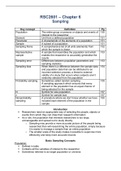
Key concept Definition Pg
Population The entire group or persons or objects and events of 150
interest to the researcher
Element Unit from a defined population 151
Parameter A characteristic of the elements of a population 151
Sample A subset of a population 151
Sampling frame A comprehensive list of all units (elements) from 152
which the sample is drawn
Representative A sample that resembles the population and which 153
sample enables the researcher to accurately generalise the
results
Sampling error Differences between population parameters and 153
sampling statistics
Sampling bias When there is a difference between the sample data 154
and population data that can be attributed to an
incorrect selection process; a threat to external
validity of a study that occurs when subjects aren’t
randomly selected from the population
Probability sampling Sometimes called random sampling 155
A sampling approach which ensures that every
element in the population has an equal chance of
being selected for the sample
N Symbol for size population 157
n Symbol for sample size 157
Nonprobability A procedure where we don’t know whether we have 160
sampling included each element of the population in the
sample
Introduction
Researchers need an appropriate way of selecting the people, objects or
events from which they can draw their research information
As a rule, the population that interests researchers is too large,
unmanageable and spread out to study directly
o Sampling may provide a more accurate picture of the people being
researched than will researching the entire population, simply because
it is easier to manage a sample than an entire population
o The smaller scale of the study makes it possible to supervise more
effectively and keep more accurate records
Basic Sampling Concepts
Population:
Defined in table
Contains all the variables of interest to the researcher
Sometimes referred to as target population or universe
Sampling
Key concept Definition Pg
Population The entire group or persons or objects and events of 150
interest to the researcher
Element Unit from a defined population 151
Parameter A characteristic of the elements of a population 151
Sample A subset of a population 151
Sampling frame A comprehensive list of all units (elements) from 152
which the sample is drawn
Representative A sample that resembles the population and which 153
sample enables the researcher to accurately generalise the
results
Sampling error Differences between population parameters and 153
sampling statistics
Sampling bias When there is a difference between the sample data 154
and population data that can be attributed to an
incorrect selection process; a threat to external
validity of a study that occurs when subjects aren’t
randomly selected from the population
Probability sampling Sometimes called random sampling 155
A sampling approach which ensures that every
element in the population has an equal chance of
being selected for the sample
N Symbol for size population 157
n Symbol for sample size 157
Nonprobability A procedure where we don’t know whether we have 160
sampling included each element of the population in the
sample
Introduction
Researchers need an appropriate way of selecting the people, objects or
events from which they can draw their research information
As a rule, the population that interests researchers is too large,
unmanageable and spread out to study directly
o Sampling may provide a more accurate picture of the people being
researched than will researching the entire population, simply because
it is easier to manage a sample than an entire population
o The smaller scale of the study makes it possible to supervise more
effectively and keep more accurate records
Basic Sampling Concepts
Population:
Defined in table
Contains all the variables of interest to the researcher
Sometimes referred to as target population or universe


