
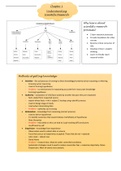
Chapter 1
Understanding
Scientific Research
Why learn about
scientific research
processes?
2 learn research processes
Provide foundation for other
courses
Become critical consumer of
info
Develop critical + analytic
thinking
Learn 2 critically read +
research article
Methods of getting knowledge
Intuition – the act/process of coming to direct knowledge/certainty w/out reasoning or inferring
- knowing w/out reasoning
- Used in forming hypotheses
- Problem – no mechanisms for separating accurate form inaccurate knowledge
- Forming hypotheses
Authority – acceptance of info/facts stated by another because they are respected
- facts stated from respected source
- expert whose facts + info r subject 2 testing using scientific process
- Used in design stage of study
- Used when interpreting data
- Problem – authority can b wrong
Rationalism – knowledge from reasoning (correct process)
- Used to derive hypotheses
- To identify outcomes that would indicate truth/falsity of hypotheses
- Rene Descartes
- Problem – rely solely on this can lead to 2 ppl reaching diff conclusions
- Insufficient by self
Empiricism – knowledge from experience
- Observation used to collect data in science
- Facts that concur w/ experience accepted. Those that do not = rejected
- John Locke – tabula rasa
- David Hume
- Problem – research bias. Must be under controlled conditions.
Systematic strategies must b used to reduce researcher bias + maximise objectivity. Naïve
Empericism. Mem of events not constant.
, Science
Scientific methods
Designed to systematically produce
Induction – specific to general reasoning process reliable + valid knowledge about natural
- Aristotle world
- Take a limited amount of observations and Scire
making it something general William Whewell
- Still used today when generalising from Diff methods
specific experiments to general hypotheses/
theory
- Latane Abductive reasoning (scientific
= Observed ppl don’t exert as much effort in method)
group as they do working alone
Abduction
= inferred that this represents more general
Inference to best explanation
construct of social loafing
What explanation fits observed data best?
- Researchers relying on sample to represent
Crime scene
population
- Find empty care in driveway
- May be wrong
- Blood splattered there
- My friend who is left handed uses left handed
- Broken window
scissors. Therefore, all left handed people use
left handed scissors. Scientific methods
Deduction – general to specific reasoning
- Involved in forming hypothesis from theory Naturalism – science should be studied +
- When you take 2 true statements to form a evaluated empirically
conclusion - Rejects foundational epistemology
- Levine (assumes knowledge is a matter of
- Used idea of social loafing to deduce specific deductive reasoning + is fully certain)
set of events that would reduce social loafing - We should continually evaluate our
= ‘a person who views group’s task as theories based on empirical adequacy
important and does not expect others to - Do empirical data support theory? Does
contribute adequately to the group’s theory make adequate predictions?
performance will work harder’ - pragmatic
- All dolphins are mammals. All mammals have 1. Thomas Kuhn
kidneys. Thus, all dolphins have kidneys. - Paradigm – framework of thought/belief
Hypothesis testing where you interpret reality
- Formulating hypothesis to explain some - Science governed by 2 types of activities
phenomenon that’s been observed + then 1. Normal science-shared paradigm = 1x
compared to hypothesis w/ facts paradigm/set of values etc shared by
- Prominent form mid 19th c to 1960, still used community + forms particular view of
- Associated w/ logical positivists = reality
philosophical position started by scholars at 2. Revolutionary science – replace 1
Uni of Vienna, believed statements paradigm w/ another
meaningful only when verifiable by 2. Paul Feyerabend
observation/exp - Feyerabend’s Anarchists Theory of Science
Criticism of Hypothesis testing ▪ argued there is no such thing as method
- Popper + his falsification position. He said of science, but
the typical manner of justifying the science has many methods
hypothesis by observing facts cannot work. ▪ advocated that science does not give
Prob of induction. You must look for one knowledge superior
falsity of you hypotheses. If you find it, you to other forms of knowledge
know you are wrong. ▪ his position – the unchanging principle of
- Helps eliminate false theories scientific method
- Duhem-Quine principle = a hypothesis is that “anything goes”
cannot be tested in isolation ▪ scientific knowledge is not better than
- Must make many assumptions in hypothesis other forms of
testing knowledge
, Scientific approaches What is science
Meta theories Multiple methods + practices used to
Reality (ontology) + knowledge (epistemology) develop secure scientific knowledge
Scientists must
summary - Be sceptical, creative, systematic
Rationalism - Identify probs
Empiricism - Question current solns that aren’t
Positivism working
Naturalism/ post positivism - Creatively + systematically come up w/
Realism new solns
- Subject new solns to empirical testing
Realism: 2 b successful, science must
- Conduct research ethically
Independent of mind + reality
- Critically self-examine practices 2
Unobservable are real
determine what is working/not
Many versions of realism: critical, scientific,
- Engage in ongoing learning +
situational, new, speculative etc
improvement
Process of realistic science
- Diff methods apply 2 diff phenomena
- Science = critical process for engaging +
- Open 2 change
understanding reality
- Claims + counter claims
Intimate connection btwn theory + empirical
testing
- Abductive reasoning
Knowledge + facts = fallible. Might be false
Search for casual; mechanisms explaining Characteristics scientific research
phenomena
Control
Holding constant/eliminating influence of
Basic assumptions underlying extraneous variables
scientific research Allows unambiguous claims about cause + effect
Experiments = preferred research method when
Uniformity/ regularity in nature you need to address issue of cause + effect
- Determinism = belief there r Placebo effect = improvement due to
causes/determinants of mental participants’ expectations for improvement,
processes + behaviour rather than the actual treatment
- mental processes fully caused by prior Operationism
natural factors representing constructs by specific set of
- Probabilistic causes = causes that operations
produce outcomes = weaker form of NB for empirical research
determinism that indicated regularities operational definition = defining a concept by
that usually occur the operations used to represent or measure it
- Realism = depth, not regularity objections to operational definition
Reality in nature demands too strict
- Assumption that things we see, hear, single operational definition could not
feel, smell, taste = real completely specify meaning of a term -> leads to
- In science, everything must be tested multiplicity of concepts
- Realism = unobservable r real eg. Aggression : fighting, hooting
Discoverability multiple operationalism: use of multiple measures of
- Assumption that its possible to discover construct
regularities that exist in nature Campbell
- Task may not b simple: cure for cancer realism
- 2 components - taxonomical- describe phenomena
1. Discovering pieces f puzzle - explanatory- how underlying mechanisms are
2. Putting 2gether responsible
Understanding
Scientific Research
Why learn about
scientific research
processes?
2 learn research processes
Provide foundation for other
courses
Become critical consumer of
info
Develop critical + analytic
thinking
Learn 2 critically read +
research article
Methods of getting knowledge
Intuition – the act/process of coming to direct knowledge/certainty w/out reasoning or inferring
- knowing w/out reasoning
- Used in forming hypotheses
- Problem – no mechanisms for separating accurate form inaccurate knowledge
- Forming hypotheses
Authority – acceptance of info/facts stated by another because they are respected
- facts stated from respected source
- expert whose facts + info r subject 2 testing using scientific process
- Used in design stage of study
- Used when interpreting data
- Problem – authority can b wrong
Rationalism – knowledge from reasoning (correct process)
- Used to derive hypotheses
- To identify outcomes that would indicate truth/falsity of hypotheses
- Rene Descartes
- Problem – rely solely on this can lead to 2 ppl reaching diff conclusions
- Insufficient by self
Empiricism – knowledge from experience
- Observation used to collect data in science
- Facts that concur w/ experience accepted. Those that do not = rejected
- John Locke – tabula rasa
- David Hume
- Problem – research bias. Must be under controlled conditions.
Systematic strategies must b used to reduce researcher bias + maximise objectivity. Naïve
Empericism. Mem of events not constant.
, Science
Scientific methods
Designed to systematically produce
Induction – specific to general reasoning process reliable + valid knowledge about natural
- Aristotle world
- Take a limited amount of observations and Scire
making it something general William Whewell
- Still used today when generalising from Diff methods
specific experiments to general hypotheses/
theory
- Latane Abductive reasoning (scientific
= Observed ppl don’t exert as much effort in method)
group as they do working alone
Abduction
= inferred that this represents more general
Inference to best explanation
construct of social loafing
What explanation fits observed data best?
- Researchers relying on sample to represent
Crime scene
population
- Find empty care in driveway
- May be wrong
- Blood splattered there
- My friend who is left handed uses left handed
- Broken window
scissors. Therefore, all left handed people use
left handed scissors. Scientific methods
Deduction – general to specific reasoning
- Involved in forming hypothesis from theory Naturalism – science should be studied +
- When you take 2 true statements to form a evaluated empirically
conclusion - Rejects foundational epistemology
- Levine (assumes knowledge is a matter of
- Used idea of social loafing to deduce specific deductive reasoning + is fully certain)
set of events that would reduce social loafing - We should continually evaluate our
= ‘a person who views group’s task as theories based on empirical adequacy
important and does not expect others to - Do empirical data support theory? Does
contribute adequately to the group’s theory make adequate predictions?
performance will work harder’ - pragmatic
- All dolphins are mammals. All mammals have 1. Thomas Kuhn
kidneys. Thus, all dolphins have kidneys. - Paradigm – framework of thought/belief
Hypothesis testing where you interpret reality
- Formulating hypothesis to explain some - Science governed by 2 types of activities
phenomenon that’s been observed + then 1. Normal science-shared paradigm = 1x
compared to hypothesis w/ facts paradigm/set of values etc shared by
- Prominent form mid 19th c to 1960, still used community + forms particular view of
- Associated w/ logical positivists = reality
philosophical position started by scholars at 2. Revolutionary science – replace 1
Uni of Vienna, believed statements paradigm w/ another
meaningful only when verifiable by 2. Paul Feyerabend
observation/exp - Feyerabend’s Anarchists Theory of Science
Criticism of Hypothesis testing ▪ argued there is no such thing as method
- Popper + his falsification position. He said of science, but
the typical manner of justifying the science has many methods
hypothesis by observing facts cannot work. ▪ advocated that science does not give
Prob of induction. You must look for one knowledge superior
falsity of you hypotheses. If you find it, you to other forms of knowledge
know you are wrong. ▪ his position – the unchanging principle of
- Helps eliminate false theories scientific method
- Duhem-Quine principle = a hypothesis is that “anything goes”
cannot be tested in isolation ▪ scientific knowledge is not better than
- Must make many assumptions in hypothesis other forms of
testing knowledge
, Scientific approaches What is science
Meta theories Multiple methods + practices used to
Reality (ontology) + knowledge (epistemology) develop secure scientific knowledge
Scientists must
summary - Be sceptical, creative, systematic
Rationalism - Identify probs
Empiricism - Question current solns that aren’t
Positivism working
Naturalism/ post positivism - Creatively + systematically come up w/
Realism new solns
- Subject new solns to empirical testing
Realism: 2 b successful, science must
- Conduct research ethically
Independent of mind + reality
- Critically self-examine practices 2
Unobservable are real
determine what is working/not
Many versions of realism: critical, scientific,
- Engage in ongoing learning +
situational, new, speculative etc
improvement
Process of realistic science
- Diff methods apply 2 diff phenomena
- Science = critical process for engaging +
- Open 2 change
understanding reality
- Claims + counter claims
Intimate connection btwn theory + empirical
testing
- Abductive reasoning
Knowledge + facts = fallible. Might be false
Search for casual; mechanisms explaining Characteristics scientific research
phenomena
Control
Holding constant/eliminating influence of
Basic assumptions underlying extraneous variables
scientific research Allows unambiguous claims about cause + effect
Experiments = preferred research method when
Uniformity/ regularity in nature you need to address issue of cause + effect
- Determinism = belief there r Placebo effect = improvement due to
causes/determinants of mental participants’ expectations for improvement,
processes + behaviour rather than the actual treatment
- mental processes fully caused by prior Operationism
natural factors representing constructs by specific set of
- Probabilistic causes = causes that operations
produce outcomes = weaker form of NB for empirical research
determinism that indicated regularities operational definition = defining a concept by
that usually occur the operations used to represent or measure it
- Realism = depth, not regularity objections to operational definition
Reality in nature demands too strict
- Assumption that things we see, hear, single operational definition could not
feel, smell, taste = real completely specify meaning of a term -> leads to
- In science, everything must be tested multiplicity of concepts
- Realism = unobservable r real eg. Aggression : fighting, hooting
Discoverability multiple operationalism: use of multiple measures of
- Assumption that its possible to discover construct
regularities that exist in nature Campbell
- Task may not b simple: cure for cancer realism
- 2 components - taxonomical- describe phenomena
1. Discovering pieces f puzzle - explanatory- how underlying mechanisms are
2. Putting 2gether responsible


