
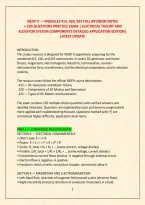
NEIEP II — MODULES 415, 420, 425 FULL REVISION NOTES
+ 250-QUESTIONS PRACTICE EXAM | ELECTRICAL THEORY AND
ELEVATOR SYSTEM COMPONENTS DETAILED APPLICATION EDITION|
LATEST UPDATE
INTRODUCTION
This study resource is designed for NEIEP II apprentices preparing for the
combined 415, 420, and 425 assessments. It covers DC generator and motor
theory, magnetism, electromagnetic induction, commutation, counter-
electromotive force, transformers, and the electrical components used in elevator
systems.
The revision notes follow the official NEIEP course descriptions:
415 — DC Generator and Motor Theory
420 — Components of DC Motors and Generators
425 — Types of DC Motors and Generators
The exam contains 250 multiple-choice questions with verified answers and
detailed rationales. Questions are organised by topic and become progressively
more applied and troubleshooting-focused. Questions marked with (*) are
considered higher-difficulty, application-level items.
PART 1 — CONDENSED REVISION NOTES
SECTION A — ELECTRICAL FUNDAMENTALS
• Ohm's Law: E = I × R
• Power: P = E × I = I² × R = E² / R
• Series: R_total = R₁ + R₂ + ... (same current, voltage divides)
• Parallel: 1/R_total = 1/R₁ + 1/R₂ + ... (same voltage, current divides)
• Conventional current flows positive → negative through external circuit.
• Electron flow is negative → positive.
• Insulators resist current; conductors (copper, aluminium) allow it.
SECTION B — MAGNETISM AND ELECTROMAGNETISM
• Left-Hand Rule: direction of magnetic field around a wire (electron flow).
• Right-Hand Rule (motors): direction of conductor movement in a field.
1
,• Electromagnetism: magnetism from current through a coil.
• Electromagnetic induction: moving a conductor through a magnetic field
induces
EMF. A conductor moving through a field results in reduced EMF.
SECTION C — DC GENERATOR THEORY (415)
• Armature: rotating coil where EMF is induced.
• Commutator: mechanical rectifier — converts AC to DC (commutation).
• Brushes: provide electrical connection to commutator.
• Riser: connects armature coil ends to commutator.
• Pole pieces: made of laminations to reduce eddy currents.
• Slip rings: electrical connection for elementary generator output.
• More loops → reduced ripple. More turns per coil → increased voltage.
• Neutral plane: points where zero voltage is induced.
• Armature reaction shifts the neutral plane (direction of rotation in generators).
• Interpoles counteract armature reaction and reduce brush sparking.
SECTION D — DC MOTOR THEORY (420, 425)
• CEMF (counter-electromotive force): inherent current limiter in a rotating
armature; opposes applied EMF. More turns → more CEMF.
• Series motor: few turns of heavy wire; high starting torque, poor speed
regulation.
• Shunt motor: many turns of fine wire; good speed regulation.
• Compound motor: both shunt and series fields.
• Ward-Leonard system: AC motor + DC generator + DC motor. Reversing
generator
field polarity reverses hoist motor. "Suicide circuit" = brake set but motor
tries to slip through.
• Regenerative braking: stored mechanical energy fed back into electrical lines.
SECTION E — DC MACHINE COMPONENTS (420)
• Commutator: passes current between brushes and windings; provides
switching;
turns with armature. Contains mica insulation between bars.
• Armature: wire-wound laminated core of rotating part.
• Brush rigging: must not drag across commutator when removing end bell.
• Coil pitch: number of slots between coil sides.
• End bell: supports brush rigging.
2
,• Main frame: made of electrical grade steel; holds windings.
• Pole piece: holds windings on DC motor.
• Bearing: common cause of grinding noise.
• Laminations: thin layers of iron/steel in pole pieces and cores.
SECTION F — ELEVATOR SYSTEM COMPONENTS AND TROUBLESHOOTING
• Governor: detects overspeed, triggers safety gear.
• Safety gear: mechanically stops car on guide rails.
• Buffers: absorb kinetic energy at travel limits.
• Door interlock: prevents door opening when car not at landing.
• Four-step troubleshooting: Analysis → Measurement → Conclusion →
Verification.
• Logic functions in relay control: power control, selector, call registration,
direction selection, starting/acceleration, stopping, door operation, call
cancellation.
• Common issues:
- DC machine grinding noise → bearing
- Voltage at generator but not motor armature → loop circuit open
- Three-phase motor hums but won't rotate → blown fuse or contactor pole
- Commutator sparking → armature reaction or brush misalignment
PART 2 — 250-QUESTION PRACTICE EXAM
SECTION 1 — ELECTRICAL FUNDAMENTALS AND OHM'S LAW (Questions 1–40)
1. What is the basic unit of electrical current?
A) Volt
B) Ohm
C) Ampere
D) Watt
Answer: C
Rationale: Electrical current is measured in amperes (A), describing the rate of
electric charge flow.
2. Which unit measures electrical potential difference?
A) Watt
B) Volt
C) Henry
3
, D) Coulomb
Answer: B
Rationale: Voltage (V) is the electrical potential difference that drives current
through a circuit.
3. Which unit is used to measure electrical resistance?
A) Ohm
B) Ampere
C) Watt-hour
D) Hertz
Answer: A
Rationale: Resistance, measured in ohms (Ω), describes opposition to current
flow.
4. Which statement best describes conventional current flow?
A) Flows from negative to positive through the external circuit
B) Flows from higher potential to lower potential through the external circuit
C) Always flows in one direction in every circuit
D) Flows only when resistance is zero
Answer: B
Rationale: Conventional current is defined as flowing from positive to negative
(higher to lower potential) through the external circuit.
5. What is the direction of electron current flow?
A) Positive to negative
B) Negative to positive
C) Always clockwise
D) Always counterclockwise
Answer: B
Rationale: Electron current flows from negative to positive, opposite to
conventional current.
6. What is the primary purpose of an electrical insulator?
A) To increase current continuously
B) To provide a low-resistance path
C) To resist the movement of electric charge
D) To convert AC into DC
Answer: C
4
+ 250-QUESTIONS PRACTICE EXAM | ELECTRICAL THEORY AND
ELEVATOR SYSTEM COMPONENTS DETAILED APPLICATION EDITION|
LATEST UPDATE
INTRODUCTION
This study resource is designed for NEIEP II apprentices preparing for the
combined 415, 420, and 425 assessments. It covers DC generator and motor
theory, magnetism, electromagnetic induction, commutation, counter-
electromotive force, transformers, and the electrical components used in elevator
systems.
The revision notes follow the official NEIEP course descriptions:
415 — DC Generator and Motor Theory
420 — Components of DC Motors and Generators
425 — Types of DC Motors and Generators
The exam contains 250 multiple-choice questions with verified answers and
detailed rationales. Questions are organised by topic and become progressively
more applied and troubleshooting-focused. Questions marked with (*) are
considered higher-difficulty, application-level items.
PART 1 — CONDENSED REVISION NOTES
SECTION A — ELECTRICAL FUNDAMENTALS
• Ohm's Law: E = I × R
• Power: P = E × I = I² × R = E² / R
• Series: R_total = R₁ + R₂ + ... (same current, voltage divides)
• Parallel: 1/R_total = 1/R₁ + 1/R₂ + ... (same voltage, current divides)
• Conventional current flows positive → negative through external circuit.
• Electron flow is negative → positive.
• Insulators resist current; conductors (copper, aluminium) allow it.
SECTION B — MAGNETISM AND ELECTROMAGNETISM
• Left-Hand Rule: direction of magnetic field around a wire (electron flow).
• Right-Hand Rule (motors): direction of conductor movement in a field.
1
,• Electromagnetism: magnetism from current through a coil.
• Electromagnetic induction: moving a conductor through a magnetic field
induces
EMF. A conductor moving through a field results in reduced EMF.
SECTION C — DC GENERATOR THEORY (415)
• Armature: rotating coil where EMF is induced.
• Commutator: mechanical rectifier — converts AC to DC (commutation).
• Brushes: provide electrical connection to commutator.
• Riser: connects armature coil ends to commutator.
• Pole pieces: made of laminations to reduce eddy currents.
• Slip rings: electrical connection for elementary generator output.
• More loops → reduced ripple. More turns per coil → increased voltage.
• Neutral plane: points where zero voltage is induced.
• Armature reaction shifts the neutral plane (direction of rotation in generators).
• Interpoles counteract armature reaction and reduce brush sparking.
SECTION D — DC MOTOR THEORY (420, 425)
• CEMF (counter-electromotive force): inherent current limiter in a rotating
armature; opposes applied EMF. More turns → more CEMF.
• Series motor: few turns of heavy wire; high starting torque, poor speed
regulation.
• Shunt motor: many turns of fine wire; good speed regulation.
• Compound motor: both shunt and series fields.
• Ward-Leonard system: AC motor + DC generator + DC motor. Reversing
generator
field polarity reverses hoist motor. "Suicide circuit" = brake set but motor
tries to slip through.
• Regenerative braking: stored mechanical energy fed back into electrical lines.
SECTION E — DC MACHINE COMPONENTS (420)
• Commutator: passes current between brushes and windings; provides
switching;
turns with armature. Contains mica insulation between bars.
• Armature: wire-wound laminated core of rotating part.
• Brush rigging: must not drag across commutator when removing end bell.
• Coil pitch: number of slots between coil sides.
• End bell: supports brush rigging.
2
,• Main frame: made of electrical grade steel; holds windings.
• Pole piece: holds windings on DC motor.
• Bearing: common cause of grinding noise.
• Laminations: thin layers of iron/steel in pole pieces and cores.
SECTION F — ELEVATOR SYSTEM COMPONENTS AND TROUBLESHOOTING
• Governor: detects overspeed, triggers safety gear.
• Safety gear: mechanically stops car on guide rails.
• Buffers: absorb kinetic energy at travel limits.
• Door interlock: prevents door opening when car not at landing.
• Four-step troubleshooting: Analysis → Measurement → Conclusion →
Verification.
• Logic functions in relay control: power control, selector, call registration,
direction selection, starting/acceleration, stopping, door operation, call
cancellation.
• Common issues:
- DC machine grinding noise → bearing
- Voltage at generator but not motor armature → loop circuit open
- Three-phase motor hums but won't rotate → blown fuse or contactor pole
- Commutator sparking → armature reaction or brush misalignment
PART 2 — 250-QUESTION PRACTICE EXAM
SECTION 1 — ELECTRICAL FUNDAMENTALS AND OHM'S LAW (Questions 1–40)
1. What is the basic unit of electrical current?
A) Volt
B) Ohm
C) Ampere
D) Watt
Answer: C
Rationale: Electrical current is measured in amperes (A), describing the rate of
electric charge flow.
2. Which unit measures electrical potential difference?
A) Watt
B) Volt
C) Henry
3
, D) Coulomb
Answer: B
Rationale: Voltage (V) is the electrical potential difference that drives current
through a circuit.
3. Which unit is used to measure electrical resistance?
A) Ohm
B) Ampere
C) Watt-hour
D) Hertz
Answer: A
Rationale: Resistance, measured in ohms (Ω), describes opposition to current
flow.
4. Which statement best describes conventional current flow?
A) Flows from negative to positive through the external circuit
B) Flows from higher potential to lower potential through the external circuit
C) Always flows in one direction in every circuit
D) Flows only when resistance is zero
Answer: B
Rationale: Conventional current is defined as flowing from positive to negative
(higher to lower potential) through the external circuit.
5. What is the direction of electron current flow?
A) Positive to negative
B) Negative to positive
C) Always clockwise
D) Always counterclockwise
Answer: B
Rationale: Electron current flows from negative to positive, opposite to
conventional current.
6. What is the primary purpose of an electrical insulator?
A) To increase current continuously
B) To provide a low-resistance path
C) To resist the movement of electric charge
D) To convert AC into DC
Answer: C
4


