
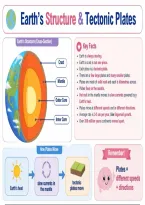
Earth’s Structure & Tectonic Plates
Earth’s Structure (Cross-Section)
Key Facts
Earth is always moving.
Crust Earth's crust is not one piece.
Each piece is a tectonic plate.
There are a few large plates and many smaller plates.
Mantle Plates are made of solid rock and each is kilometres across.
Plates float on the mantle.
Hot rock in the mantle moves in slow currents powered by y
Outer Core Earth's heat.
Plates move at different speeds and in different directions.
Average rate is 3-5 cm per year,
year, like fingernail growth.
Inner Core Over 200 million years continents moved apart.
How Plates Move
Remember!
Plates =
tectonic
different speeds
slow currents in
Earth’s heat the mantle plates move + directions
, Plate Movement & Volcanoes
DIVERGENT CONVERGENT TRANSFORM
plates move away plates move towards plates slide past
each other each other
magma rises to the crust one plate is pushed under the other example Pacific and
under the ocean the sea floor volcanoes are likely because molten North American plates at
spreads and an ocean ridge forms material from the sinking plate rises the San Andreas Fault
plates meet and lift mountains
if plates get stuck, pressure
A volcano
example is a type of mountain
South American and example builds, rocks break and pull
apart, causing an earthquake where lava, gas and
African plates Himalayas steam shoot out.
Magma is forced Volcanoes Hotspots:
Volcanoes through faults and helped form
regions with a lot of
joints in rock, erupts Earth, oceans,
form where rivers, lakes
volcanic activity;
onto Earth's surface,
plates meet and forms a mountain and the the mantle at
of ash, lava and cinders atmosphere hotspots is hotter.
Ring of Fire: a large number of earthquakes and
volcanic eruptions around the basin 👉 452 volcanoes 90% of Earth's
earthquakes
of the Pacific Ocean
Earth’s Structure (Cross-Section)
Key Facts
Earth is always moving.
Crust Earth's crust is not one piece.
Each piece is a tectonic plate.
There are a few large plates and many smaller plates.
Mantle Plates are made of solid rock and each is kilometres across.
Plates float on the mantle.
Hot rock in the mantle moves in slow currents powered by y
Outer Core Earth's heat.
Plates move at different speeds and in different directions.
Average rate is 3-5 cm per year,
year, like fingernail growth.
Inner Core Over 200 million years continents moved apart.
How Plates Move
Remember!
Plates =
tectonic
different speeds
slow currents in
Earth’s heat the mantle plates move + directions
, Plate Movement & Volcanoes
DIVERGENT CONVERGENT TRANSFORM
plates move away plates move towards plates slide past
each other each other
magma rises to the crust one plate is pushed under the other example Pacific and
under the ocean the sea floor volcanoes are likely because molten North American plates at
spreads and an ocean ridge forms material from the sinking plate rises the San Andreas Fault
plates meet and lift mountains
if plates get stuck, pressure
A volcano
example is a type of mountain
South American and example builds, rocks break and pull
apart, causing an earthquake where lava, gas and
African plates Himalayas steam shoot out.
Magma is forced Volcanoes Hotspots:
Volcanoes through faults and helped form
regions with a lot of
joints in rock, erupts Earth, oceans,
form where rivers, lakes
volcanic activity;
onto Earth's surface,
plates meet and forms a mountain and the the mantle at
of ash, lava and cinders atmosphere hotspots is hotter.
Ring of Fire: a large number of earthquakes and
volcanic eruptions around the basin 👉 452 volcanoes 90% of Earth's
earthquakes
of the Pacific Ocean


