
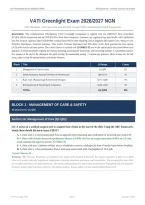
VATI Greenlight Exam 2026/2027 NGN 350 Questions - Verified Answers (A-Grade)
VATI Greenlight Exam 2026/2027 NGN
Full Test Bank - 350 Questions with Verified Answers (Next Generation NCLEX Integrated)
Instructions: This comprehensive 350-question VATI Greenlight examination is aligned with the 2026/2027 Next Generation
NCLEX (NGN) framework and the NCLEX-RN Client Need categories. Questions are organized into four blocks, each subdivided
into four sections. Question types include 80% scenario-based NGN items requiring clinical judgment (Recognize Cues, Analyze Cues,
Prioritize Hypotheses, Generate Solutions, Take Action, Evaluate Outcomes) and 20% direct recall. Each question has four options
(A-D) with exactly one best answer. The correct answer is marked with [CORRECT] next to the option and is also stated below each
question. A detailed rationale explains the clinical reasoning, prioritization framework, and test-taking strategy. A consolidated answer
key appears at the end of the document for rapid scoring. Recommended pacing: ~1 minute per question; allow 6 hours for the full
exam, taken in four 90-minute blocks with breaks between.
Block Title Q Range Count
1 Management of Care & Safety Q1-Q85 85
2 Health Promotion, Maternal-Newborn & Psychosocial Q86-Q170 85
3 Basic Care, Pharmacology & Parenteral Therapies Q171-Q260 90
4 Risk Reduction & Physiological Adaptation Q261-Q350 90
TOTAL Q1-Q350 350
BLOCK 1 - MANAGEMENT OF CARE & SAFETY
85 Questions | Q1-Q85
Section 1A: Management of Care (Q1-Q22)
Q1: A nurse on a medical-surgical unit is assigned four clients at the start of the shift. Using the ABC framework,
which client should the nurse assess FIRST?
A. A client who is 2 days postoperative from an appendectomy requesting pain medication for incisional pain rated 6/10
B. A client with chronic obstructive pulmonary disease (COPD) who has an oxygen saturation of 88% on 2 L/min
nasal cannula and appears anxious [CORRECT]
C. A client with type 1 diabetes mellitus who is scheduled to receive a sliding-scale dose of insulin lispro before breakfast
D. A client who is 1 day postoperative from a total knee replacement with a hemoglobin of 10.8 g/dL
Correct Answer: B
Rationale: ABC (Airway, Breathing, Circulation) is the highest prioritization framework. An oxygen saturation of 88% in a COPD
client with anxiety indicates respiratory compromise requiring immediate assessment and intervention. The postoperative pain client
(A) is stable and follows the pain framework. The insulin administration (C) and routine postoperative hemoglobin (D) are important
but lower priority than respiratory distress. Test-taking strategy: Always address airway and breathing threats first.
VATI Greenlight NGN Page 1 A-Grade Verified
,VATI Greenlight Exam 2026/2027 NGN 350 Questions - Verified Answers (A-Grade)
Q2: A registered nurse (RN) is delegating care for a team of clients on a medical unit. Which task is appropriate to
delegate to a licensed practical nurse (LPN)?
A. Developing the plan of care for a client with new-onset diabetic ketoacidosis
B. Initial admission assessment of a client transferred from the emergency department with chest pain
C. Reinforcement of discharge teaching for a client with newly diagnosed heart failure [CORRECT]
D. Titration of a continuous IV heparin drip based on activated partial thromboplastin time (aPTT)
Correct Answer: C
Rationale: The LPN scope of practice includes reinforcing teaching (already initiated by the RN), caring for stable clients, and
performing tasks within their educational preparation. Initial admission assessments (A), titration of high-alert medications like
heparin (C), and development of plans of care (D) require RN-level judgment and cannot be delegated to LPNs. Test-taking strategy:
LPN = stable clients, reinforce teaching, routine care; RN = unstable clients, initial assessment, complex teaching.
Q3: An RN is working with an unlicensed assistive personnel (UAP). Which task can the RN safely delegate to the
UAP?
A. Assessing a stage 2 pressure injury for signs of infection
B. Administering oral acetaminophen to a client with a mild headache
C. Measuring and recording vital signs on a stable client 1 day after an appendectomy [CORRECT]
D. Teaching a client about a low-sodium diet before discharge
Correct Answer: C
Rationale: UAPs can perform activities of daily living, take vital signs on stable clients, and provide basic hygiene and comfort
measures. Teaching (B), assessment (C), and medication administration (D) are outside the UAP scope and require nursing judgment.
The Five Rights of Delegation include right task, right circumstance, right person, right direction/communication, and right
supervision. Test-taking strategy: UAP = ADLs, vital signs on stable clients, ambulation, feeding; never assessment, teaching, or
medications.
Q4: A charge nurse is prioritizing care for four clients using Maslow's Hierarchy of Needs. Which client should
receive priority care?
A. A client who has not had a bowel movement in 3 days and reports abdominal discomfort [CORRECT]
B. A client who is requesting assistance to ambulate to the bathroom
C. A client who is scheduled for a diagnostic test in 2 hours
D. A client who is tearful after receiving a new diagnosis of breast cancer
Correct Answer: A
Rationale: Maslow's Hierarchy prioritizes physiological needs (elimination) above safety, love/belonging, esteem, and
self-actualization needs. The client with abdominal discomfort from constipation has an unmet physiological need (elimination).
Ambulation to the bathroom (C) is also physiological but less urgent. The emotional response to diagnosis (A) addresses psychosocial
needs (love/belonging and esteem). The scheduled diagnostic test (D) is a safety/logistical concern. Test-taking strategy: Physiological
needs come first, then safety, then psychosocial.
VATI Greenlight NGN Page 2 A-Grade Verified
,VATI Greenlight Exam 2026/2027 NGN 350 Questions - Verified Answers (A-Grade)
Q5: A nurse case manager is coordinating discharge planning for a client who had a stroke and requires ongoing
rehabilitation. Which action by the case manager demonstrates effective continuity of care?
A. Scheduling a follow-up appointment with the primary care provider 6 weeks after discharge
B. Communicating the client's functional status, current medications, and rehabilitation goals to the skilled nursing
facility before transfer [CORRECT]
C. Providing the client with a written list of medications and instructing them to call if they have questions
D. Notifying the insurance company that the client no longer requires acute care
Correct Answer: B
Rationale: Effective continuity of care requires communication of essential clinical information (functional status, medications, goals)
to the receiving facility to ensure seamless transitions. The case manager coordinates care across settings to prevent gaps, duplication,
and adverse events. Option A is too delayed, C does not ensure ongoing coordination, and D is administrative rather than
client-focused. Test-taking strategy: Continuity = seamless information transfer, ongoing coordination, and prevention of care gaps.
Q6: An RN is caring for a client who refuses a prescribed blood transfusion due to religious beliefs. Which action
by the nurse demonstrates client advocacy?
A. Asking the family to convince the client to accept the transfusion
B. Administering the transfusion anyway because it is in the client's best medical interest
C. Informing the client that the transfusion is medically necessary and they could die without it
D. Notifying the provider of the client's refusal, documenting the refusal, and supporting the client's autonomous
decision [CORRECT]
Correct Answer: D
Rationale: Client advocacy respects client autonomy and self-determination, even when the nurse disagrees with the decision. The
nurse must inform the provider, document the refusal, ensure the client understands the consequences (informed refusal), and continue
to support the client. Coercing the client (A, C) or overriding the refusal (D) violates autonomy and ethical principles. Test-taking
strategy: Advocacy = support autonomy, communicate with provider, document thoroughly, never coerce.
Q7: A nurse is using the SBAR communication tool to report a change in a client's condition to the provider.
Which statement by the nurse represents the 'A' (Assessment) component?
A. I would like you to come evaluate the client and consider ordering a lactate level and blood cultures.
B. The client is a 68-year-old admitted with community-acquired pneumonia.
C. The client's blood pressure has dropped from 124/78 to 92/56 mmHg in the last hour.
D. I think the client may be developing sepsis based on the vital sign changes and increasing confusion.
[CORRECT]
Correct Answer: D
Rationale: SBAR = Situation (current problem), Background (relevant history), Assessment (nurse's clinical judgment),
Recommendation (proposed action). Option C is the nurse's assessment, drawing a clinical conclusion from the data. Option A is
background, B is situation/data, and D is recommendation. Test-taking strategy: 'A' in SBAR = the nurse's professional clinical
judgment about what's happening.
VATI Greenlight NGN Page 3 A-Grade Verified
, VATI Greenlight Exam 2026/2027 NGN 350 Questions - Verified Answers (A-Grade)
Q8: A nurse is caring for four clients. Which client should the nurse assess FIRST using the 'least restrictive'
principle?
A. A client who requires soft wrist restraints to prevent self-extubation
B. A client who is agitated and has been prescribed PRN haloperidol
C. A client in 4-point leather restraints who is calm and requesting water [CORRECT]
D. A client who has a sitter and is trying to pull out their IV line
Correct Answer: C
Rationale: The least restrictive principle mandates that the nurse assess the client in the most restrictive intervention first to determine
if the restraint can be reduced or removed. A 4-point leather restraint is the most restrictive option listed. Restraints require ongoing
assessment, periodic release, and documentation of the least effective intervention. The agitated client requiring de-escalation (D)
should be addressed but is less restrictive than 4-point restraints. Test-taking strategy: When applying least restrictive, prioritize
assessing the most restrictive intervention first.
Q9: A new graduate nurse is assigned to care for a client with a chest tube. The nurse has not cared for a chest tube
since nursing school. Which action demonstrates professional accountability?
A. Care for the client using knowledge gained in nursing school without asking for help
B. Ask the UAP to monitor the chest tube drainage while the nurse focuses on other clients
C. Decline the assignment and request reassignment to a different client
D. Review the policy and procedure, consult with a more experienced nurse, and ask for assistance during the shift
[CORRECT]
Correct Answer: D
Rationale: Professional accountability includes recognizing one's own limitations, seeking education and consultation, and ensuring
safe care. Reviewing policies, consulting experienced colleagues, and asking for assistance demonstrates safe practice and lifelong
learning. Refusing the assignment entirely (A) does not address the learning need, providing care without support (C) endangers the
client, and delegating chest tube monitoring to a UAP (D) is inappropriate. Test-taking strategy: When uncertain, ask for help, review
policies, and consult experts.
Q10: A nurse is preparing to administer a medication when the pharmacy delivers a dose that looks different from
what the nurse has previously given. Which action should the nurse take FIRST?
A. Administer the medication and document it, then notify the provider if the client develops side effects
B. Hold the medication and verify the medication with the pharmacist before administration [CORRECT]
C. Ask the client if they recognize the medication and proceed if they do
D. Administer half the dose to assess for adverse reactions
Correct Answer: B
Rationale: The nurse should question any medication that looks different, following the 'right medication' verification process.
Holding the medication and verifying with the pharmacist ensures client safety. Administering an unrecognized medication (A) violates
safety, asking the client (C) is not a verification step, and splitting the dose (D) is outside the order. Test-taking strategy: When in
doubt about a medication, hold and verify - never administer an unfamiliar medication.
VATI Greenlight NGN Page 4 A-Grade Verified
VATI Greenlight Exam 2026/2027 NGN
Full Test Bank - 350 Questions with Verified Answers (Next Generation NCLEX Integrated)
Instructions: This comprehensive 350-question VATI Greenlight examination is aligned with the 2026/2027 Next Generation
NCLEX (NGN) framework and the NCLEX-RN Client Need categories. Questions are organized into four blocks, each subdivided
into four sections. Question types include 80% scenario-based NGN items requiring clinical judgment (Recognize Cues, Analyze Cues,
Prioritize Hypotheses, Generate Solutions, Take Action, Evaluate Outcomes) and 20% direct recall. Each question has four options
(A-D) with exactly one best answer. The correct answer is marked with [CORRECT] next to the option and is also stated below each
question. A detailed rationale explains the clinical reasoning, prioritization framework, and test-taking strategy. A consolidated answer
key appears at the end of the document for rapid scoring. Recommended pacing: ~1 minute per question; allow 6 hours for the full
exam, taken in four 90-minute blocks with breaks between.
Block Title Q Range Count
1 Management of Care & Safety Q1-Q85 85
2 Health Promotion, Maternal-Newborn & Psychosocial Q86-Q170 85
3 Basic Care, Pharmacology & Parenteral Therapies Q171-Q260 90
4 Risk Reduction & Physiological Adaptation Q261-Q350 90
TOTAL Q1-Q350 350
BLOCK 1 - MANAGEMENT OF CARE & SAFETY
85 Questions | Q1-Q85
Section 1A: Management of Care (Q1-Q22)
Q1: A nurse on a medical-surgical unit is assigned four clients at the start of the shift. Using the ABC framework,
which client should the nurse assess FIRST?
A. A client who is 2 days postoperative from an appendectomy requesting pain medication for incisional pain rated 6/10
B. A client with chronic obstructive pulmonary disease (COPD) who has an oxygen saturation of 88% on 2 L/min
nasal cannula and appears anxious [CORRECT]
C. A client with type 1 diabetes mellitus who is scheduled to receive a sliding-scale dose of insulin lispro before breakfast
D. A client who is 1 day postoperative from a total knee replacement with a hemoglobin of 10.8 g/dL
Correct Answer: B
Rationale: ABC (Airway, Breathing, Circulation) is the highest prioritization framework. An oxygen saturation of 88% in a COPD
client with anxiety indicates respiratory compromise requiring immediate assessment and intervention. The postoperative pain client
(A) is stable and follows the pain framework. The insulin administration (C) and routine postoperative hemoglobin (D) are important
but lower priority than respiratory distress. Test-taking strategy: Always address airway and breathing threats first.
VATI Greenlight NGN Page 1 A-Grade Verified
,VATI Greenlight Exam 2026/2027 NGN 350 Questions - Verified Answers (A-Grade)
Q2: A registered nurse (RN) is delegating care for a team of clients on a medical unit. Which task is appropriate to
delegate to a licensed practical nurse (LPN)?
A. Developing the plan of care for a client with new-onset diabetic ketoacidosis
B. Initial admission assessment of a client transferred from the emergency department with chest pain
C. Reinforcement of discharge teaching for a client with newly diagnosed heart failure [CORRECT]
D. Titration of a continuous IV heparin drip based on activated partial thromboplastin time (aPTT)
Correct Answer: C
Rationale: The LPN scope of practice includes reinforcing teaching (already initiated by the RN), caring for stable clients, and
performing tasks within their educational preparation. Initial admission assessments (A), titration of high-alert medications like
heparin (C), and development of plans of care (D) require RN-level judgment and cannot be delegated to LPNs. Test-taking strategy:
LPN = stable clients, reinforce teaching, routine care; RN = unstable clients, initial assessment, complex teaching.
Q3: An RN is working with an unlicensed assistive personnel (UAP). Which task can the RN safely delegate to the
UAP?
A. Assessing a stage 2 pressure injury for signs of infection
B. Administering oral acetaminophen to a client with a mild headache
C. Measuring and recording vital signs on a stable client 1 day after an appendectomy [CORRECT]
D. Teaching a client about a low-sodium diet before discharge
Correct Answer: C
Rationale: UAPs can perform activities of daily living, take vital signs on stable clients, and provide basic hygiene and comfort
measures. Teaching (B), assessment (C), and medication administration (D) are outside the UAP scope and require nursing judgment.
The Five Rights of Delegation include right task, right circumstance, right person, right direction/communication, and right
supervision. Test-taking strategy: UAP = ADLs, vital signs on stable clients, ambulation, feeding; never assessment, teaching, or
medications.
Q4: A charge nurse is prioritizing care for four clients using Maslow's Hierarchy of Needs. Which client should
receive priority care?
A. A client who has not had a bowel movement in 3 days and reports abdominal discomfort [CORRECT]
B. A client who is requesting assistance to ambulate to the bathroom
C. A client who is scheduled for a diagnostic test in 2 hours
D. A client who is tearful after receiving a new diagnosis of breast cancer
Correct Answer: A
Rationale: Maslow's Hierarchy prioritizes physiological needs (elimination) above safety, love/belonging, esteem, and
self-actualization needs. The client with abdominal discomfort from constipation has an unmet physiological need (elimination).
Ambulation to the bathroom (C) is also physiological but less urgent. The emotional response to diagnosis (A) addresses psychosocial
needs (love/belonging and esteem). The scheduled diagnostic test (D) is a safety/logistical concern. Test-taking strategy: Physiological
needs come first, then safety, then psychosocial.
VATI Greenlight NGN Page 2 A-Grade Verified
,VATI Greenlight Exam 2026/2027 NGN 350 Questions - Verified Answers (A-Grade)
Q5: A nurse case manager is coordinating discharge planning for a client who had a stroke and requires ongoing
rehabilitation. Which action by the case manager demonstrates effective continuity of care?
A. Scheduling a follow-up appointment with the primary care provider 6 weeks after discharge
B. Communicating the client's functional status, current medications, and rehabilitation goals to the skilled nursing
facility before transfer [CORRECT]
C. Providing the client with a written list of medications and instructing them to call if they have questions
D. Notifying the insurance company that the client no longer requires acute care
Correct Answer: B
Rationale: Effective continuity of care requires communication of essential clinical information (functional status, medications, goals)
to the receiving facility to ensure seamless transitions. The case manager coordinates care across settings to prevent gaps, duplication,
and adverse events. Option A is too delayed, C does not ensure ongoing coordination, and D is administrative rather than
client-focused. Test-taking strategy: Continuity = seamless information transfer, ongoing coordination, and prevention of care gaps.
Q6: An RN is caring for a client who refuses a prescribed blood transfusion due to religious beliefs. Which action
by the nurse demonstrates client advocacy?
A. Asking the family to convince the client to accept the transfusion
B. Administering the transfusion anyway because it is in the client's best medical interest
C. Informing the client that the transfusion is medically necessary and they could die without it
D. Notifying the provider of the client's refusal, documenting the refusal, and supporting the client's autonomous
decision [CORRECT]
Correct Answer: D
Rationale: Client advocacy respects client autonomy and self-determination, even when the nurse disagrees with the decision. The
nurse must inform the provider, document the refusal, ensure the client understands the consequences (informed refusal), and continue
to support the client. Coercing the client (A, C) or overriding the refusal (D) violates autonomy and ethical principles. Test-taking
strategy: Advocacy = support autonomy, communicate with provider, document thoroughly, never coerce.
Q7: A nurse is using the SBAR communication tool to report a change in a client's condition to the provider.
Which statement by the nurse represents the 'A' (Assessment) component?
A. I would like you to come evaluate the client and consider ordering a lactate level and blood cultures.
B. The client is a 68-year-old admitted with community-acquired pneumonia.
C. The client's blood pressure has dropped from 124/78 to 92/56 mmHg in the last hour.
D. I think the client may be developing sepsis based on the vital sign changes and increasing confusion.
[CORRECT]
Correct Answer: D
Rationale: SBAR = Situation (current problem), Background (relevant history), Assessment (nurse's clinical judgment),
Recommendation (proposed action). Option C is the nurse's assessment, drawing a clinical conclusion from the data. Option A is
background, B is situation/data, and D is recommendation. Test-taking strategy: 'A' in SBAR = the nurse's professional clinical
judgment about what's happening.
VATI Greenlight NGN Page 3 A-Grade Verified
, VATI Greenlight Exam 2026/2027 NGN 350 Questions - Verified Answers (A-Grade)
Q8: A nurse is caring for four clients. Which client should the nurse assess FIRST using the 'least restrictive'
principle?
A. A client who requires soft wrist restraints to prevent self-extubation
B. A client who is agitated and has been prescribed PRN haloperidol
C. A client in 4-point leather restraints who is calm and requesting water [CORRECT]
D. A client who has a sitter and is trying to pull out their IV line
Correct Answer: C
Rationale: The least restrictive principle mandates that the nurse assess the client in the most restrictive intervention first to determine
if the restraint can be reduced or removed. A 4-point leather restraint is the most restrictive option listed. Restraints require ongoing
assessment, periodic release, and documentation of the least effective intervention. The agitated client requiring de-escalation (D)
should be addressed but is less restrictive than 4-point restraints. Test-taking strategy: When applying least restrictive, prioritize
assessing the most restrictive intervention first.
Q9: A new graduate nurse is assigned to care for a client with a chest tube. The nurse has not cared for a chest tube
since nursing school. Which action demonstrates professional accountability?
A. Care for the client using knowledge gained in nursing school without asking for help
B. Ask the UAP to monitor the chest tube drainage while the nurse focuses on other clients
C. Decline the assignment and request reassignment to a different client
D. Review the policy and procedure, consult with a more experienced nurse, and ask for assistance during the shift
[CORRECT]
Correct Answer: D
Rationale: Professional accountability includes recognizing one's own limitations, seeking education and consultation, and ensuring
safe care. Reviewing policies, consulting experienced colleagues, and asking for assistance demonstrates safe practice and lifelong
learning. Refusing the assignment entirely (A) does not address the learning need, providing care without support (C) endangers the
client, and delegating chest tube monitoring to a UAP (D) is inappropriate. Test-taking strategy: When uncertain, ask for help, review
policies, and consult experts.
Q10: A nurse is preparing to administer a medication when the pharmacy delivers a dose that looks different from
what the nurse has previously given. Which action should the nurse take FIRST?
A. Administer the medication and document it, then notify the provider if the client develops side effects
B. Hold the medication and verify the medication with the pharmacist before administration [CORRECT]
C. Ask the client if they recognize the medication and proceed if they do
D. Administer half the dose to assess for adverse reactions
Correct Answer: B
Rationale: The nurse should question any medication that looks different, following the 'right medication' verification process.
Holding the medication and verifying with the pharmacist ensures client safety. Administering an unrecognized medication (A) violates
safety, asking the client (C) is not a verification step, and splitting the dose (D) is outside the order. Test-taking strategy: When in
doubt about a medication, hold and verify - never administer an unfamiliar medication.
VATI Greenlight NGN Page 4 A-Grade Verified


