
DELICT NOTES
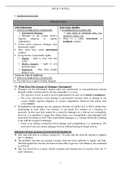
5. HARM (DAMAGES)
Delictual Claims
Actio Injuriarum Actio Legis Aquiliae
NON-PATRIMONIAL DAMAGES PATRIMONIAL DAMAGES
Sentimental Damages Any kind of financial loss, e.g.
Damages to the corpus (body), property, money, etc
dignitas (dignity) or reputas There is a either intentional or
(reputation) negligent conduct.
Action when someone infringes your
personality rights.
They must have acted intentional
conduct.
Everyone has 3 personality rights:
1. Dignity – right to your own self
worth
2. Bodily Integrity – right to you
personal space
3. Reputation – what other people
think of you
Action for Pain & Suffering
NON-PATRIMONIAL DAMAGES
You only have a right to bodily integrity
5.1. What Does The Concept of ‘Damages’ Encompass?
Damages are the detrimental impact upon any patrimonial or non-patrimonial interest
deemed worthy of protection by the law especially w.r.t. loss.
o The Aquilian Action is used to recover patrimonial loss and cover intent & negligence.
o The Actio injuriarum covers damage to personality interests such as damage to the
corpus (body), dignitas (dignity) or reputas (reputation). However this action only
covers intent.
Wrongfulness and damage are two separate elements of a delict & it is NB to define their
relationship to each other. For instance A can break B’s window in a situation of
necessity. In this case here cannot be a claim for damages as A did not act wrongfully;
however, it is pointless to argue that where there is no wrongfulness, then damages will
necessarily be absent as well. This would define damages i.t.o. criteria which have nothing
to do with the concept of damages.
o There is an indirect connection btwn damage and wrongfulness i.t.o. patrimony. We
must ask if you can sustain damages for loss suffered during an illegal activity.
Dhlamini v Protea Assurance Co Ltd 1974 (4) SA 906 (A)
Mrs. had sold fruit at a railway station for ~20 years and she used the income to support
her 11 children.
The problem was that you needed a licence from the local authority to legally sell fruit.
She had applied for a licence but had not been able to get one. Nevertheless, she continued
to sell fruit.
She was involved in a motor vehicle accident and claimed loss of income form the 3 rd
party insurance.
1
, DELICT NOTES
In a case like this we should draw a distinction btwn illegal acts and colourless acts
(which are not criminal or immoral).
o It is not the purpose of the law of delict to determine laws.
The crt ruled in favour of the respondent b/c there if the law had come to the assistance of
D, then the crt would have gone against NB public policy principles.
o This was whether the income was valid, notwithstanding the fact that it arose from an
illegal activity.
When one is dealing with colourless crimes, the question arises whether the legislature
intended income derived from illegal activities to be illegal as well.
o Public policy considerations need to be taken into account.
o In this case the issue of health was NB and here the legislature intended to maintain
health standards.
The judgement was problematic. The judge initially said that selling fruit without a
licence was not morally tainted but then contradicted himself when he compared it to
theft.
Samtam Insurance Ltd v Ferguson 1985 (4) SA 843 (A)
F was a panel beater but needed a licence, which he did not possess. The local authorities
were involved in zoning certain activities in specific areas. F, however, worked from
home and even visited peoples’ houses in order to work.
F was injured in a motor vehicle accident and claimed loss of support.
S.I. claimed that the income was illegal b/c he didn’t possess a licence.
Following Dhlamini v Protea Assurance, the crt decided that the income was illegal b/c
the activity was illegal. In order to award damages the crt would have to regard the illegal
income, which for policy reasons, it cannot do.
An activity is illegal/unlawful when it:
a) Contravenes criminal law.
b) Is against public policy considerations
c) Is forbidden by statute.
o This one can be problematic when a statute is not express.
o In such cases, the statute and public policy need to be interpreted
There are 3 possible ways for a claimant (mainly a dependent) to recover damages
i.t.o. an illegal activity.
1. Put emphasis on loss of earning capacity, as opposed to lack of actual income.
2. Consider whether the income is enforceable by the injured party himself (i.e.
owner of an illegal taxi business is still liable for the salaries of his employees).
3. If there are no public policy considerations indicating that the income itself should
be tainted with illegality.
What is the scope of damages?
We can only recover damages for uncertain events.
We can only recover perspective loss.
The Law of Delict has a compensatory function which may take the following forms:
a) Compensation for Damage – monetary compensation awarded to a person to eliminate
his past as well as future patrimonial (and non-patrimonial) damage / loss.
o Money is intended as an equivalent of damage
b) Satisfaction – where damage / loss is incapable of being compensated b/c it is impossible
to ascertain the value of the infringement(s). It can imply the reparation of damage in the
2
, DELICT NOTES
form of injury to personality for forming retribution for the harm suffered by the plaintiff
and by satisfying his and/or society’s sense of justice.
o It is typically a sum of money awarded to the plaintiff in proportion to the wrong
inflicted on him.
5.2. Forms of Damage
5.2.1. Nature of Harm: Patrimonial (pecuniary) v non-Patrimonial (non-pecuniary) loss
Damage or loss must always be taken to include both types of loss.
The main point of agreement btwn patrimonial and non-patrimonial loss is that in both the
utility or quality of an interest of the plaintiff is infringed.
There are, however, many differences:
Patrimonial (Pecuniary) Loss Non-Patrimonial (Non-Pecuniary) Loss
Measurable in monetary terms At most is indirectly measured in
monetary terms.
Extent / quantity can be ascertained Quantity cannot be ascertained with
with greater precision. precision and can only be estimated.
Objective discrimination i.t.o. market Subjective discrimination b/c it relates
value, cost of repairs, etc. to subjective feelings.
Genuine equivalent for damage. No true relationship btwn damage and
compensation – (money and injury to
personality)
Utility of a patrimonial interest is Non-pecuniary damage
reduced.
Union Government (Minister of Railways & Harbours) v Warneke 1911 AD 657
The plaintiff’s wife was killed on the railways due to the negligence of the railway
company.
The husband instituted a claim for:
1. Loss of the comfort and society of his wife (non-patrimonial loss)
2. Loss of assistance of his wife in bringing up his children. (patrimonial loss)
W.r.t. the 1st claim, the crt ruled that W cannot claim damages for this non-patrimonial
loss b/c in this case the loss had been due to negligence and not intent which is needed for
an Actio injuriarum.
W.r.t. the 2nd claim, the crt ruled that it would be possible quantify this b/c it was a
patrimonial loss and negligence fall under the scope of the Aquilian action.
You can’t use the lex Aquilia for the recovery of damages to feelings.
o This gives the idea that feelings are excluded from the law – which is a patriarchal
viewpoint.
5.2.2. Damnum emergens / lucrum cessans
Damnum emergens – is patrimonial loss suffered up to the date of the trial.
o I.e. damage so far emerged
Lucrum cessans – loss of profit, looking to the future.
o Also describes prospective patrimonial loss.
5.2.3. Pure Economic (‘Financial’) Loss – later section
This is damage that does not arise from injury to personality or corporeal property.
o E.g. if you lose out in a business opportunity.
This can also be damage to corporeal property or injury to personality but where it is not
the plaintiff’s property or the defendant did not cause the damage or loss.
3
, DELICT NOTES
5.2.4. Direct / consequential loss – from English Law
Direct and consequential losses are distinguished for the purpose of limitation of liability
(remoteness of damage).
Damages for consequential loss may be denied if the loss is considered to be ‘too remote.’
o In terms of one view direct loss means the immediate or natural consequence(s) of a
damage-causing event,
o Consequential loss is damage that flows from the direct loss.
5.2.5. General (intrinsic) & Special (extrinsic) Damages
In SA law these are applicable in the Action for Pain and Suffering.
o delictual liability for bodily injuries arise w.r.t. negligence only.
General Damages:
a) Non-patrimonial damages loss such as pain and suffering, loss of amenities of life.
b) Prospective patrimonial loss
Special Damages:
o Patrimonial damages up to the date of the trial.
5.2.6. Constitutional Damages
This has to do with the infringement of Constitutional rights.
The crts must bear the Constitution in mind when deciding on an appropriate remedy.
o S173 Inherent Power of the Crts to develop the law taking into account the interests of
justice.
In this case you would normally claim compensation and then damages would be seen as a
secondary remedy.
President of the RSA v Modderklip Boerdery (Pty) Ltd 2005 (5) SA 3 (CC)
MB owned a farm which had ~ 80 000 squatters living on it.
The Government refused to remove the squatters b/c it argued that the squatters had a
right to housing and there was no place to relocate them.
The SCA ruled that MB should be compensated for damages b/c of the loss suffered by
the occupation of his land.
The CC confirmed the SCA’s decision and ruled that the awarding of Constitutional
damages was necessary to vindicate MB’s rights which hah been infringed.
Dendy v University of the Witwatersrand 2005 (5) SA 357 (W)
D applied to become a chair of law and went through the whole procedure; however,
everyone but him was appointed.
D instituted an action for Constitutional Damages where his argument was based on the
Actio Iniuriarum.
o D had to prove an infringement of his dignitus.
o He argued that his s33 (Just Administrative Action) Constitutional Rights had been
infringe.
He then argued that this had infringed his s10 Right to Human Dignity among other
Constitutional rights.
He was asking the crt to develop the Actio Iniuriarum (in accordance with s173) so that
the infringement of Constitutional rights would be recognised.
o This was b/c the Actio Iniuriarum in the common law did not include the concept of
Constitutional Rights, so D wanted this changed so that he could claim damages.
4
5. HARM (DAMAGES)
Delictual Claims
Actio Injuriarum Actio Legis Aquiliae
NON-PATRIMONIAL DAMAGES PATRIMONIAL DAMAGES
Sentimental Damages Any kind of financial loss, e.g.
Damages to the corpus (body), property, money, etc
dignitas (dignity) or reputas There is a either intentional or
(reputation) negligent conduct.
Action when someone infringes your
personality rights.
They must have acted intentional
conduct.
Everyone has 3 personality rights:
1. Dignity – right to your own self
worth
2. Bodily Integrity – right to you
personal space
3. Reputation – what other people
think of you
Action for Pain & Suffering
NON-PATRIMONIAL DAMAGES
You only have a right to bodily integrity
5.1. What Does The Concept of ‘Damages’ Encompass?
Damages are the detrimental impact upon any patrimonial or non-patrimonial interest
deemed worthy of protection by the law especially w.r.t. loss.
o The Aquilian Action is used to recover patrimonial loss and cover intent & negligence.
o The Actio injuriarum covers damage to personality interests such as damage to the
corpus (body), dignitas (dignity) or reputas (reputation). However this action only
covers intent.
Wrongfulness and damage are two separate elements of a delict & it is NB to define their
relationship to each other. For instance A can break B’s window in a situation of
necessity. In this case here cannot be a claim for damages as A did not act wrongfully;
however, it is pointless to argue that where there is no wrongfulness, then damages will
necessarily be absent as well. This would define damages i.t.o. criteria which have nothing
to do with the concept of damages.
o There is an indirect connection btwn damage and wrongfulness i.t.o. patrimony. We
must ask if you can sustain damages for loss suffered during an illegal activity.
Dhlamini v Protea Assurance Co Ltd 1974 (4) SA 906 (A)
Mrs. had sold fruit at a railway station for ~20 years and she used the income to support
her 11 children.
The problem was that you needed a licence from the local authority to legally sell fruit.
She had applied for a licence but had not been able to get one. Nevertheless, she continued
to sell fruit.
She was involved in a motor vehicle accident and claimed loss of income form the 3 rd
party insurance.
1
, DELICT NOTES
In a case like this we should draw a distinction btwn illegal acts and colourless acts
(which are not criminal or immoral).
o It is not the purpose of the law of delict to determine laws.
The crt ruled in favour of the respondent b/c there if the law had come to the assistance of
D, then the crt would have gone against NB public policy principles.
o This was whether the income was valid, notwithstanding the fact that it arose from an
illegal activity.
When one is dealing with colourless crimes, the question arises whether the legislature
intended income derived from illegal activities to be illegal as well.
o Public policy considerations need to be taken into account.
o In this case the issue of health was NB and here the legislature intended to maintain
health standards.
The judgement was problematic. The judge initially said that selling fruit without a
licence was not morally tainted but then contradicted himself when he compared it to
theft.
Samtam Insurance Ltd v Ferguson 1985 (4) SA 843 (A)
F was a panel beater but needed a licence, which he did not possess. The local authorities
were involved in zoning certain activities in specific areas. F, however, worked from
home and even visited peoples’ houses in order to work.
F was injured in a motor vehicle accident and claimed loss of support.
S.I. claimed that the income was illegal b/c he didn’t possess a licence.
Following Dhlamini v Protea Assurance, the crt decided that the income was illegal b/c
the activity was illegal. In order to award damages the crt would have to regard the illegal
income, which for policy reasons, it cannot do.
An activity is illegal/unlawful when it:
a) Contravenes criminal law.
b) Is against public policy considerations
c) Is forbidden by statute.
o This one can be problematic when a statute is not express.
o In such cases, the statute and public policy need to be interpreted
There are 3 possible ways for a claimant (mainly a dependent) to recover damages
i.t.o. an illegal activity.
1. Put emphasis on loss of earning capacity, as opposed to lack of actual income.
2. Consider whether the income is enforceable by the injured party himself (i.e.
owner of an illegal taxi business is still liable for the salaries of his employees).
3. If there are no public policy considerations indicating that the income itself should
be tainted with illegality.
What is the scope of damages?
We can only recover damages for uncertain events.
We can only recover perspective loss.
The Law of Delict has a compensatory function which may take the following forms:
a) Compensation for Damage – monetary compensation awarded to a person to eliminate
his past as well as future patrimonial (and non-patrimonial) damage / loss.
o Money is intended as an equivalent of damage
b) Satisfaction – where damage / loss is incapable of being compensated b/c it is impossible
to ascertain the value of the infringement(s). It can imply the reparation of damage in the
2
, DELICT NOTES
form of injury to personality for forming retribution for the harm suffered by the plaintiff
and by satisfying his and/or society’s sense of justice.
o It is typically a sum of money awarded to the plaintiff in proportion to the wrong
inflicted on him.
5.2. Forms of Damage
5.2.1. Nature of Harm: Patrimonial (pecuniary) v non-Patrimonial (non-pecuniary) loss
Damage or loss must always be taken to include both types of loss.
The main point of agreement btwn patrimonial and non-patrimonial loss is that in both the
utility or quality of an interest of the plaintiff is infringed.
There are, however, many differences:
Patrimonial (Pecuniary) Loss Non-Patrimonial (Non-Pecuniary) Loss
Measurable in monetary terms At most is indirectly measured in
monetary terms.
Extent / quantity can be ascertained Quantity cannot be ascertained with
with greater precision. precision and can only be estimated.
Objective discrimination i.t.o. market Subjective discrimination b/c it relates
value, cost of repairs, etc. to subjective feelings.
Genuine equivalent for damage. No true relationship btwn damage and
compensation – (money and injury to
personality)
Utility of a patrimonial interest is Non-pecuniary damage
reduced.
Union Government (Minister of Railways & Harbours) v Warneke 1911 AD 657
The plaintiff’s wife was killed on the railways due to the negligence of the railway
company.
The husband instituted a claim for:
1. Loss of the comfort and society of his wife (non-patrimonial loss)
2. Loss of assistance of his wife in bringing up his children. (patrimonial loss)
W.r.t. the 1st claim, the crt ruled that W cannot claim damages for this non-patrimonial
loss b/c in this case the loss had been due to negligence and not intent which is needed for
an Actio injuriarum.
W.r.t. the 2nd claim, the crt ruled that it would be possible quantify this b/c it was a
patrimonial loss and negligence fall under the scope of the Aquilian action.
You can’t use the lex Aquilia for the recovery of damages to feelings.
o This gives the idea that feelings are excluded from the law – which is a patriarchal
viewpoint.
5.2.2. Damnum emergens / lucrum cessans
Damnum emergens – is patrimonial loss suffered up to the date of the trial.
o I.e. damage so far emerged
Lucrum cessans – loss of profit, looking to the future.
o Also describes prospective patrimonial loss.
5.2.3. Pure Economic (‘Financial’) Loss – later section
This is damage that does not arise from injury to personality or corporeal property.
o E.g. if you lose out in a business opportunity.
This can also be damage to corporeal property or injury to personality but where it is not
the plaintiff’s property or the defendant did not cause the damage or loss.
3
, DELICT NOTES
5.2.4. Direct / consequential loss – from English Law
Direct and consequential losses are distinguished for the purpose of limitation of liability
(remoteness of damage).
Damages for consequential loss may be denied if the loss is considered to be ‘too remote.’
o In terms of one view direct loss means the immediate or natural consequence(s) of a
damage-causing event,
o Consequential loss is damage that flows from the direct loss.
5.2.5. General (intrinsic) & Special (extrinsic) Damages
In SA law these are applicable in the Action for Pain and Suffering.
o delictual liability for bodily injuries arise w.r.t. negligence only.
General Damages:
a) Non-patrimonial damages loss such as pain and suffering, loss of amenities of life.
b) Prospective patrimonial loss
Special Damages:
o Patrimonial damages up to the date of the trial.
5.2.6. Constitutional Damages
This has to do with the infringement of Constitutional rights.
The crts must bear the Constitution in mind when deciding on an appropriate remedy.
o S173 Inherent Power of the Crts to develop the law taking into account the interests of
justice.
In this case you would normally claim compensation and then damages would be seen as a
secondary remedy.
President of the RSA v Modderklip Boerdery (Pty) Ltd 2005 (5) SA 3 (CC)
MB owned a farm which had ~ 80 000 squatters living on it.
The Government refused to remove the squatters b/c it argued that the squatters had a
right to housing and there was no place to relocate them.
The SCA ruled that MB should be compensated for damages b/c of the loss suffered by
the occupation of his land.
The CC confirmed the SCA’s decision and ruled that the awarding of Constitutional
damages was necessary to vindicate MB’s rights which hah been infringed.
Dendy v University of the Witwatersrand 2005 (5) SA 357 (W)
D applied to become a chair of law and went through the whole procedure; however,
everyone but him was appointed.
D instituted an action for Constitutional Damages where his argument was based on the
Actio Iniuriarum.
o D had to prove an infringement of his dignitus.
o He argued that his s33 (Just Administrative Action) Constitutional Rights had been
infringe.
He then argued that this had infringed his s10 Right to Human Dignity among other
Constitutional rights.
He was asking the crt to develop the Actio Iniuriarum (in accordance with s173) so that
the infringement of Constitutional rights would be recognised.
o This was b/c the Actio Iniuriarum in the common law did not include the concept of
Constitutional Rights, so D wanted this changed so that he could claim damages.
4


