[STUDY GUIDE] • HIGH-YIELD PRACTICE & REVIEW EDITION
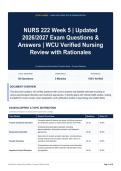
NURS 222 Week 5 | Updated
2026/2027 Exam Questions &
Answers | WCU Verified Nursing
Review with Rationales
Comprehensive Examination Question Bank • Concept Mapping
TOTAL QUESTIONS EXAM TOPICS RATIONALES
120 Questions 5 Modules 100% Verified
DOCUMENT OVERVIEW
This document contains 120 verified questions with correct answers and detailed rationales focusing on
various psychological disorders and treatment approaches. It directly aligns with mental health studies, making
it suitable for course review, exam preparation, and certification studies in psychology and related fields.
EXAM BLUEPRINT & TOPIC DISTRIBUTION
Systematic breakdown of subject domains and exam coverage.
Topic Module Scope & Core Focus Questions Share (%)
Concepts related to trauma and stress, including symptoms
Trauma and Stress Disorders and treatment options for acute stress disorder and PTSD. 24 Qs 20.0%
Understanding dissociative disorders, including
depersonalization, dissociative amnesia, and treatment
Dissociative Disorders approaches. 24 Qs 20.0%
Exploration of somatic symptom disorders, including illness
anxiety disorder and conversion disorder, with a focus on
Somatic Disorders symptoms and treatment. 24 Qs 20.0%
Characteristics and treatment of impulsive control disorders,
including oppositional defiant disorder and disruptive mood
Impulsive Control Disorders dysregulation. 24 Qs 20.0%
Confidential • Student Study Edition • Practice & Review Guide Page 1 of 39
,STUDENT STUDY & MASTERY EDITION PRACTICE & REVIEW GUIDE
Investigation of neurodevelopmental disorders like ADHD and
autism spectrum disorder, focusing on symptoms and
Neurodevelopmental Disorders educational strategies. 24 Qs 20.0%
Total Exam Coverage 5 Integrated Topic Modules 120 Qs 100.0%
Confidential • Student Study Edition • Practice & Review Guide Page 2 of 39
,STUDENT STUDY & MASTERY EDITION PRACTICE & REVIEW GUIDE
TOPIC 1: TRAUMA AND STRESS DISORDERS
24 Questions • 20.0% of Exam • Concepts related to trauma and stress, including symptoms and treatment options for acute stress
disorder and PTSD.
QUESTION 1
Trauma/Stress: Pts can develop trauma or stress related disorders when exposed to
Answer: Extreme stressors.
Rationale: Trauma and stress-related disorders arise from exposure to events that are inherently overwhelming and
threatening, exceeding an individual's capacity to cope. This principle highlights the dose-response relationship between
stressor severity and psychological impact.
QUESTION 2
Trauma/Stress: for healthcare staff, what can we do during the event
Answer: Prebrief
Triage pts.
Rationale: Prebriefing establishes expectations and provides a shared understanding of roles and procedures, while
triaging patients prioritizes care based on acuity, both of which are critical for organized and effective response during a
mass casualty incident. This addresses the principle of structured incident command and resource allocation under extreme
pressure.
QUESTION 3
Trauma/Stress: Acute stress disorder (ASD) S/S
Answer: Anxiety
Hyper vigilance
Nightmares/terrors.
Rationale: Acute stress disorder is characterized by intrusive symptoms like nightmares, hypervigilance, and intense
anxiety, reflecting the individual's psychological response to a traumatic event. These manifestations signify the body's
heightened state of arousal and distress following exposure to a significant stressor.
Confidential • Student Study Edition • Practice & Review Guide Page 3 of 39
, STUDENT STUDY & MASTERY EDITION PRACTICE & REVIEW GUIDE
QUESTION 4
Trauma/Stress: Acute stress disorder How long does this last
Answer: 3 Days > up to 1 month.
Rationale: Acute stress disorder is characterized by symptoms that begin within one month of a traumatic event and persist
for at least three days, but not longer than one month. This temporal criterion differentiates it from post-traumatic stress
disorder (PTSD).
QUESTION 5
Trauma/Stress: Post traumatic stress disorder (PTSD) how long does this last
Answer: Depends on pts high stress levels
1 month > possibly rest of life.
Rationale: PTSD symptom duration is highly variable, influenced by individual stress responses and treatment, and can
persist from a month to a lifetime. The key concept tested is the chronicity and variability of post-traumatic stress disorder
symptoms.
QUESTION 6
Trauma/Stress: Adjustment disorder
Answer: Stressors trigger a change in mood/dysfunction in usual activities Less severe compared to
ASD/PTSD.
Rationale: Adjustment disorder is characterized by emotional or behavioral symptoms that arise in response to an
identifiable stressor, causing significant distress and functional impairment but not meeting the full criteria for acute stress
disorder or PTSD. The key concept tested is the differential diagnosis of stress-related disorders based on symptom severity
and diagnostic threshold.
Confidential • Student Study Edition • Practice & Review Guide Page 4 of 39
NURS 222 Week 5 | Updated
2026/2027 Exam Questions &
Answers | WCU Verified Nursing
Review with Rationales
Comprehensive Examination Question Bank • Concept Mapping
TOTAL QUESTIONS EXAM TOPICS RATIONALES
120 Questions 5 Modules 100% Verified
DOCUMENT OVERVIEW
This document contains 120 verified questions with correct answers and detailed rationales focusing on
various psychological disorders and treatment approaches. It directly aligns with mental health studies, making
it suitable for course review, exam preparation, and certification studies in psychology and related fields.
EXAM BLUEPRINT & TOPIC DISTRIBUTION
Systematic breakdown of subject domains and exam coverage.
Topic Module Scope & Core Focus Questions Share (%)
Concepts related to trauma and stress, including symptoms
Trauma and Stress Disorders and treatment options for acute stress disorder and PTSD. 24 Qs 20.0%
Understanding dissociative disorders, including
depersonalization, dissociative amnesia, and treatment
Dissociative Disorders approaches. 24 Qs 20.0%
Exploration of somatic symptom disorders, including illness
anxiety disorder and conversion disorder, with a focus on
Somatic Disorders symptoms and treatment. 24 Qs 20.0%
Characteristics and treatment of impulsive control disorders,
including oppositional defiant disorder and disruptive mood
Impulsive Control Disorders dysregulation. 24 Qs 20.0%
Confidential • Student Study Edition • Practice & Review Guide Page 1 of 39
,STUDENT STUDY & MASTERY EDITION PRACTICE & REVIEW GUIDE
Investigation of neurodevelopmental disorders like ADHD and
autism spectrum disorder, focusing on symptoms and
Neurodevelopmental Disorders educational strategies. 24 Qs 20.0%
Total Exam Coverage 5 Integrated Topic Modules 120 Qs 100.0%
Confidential • Student Study Edition • Practice & Review Guide Page 2 of 39
,STUDENT STUDY & MASTERY EDITION PRACTICE & REVIEW GUIDE
TOPIC 1: TRAUMA AND STRESS DISORDERS
24 Questions • 20.0% of Exam • Concepts related to trauma and stress, including symptoms and treatment options for acute stress
disorder and PTSD.
QUESTION 1
Trauma/Stress: Pts can develop trauma or stress related disorders when exposed to
Answer: Extreme stressors.
Rationale: Trauma and stress-related disorders arise from exposure to events that are inherently overwhelming and
threatening, exceeding an individual's capacity to cope. This principle highlights the dose-response relationship between
stressor severity and psychological impact.
QUESTION 2
Trauma/Stress: for healthcare staff, what can we do during the event
Answer: Prebrief
Triage pts.
Rationale: Prebriefing establishes expectations and provides a shared understanding of roles and procedures, while
triaging patients prioritizes care based on acuity, both of which are critical for organized and effective response during a
mass casualty incident. This addresses the principle of structured incident command and resource allocation under extreme
pressure.
QUESTION 3
Trauma/Stress: Acute stress disorder (ASD) S/S
Answer: Anxiety
Hyper vigilance
Nightmares/terrors.
Rationale: Acute stress disorder is characterized by intrusive symptoms like nightmares, hypervigilance, and intense
anxiety, reflecting the individual's psychological response to a traumatic event. These manifestations signify the body's
heightened state of arousal and distress following exposure to a significant stressor.
Confidential • Student Study Edition • Practice & Review Guide Page 3 of 39
, STUDENT STUDY & MASTERY EDITION PRACTICE & REVIEW GUIDE
QUESTION 4
Trauma/Stress: Acute stress disorder How long does this last
Answer: 3 Days > up to 1 month.
Rationale: Acute stress disorder is characterized by symptoms that begin within one month of a traumatic event and persist
for at least three days, but not longer than one month. This temporal criterion differentiates it from post-traumatic stress
disorder (PTSD).
QUESTION 5
Trauma/Stress: Post traumatic stress disorder (PTSD) how long does this last
Answer: Depends on pts high stress levels
1 month > possibly rest of life.
Rationale: PTSD symptom duration is highly variable, influenced by individual stress responses and treatment, and can
persist from a month to a lifetime. The key concept tested is the chronicity and variability of post-traumatic stress disorder
symptoms.
QUESTION 6
Trauma/Stress: Adjustment disorder
Answer: Stressors trigger a change in mood/dysfunction in usual activities Less severe compared to
ASD/PTSD.
Rationale: Adjustment disorder is characterized by emotional or behavioral symptoms that arise in response to an
identifiable stressor, causing significant distress and functional impairment but not meeting the full criteria for acute stress
disorder or PTSD. The key concept tested is the differential diagnosis of stress-related disorders based on symptom severity
and diagnostic threshold.
Confidential • Student Study Edition • Practice & Review Guide Page 4 of 39