
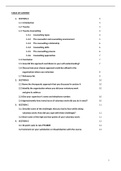
TABLE OF CONTENT
1. SECTION A 3
1.1 Introduction 3
1.2 Trauma 3
1.3 Trauma Counselling 4
1.3.1 Counselling types 4
1.3.2 The counsellor and counselling environment 5
1.3.3 The counselling relationship 6
1.3.4 Counselling skills 6
1.3.5 The counselling process 6
1.3.6 Counselling approaches 7
1.4 Conclusion 7
1.5 How did this approach contribute to your self-understanding? 7
1.6 Discuss how your chosen approach could be utilised in the
organisation where you volunteer 8
1.7 Reference list 9
2. SECTION B 10
2.1 Name the therapeutic approach that you discussed in section A 10
2.2 Identify the organisation where you did your voluntary work 10
and give its address
2.3 Give your supervisor’s name and telephone number. 10
2.4 Approximately how many hours of voluntary work did you do in total? 10
3. SECTION C 11
3.1 Describe some of the challenges that you had to face whilst doing
voluntary work. How did you cope with these challenges? 11
3.2 Share some of the high and low points of your voluntary work. 11
4. SECTION D 12
4.1 10-point scale to rate PYC4809 12
4.2 Comment on your satisfaction or dissatisfaction with the course. 12
1
, 1. SECTION A
1.1 Introduction
There is an estimation that about 5 million people in South Africa have been exposed to trauma that
led to recognisable symptoms of PTSD, and ideally need intervention. (SACAP, 2020). Trauma has far
reaching effects, not only impacting the individual but also partners, families and even communities.
The impact of PTSD on the cost to the economy, through medical treatment and behaviour, is
tremendous.
Children in South Africa’s townships are especially exposed to violence and abuse such as community
and family violence, gangsterism and neglect in a continuous and repetitive manner (Trauma Clinic,
n.d.).
Trauma counselling’s purpose is to help clients identify and process the feelings and emotions
experienced during and after a traumatic experience.
1.2 Trauma
Each individual experience and perceives trauma differently. Whilst one might shrug an experience off,
a second can be overwhelmed by PTSD. Before discussing counselling, it would be best to define
trauma.
The Greek meaning of trauma is ‘a wound’, indicating that a person has been injured or incurred
damage (Herbst & Reitsma, 2016).
The DSM-5 is very specific on the events that cause traumatic stress. A direct experience of witnessing
someone else dying or almost dying, sustaining a serious injury or being sexually violated (like rape) is
seen as a traumatic event. Different types of events that could cause traumatic stress include hijacking,
combat, natural disasters, armed robbery, physical assault with serious injury and gang violence. Being
informed of such an event happening to a person close to you, as well as physically seeing the result
can also cause traumatic stress.
Other instances like a divorce or poor exam results is not seen as traumatic, although it can be very
distressing. These rather refer to a crisis since there is no threat present. A crisis is usually not expected
and can impact a person tremendously, needing attention straight away and can cause a person to feel
overwhelmed (Herbst & Reitsma, 2016).
There are 4 classes of general symptoms defined in traumatic stress: Memory intrusion, avoidance,
changes in thought pattern and mood, and hyper arousal. It is common for people to have these
symptoms shortly after an event, whilst it disappear without assistance, but it is when the symptoms
persist that it becomes problematic. Part of being traumatised is often not only the event itself, but
2
1. SECTION A 3
1.1 Introduction 3
1.2 Trauma 3
1.3 Trauma Counselling 4
1.3.1 Counselling types 4
1.3.2 The counsellor and counselling environment 5
1.3.3 The counselling relationship 6
1.3.4 Counselling skills 6
1.3.5 The counselling process 6
1.3.6 Counselling approaches 7
1.4 Conclusion 7
1.5 How did this approach contribute to your self-understanding? 7
1.6 Discuss how your chosen approach could be utilised in the
organisation where you volunteer 8
1.7 Reference list 9
2. SECTION B 10
2.1 Name the therapeutic approach that you discussed in section A 10
2.2 Identify the organisation where you did your voluntary work 10
and give its address
2.3 Give your supervisor’s name and telephone number. 10
2.4 Approximately how many hours of voluntary work did you do in total? 10
3. SECTION C 11
3.1 Describe some of the challenges that you had to face whilst doing
voluntary work. How did you cope with these challenges? 11
3.2 Share some of the high and low points of your voluntary work. 11
4. SECTION D 12
4.1 10-point scale to rate PYC4809 12
4.2 Comment on your satisfaction or dissatisfaction with the course. 12
1
, 1. SECTION A
1.1 Introduction
There is an estimation that about 5 million people in South Africa have been exposed to trauma that
led to recognisable symptoms of PTSD, and ideally need intervention. (SACAP, 2020). Trauma has far
reaching effects, not only impacting the individual but also partners, families and even communities.
The impact of PTSD on the cost to the economy, through medical treatment and behaviour, is
tremendous.
Children in South Africa’s townships are especially exposed to violence and abuse such as community
and family violence, gangsterism and neglect in a continuous and repetitive manner (Trauma Clinic,
n.d.).
Trauma counselling’s purpose is to help clients identify and process the feelings and emotions
experienced during and after a traumatic experience.
1.2 Trauma
Each individual experience and perceives trauma differently. Whilst one might shrug an experience off,
a second can be overwhelmed by PTSD. Before discussing counselling, it would be best to define
trauma.
The Greek meaning of trauma is ‘a wound’, indicating that a person has been injured or incurred
damage (Herbst & Reitsma, 2016).
The DSM-5 is very specific on the events that cause traumatic stress. A direct experience of witnessing
someone else dying or almost dying, sustaining a serious injury or being sexually violated (like rape) is
seen as a traumatic event. Different types of events that could cause traumatic stress include hijacking,
combat, natural disasters, armed robbery, physical assault with serious injury and gang violence. Being
informed of such an event happening to a person close to you, as well as physically seeing the result
can also cause traumatic stress.
Other instances like a divorce or poor exam results is not seen as traumatic, although it can be very
distressing. These rather refer to a crisis since there is no threat present. A crisis is usually not expected
and can impact a person tremendously, needing attention straight away and can cause a person to feel
overwhelmed (Herbst & Reitsma, 2016).
There are 4 classes of general symptoms defined in traumatic stress: Memory intrusion, avoidance,
changes in thought pattern and mood, and hyper arousal. It is common for people to have these
symptoms shortly after an event, whilst it disappear without assistance, but it is when the symptoms
persist that it becomes problematic. Part of being traumatised is often not only the event itself, but
2


