
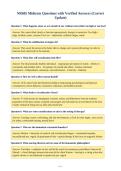
NR605 Midterm Questions with Verified Answers (Correct
Update)
Question 1: What happens when we are outside of our resilient zone (either too high or too low)?
Answer: We cannot think clearly or function appropriately; therapy is inettective Too High =
edgy, irritable, manic, anxious Too Low = depression, isolated, fatigue, numb
Question 2: What do stabilization strategies do?
Answer: They assist the person to be better able to change one's present physiology in order to
function more ettectively in the moment
Question 3: What does self-actualization look like?
Answer: The ideal mentally healthy individual: - Appropriate perception of reality - Ability to
concentrate and problem solve - Acceptance of oneself and others - Intense emotional
experiences - Independence, autonomy, nonconformance - Creativity - Maturity
Question 4: How do ACEs affect mental health?
Answer: ACEs attect brain development leading to long-lasting psychological and physical
consequences; ettects behavior, economics, education, and health outcomes
Question 5: What leads to Acculturative Stress?
Answer: To what extent are immigrants' customs, values, and ditterences from the majority
population of the host country accepted, encouraged, and welcomed as an enrichment of the host
country instead of being seen as alien and unwelcome
Question 6: What are some considerations to take in the setting of therapy?
Answer: Creating a warm, welcoming, and safe environment, a clock for time mgmt., easy access
for safety, comfortable seating, neutral decor
Question 7: Who are the humanistic-existential founders?
Answer: Maslow = hierarchy of needs & self-actualization Rogers = assimilated empathy,
unconditional pos. regard, & genuineness Perls = gestalt therapy & the focus on orgasmic holism
Question 8: What nursing theorists mirror some of the humanistic philosophies?
Answer: Travelbee = emphasis on free will & the search for meaning in pain/illness Paterson &
Zderad = a lived dialogue between the nurse & the client Watson = nursing is a caring action that
regards clients w/ unconditional acceptance & pos. regard
Page 1
Update)
Question 1: What happens when we are outside of our resilient zone (either too high or too low)?
Answer: We cannot think clearly or function appropriately; therapy is inettective Too High =
edgy, irritable, manic, anxious Too Low = depression, isolated, fatigue, numb
Question 2: What do stabilization strategies do?
Answer: They assist the person to be better able to change one's present physiology in order to
function more ettectively in the moment
Question 3: What does self-actualization look like?
Answer: The ideal mentally healthy individual: - Appropriate perception of reality - Ability to
concentrate and problem solve - Acceptance of oneself and others - Intense emotional
experiences - Independence, autonomy, nonconformance - Creativity - Maturity
Question 4: How do ACEs affect mental health?
Answer: ACEs attect brain development leading to long-lasting psychological and physical
consequences; ettects behavior, economics, education, and health outcomes
Question 5: What leads to Acculturative Stress?
Answer: To what extent are immigrants' customs, values, and ditterences from the majority
population of the host country accepted, encouraged, and welcomed as an enrichment of the host
country instead of being seen as alien and unwelcome
Question 6: What are some considerations to take in the setting of therapy?
Answer: Creating a warm, welcoming, and safe environment, a clock for time mgmt., easy access
for safety, comfortable seating, neutral decor
Question 7: Who are the humanistic-existential founders?
Answer: Maslow = hierarchy of needs & self-actualization Rogers = assimilated empathy,
unconditional pos. regard, & genuineness Perls = gestalt therapy & the focus on orgasmic holism
Question 8: What nursing theorists mirror some of the humanistic philosophies?
Answer: Travelbee = emphasis on free will & the search for meaning in pain/illness Paterson &
Zderad = a lived dialogue between the nurse & the client Watson = nursing is a caring action that
regards clients w/ unconditional acceptance & pos. regard
Page 1


