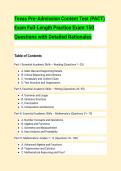
Texas Pre-Admission Content Test (PACT)
Exam Full-Length Practice Exam 150
Questions with Detailed Rationales
Table of Contents
Part I: Essential Academic Skills – Reading (Questions 1–25)
● A. Main Idea and Supporting Details
● B. Critical Reasoning and Inference
● C. Vocabulary and Context Clues
● D. Text Structure and Organization
Part II: Essential Academic Skills – Writing (Questions 26–50)
● A. Grammar and Usage
● B. Sentence Structure
● C. Punctuation
● D. Composition and Revision
Part III: Essential Academic Skills – Mathematics (Questions 51–75)
● A. Number Concepts and Operations
● B. Algebra and Functions
● C. Geometry and Measurement
● D. Data Analysis and Probability
Part IV: Mathematics: Grades 7–12 (Questions 76–100)
● A. Advanced Algebra and Functions
● B. Trigonometry and Calculus
● C. Mathematical Reasoning and Proof
, ● D. Statistics and Probability
Part V: Science: Grades 7–12 (Questions 101–125)
● A. Life Science
● B. Physical Science
● C. Earth and Space Science
● D. Scientific Inquiry and Process Skills
Part VI: Social Studies: Grades 7–12 (Questions 126–150)
● A. U.S. History
● B. World History
● C. Geography and Culture
● D. Government and Economics
Part I: Essential Academic Skills – Reading
1. Which of the following best identifies the main idea of a passage?
A) The first sentence of the passage
B) The central point or message that the author conveys ✅
C) A detail that supports the author's argument
D) The title of the passage
The main idea is the central point or message that the author is trying to convey
about the topic. While the first sentence can sometimes introduce the main idea, it
is not always the main idea. Supporting details and titles are not the main idea;
supporting details explain or support the main idea, and a title is often a label rather
than the central message.
2. A student is reading a passage and encounters the word "ubiquitous." The
student is unsure of its meaning but notices the sentence says, "Smartphones
,have become ubiquitous; you see them everywhere." Based on the context,
"ubiquitous" most nearly means:
A) Rare
B) Expensive
C) Present everywhere ✅
D) Difficult to use
The context clue "you see them everywhere" directly signals that "ubiquitous"
means present everywhere or widespread. Rare is the opposite of the intended
meaning. Expensive and difficult to use are not supported by the context of the
sentence.
3. In a well-written paragraph, the topic sentence typically:
A) Provides a concluding thought
B) Introduces the main idea of the paragraph ✅
C) Offers a specific supporting detail
D) Provides a counterargument
The topic sentence introduces the main idea of the paragraph, signaling what the
rest of the paragraph will be about. A concluding thought typically appears at the
end of the paragraph. Specific supporting details support the topic sentence, and a
counterargument would be part of an argumentative structure, not the standard role
of a topic sentence.
4. Which of the following is an example of an inference?
A) The passage states that the experiment failed.
B) The passage explains that the scientist was disappointed. ✅
, C) The passage lists three causes of the failure.
D) The passage defines the scientific method.
An inference is a conclusion drawn from evidence and reasoning rather than from
explicit statements. Stating that the scientist was disappointed is an inference
because the passage does not directly say the scientist was disappointed; the
reader draws that conclusion from the context. The other options describe explicit
statements or structural features of the passage.
5. An author's purpose in writing a persuasive essay is to:
A) Entertain the reader
B) Inform the reader
C) Convince the reader to adopt a particular viewpoint ✅
D) Describe a personal experience
The primary purpose of a persuasive essay is to convince the reader to adopt a
particular viewpoint or take a specific action. Entertaining and informing are
purposes of other text types. Describing a personal experience is typically the
purpose of a narrative, not a persuasive essay.
6. Which of the following best describes the relationship between a claim and
evidence in an argument?
A) Evidence is the main point, and the claim supports it.
B) The claim is the main point, and evidence supports it. ✅
C) Claims and evidence are unrelated.
D) Evidence is always stronger than the claim.
Exam Full-Length Practice Exam 150
Questions with Detailed Rationales
Table of Contents
Part I: Essential Academic Skills – Reading (Questions 1–25)
● A. Main Idea and Supporting Details
● B. Critical Reasoning and Inference
● C. Vocabulary and Context Clues
● D. Text Structure and Organization
Part II: Essential Academic Skills – Writing (Questions 26–50)
● A. Grammar and Usage
● B. Sentence Structure
● C. Punctuation
● D. Composition and Revision
Part III: Essential Academic Skills – Mathematics (Questions 51–75)
● A. Number Concepts and Operations
● B. Algebra and Functions
● C. Geometry and Measurement
● D. Data Analysis and Probability
Part IV: Mathematics: Grades 7–12 (Questions 76–100)
● A. Advanced Algebra and Functions
● B. Trigonometry and Calculus
● C. Mathematical Reasoning and Proof
, ● D. Statistics and Probability
Part V: Science: Grades 7–12 (Questions 101–125)
● A. Life Science
● B. Physical Science
● C. Earth and Space Science
● D. Scientific Inquiry and Process Skills
Part VI: Social Studies: Grades 7–12 (Questions 126–150)
● A. U.S. History
● B. World History
● C. Geography and Culture
● D. Government and Economics
Part I: Essential Academic Skills – Reading
1. Which of the following best identifies the main idea of a passage?
A) The first sentence of the passage
B) The central point or message that the author conveys ✅
C) A detail that supports the author's argument
D) The title of the passage
The main idea is the central point or message that the author is trying to convey
about the topic. While the first sentence can sometimes introduce the main idea, it
is not always the main idea. Supporting details and titles are not the main idea;
supporting details explain or support the main idea, and a title is often a label rather
than the central message.
2. A student is reading a passage and encounters the word "ubiquitous." The
student is unsure of its meaning but notices the sentence says, "Smartphones
,have become ubiquitous; you see them everywhere." Based on the context,
"ubiquitous" most nearly means:
A) Rare
B) Expensive
C) Present everywhere ✅
D) Difficult to use
The context clue "you see them everywhere" directly signals that "ubiquitous"
means present everywhere or widespread. Rare is the opposite of the intended
meaning. Expensive and difficult to use are not supported by the context of the
sentence.
3. In a well-written paragraph, the topic sentence typically:
A) Provides a concluding thought
B) Introduces the main idea of the paragraph ✅
C) Offers a specific supporting detail
D) Provides a counterargument
The topic sentence introduces the main idea of the paragraph, signaling what the
rest of the paragraph will be about. A concluding thought typically appears at the
end of the paragraph. Specific supporting details support the topic sentence, and a
counterargument would be part of an argumentative structure, not the standard role
of a topic sentence.
4. Which of the following is an example of an inference?
A) The passage states that the experiment failed.
B) The passage explains that the scientist was disappointed. ✅
, C) The passage lists three causes of the failure.
D) The passage defines the scientific method.
An inference is a conclusion drawn from evidence and reasoning rather than from
explicit statements. Stating that the scientist was disappointed is an inference
because the passage does not directly say the scientist was disappointed; the
reader draws that conclusion from the context. The other options describe explicit
statements or structural features of the passage.
5. An author's purpose in writing a persuasive essay is to:
A) Entertain the reader
B) Inform the reader
C) Convince the reader to adopt a particular viewpoint ✅
D) Describe a personal experience
The primary purpose of a persuasive essay is to convince the reader to adopt a
particular viewpoint or take a specific action. Entertaining and informing are
purposes of other text types. Describing a personal experience is typically the
purpose of a narrative, not a persuasive essay.
6. Which of the following best describes the relationship between a claim and
evidence in an argument?
A) Evidence is the main point, and the claim supports it.
B) The claim is the main point, and evidence supports it. ✅
C) Claims and evidence are unrelated.
D) Evidence is always stronger than the claim.