[STUDY GUIDE] • HIGH-YIELD PRACTICE & REVIEW EDITION
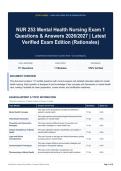
NUR 253 Mental Health Nursing Exam 1
Questions & Answers 2026/2027 | Latest
Verified Exam Edition (Rationales)
Comprehensive Examination Question Bank • Concept Mapping
TOTAL QUESTIONS EXAM TOPICS RATIONALES
117 Questions 11 Modules 100% Verified
DOCUMENT OVERVIEW
This document contains 117 verified questions with correct answers and detailed rationales related to mental
health nursing. Each question is designed to test knowledge of key concepts and frameworks in mental health
care, making it suitable for exam preparation, course review, and certification readiness.
EXAM BLUEPRINT & TOPIC DISTRIBUTION
Systematic breakdown of subject domains and exam coverage.
Topic Module Scope & Core Focus Questions Share (%)
This topic covers foundational concepts and definitions
Mental Health Concepts related to mental health. 11 Qs 9.4%
This topic explores various psychological theories and their
Theoretical Frameworks applications in mental health. 11 Qs 9.4%
Prevention and Intervention This topic examines different levels of prevention and
Strategies intervention strategies in mental health care. 11 Qs 9.4%
Cultural Competence in Mental This topic addresses cultural considerations and stigma in
Health mental health treatment. 11 Qs 9.4%
Legal and Ethical This topic focuses on the legal and ethical frameworks guiding
Considerations nursing practice in mental health. 11 Qs 9.4%
This topic reviews effective communication strategies and
Communication Techniques techniques in therapeutic settings. 11 Qs 9.4%
This topic covers medication management and
Pharmacology in Mental Health pharmacological interventions for mental health disorders. 11 Qs 9.4%
Confidential • Student Study Edition • Practice & Review Guide Page 1 of 36
,STUDENT STUDY & MASTERY EDITION PRACTICE & REVIEW GUIDE
This topic discusses assessment tools and techniques used in
Mental Health Assessment evaluating mental health. 10 Qs 8.5%
Psychiatric Disorders and This topic focuses on understanding psychiatric disorders and
Comorbidities their common comorbid conditions. 10 Qs 8.5%
This topic explores therapeutic interventions and techniques
Therapeutic Techniques used in mental health treatment. 10 Qs 8.5%
Rights and Advocacy in Mental This topic highlights the rights of individuals with mental
Health health conditions and advocacy efforts. 10 Qs 8.5%
Total Exam Coverage 11 Integrated Topic Modules 117 Qs 100.0%
Confidential • Student Study Edition • Practice & Review Guide Page 2 of 36
,STUDENT STUDY & MASTERY EDITION PRACTICE & REVIEW GUIDE
TOPIC 1: MENTAL HEALTH CONCEPTS
11 Questions • 9.4% of Exam • This topic covers foundational concepts and definitions related to mental health.
QUESTION 1
How is mental health best described?
Answer: A state of well-being where an individual realizes their potential and copes with normal stresses.
Rationale: A state of well-being where an individual realizes their potential and copes with normal stresses.
This definition encapsulates both the positive aspects of mental health, such as personal fulfillment, and the ability to
manage everyday life challenges effectively.
QUESTION 2
What is the primary diagnostic resource used in the US to classify mental disorders?
Answer: The Diagnostic and Statistical Manual of Mental Disorders, 5th Edition (DSM-5).
Rationale: The Diagnostic and Statistical Manual of Mental Disorders, 5th Edition (DSM-5). This publication by the
American Psychiatric Association is the standard classification of mental disorders used by mental health professionals in
the United States.
QUESTION 3
What is true regarding the Mental Health Continuum?
Answer: Movement is dynamic and influenced by stressors and coping mechanisms.
Rationale: Movement is dynamic and influenced by stressors and coping mechanisms. This reflects the understanding that
mental well-being exists on a spectrum, not as a static state, and can shift based on life events and an individual's ability to
manage them.
QUESTION 4
According to the Diathesis-Stress Model, how do psychiatric disorders manifest?
Confidential • Student Study Edition • Practice & Review Guide Page 3 of 36
, STUDENT STUDY & MASTERY EDITION PRACTICE & REVIEW GUIDE
Figure Q4: Reference Image
Answer: Through a combination of genetic predisposition (diathesis) and environmental triggers
(stress).
Rationale: Through a combination of genetic predisposition (diathesis) and environmental triggers (stress).
The Diathesis-Stress Model posits that psychiatric disorders arise from the interplay between an individual's underlying
vulnerability and external life events.
QUESTION 5
What did the 1999 Olmstead decision mandate for individuals with mental disabilities?
Answer: The right to receive care in the community rather than in institutions when appropriate.
Rationale: The right to receive care in the community rather than in institutions when appropriate. This decision affirmed
that individuals with mental disabilities have a right to live in the community if they can be appropriately treated there,
aligning with principles of least restrictive environment.
Confidential • Student Study Edition • Practice & Review Guide Page 4 of 36
NUR 253 Mental Health Nursing Exam 1
Questions & Answers 2026/2027 | Latest
Verified Exam Edition (Rationales)
Comprehensive Examination Question Bank • Concept Mapping
TOTAL QUESTIONS EXAM TOPICS RATIONALES
117 Questions 11 Modules 100% Verified
DOCUMENT OVERVIEW
This document contains 117 verified questions with correct answers and detailed rationales related to mental
health nursing. Each question is designed to test knowledge of key concepts and frameworks in mental health
care, making it suitable for exam preparation, course review, and certification readiness.
EXAM BLUEPRINT & TOPIC DISTRIBUTION
Systematic breakdown of subject domains and exam coverage.
Topic Module Scope & Core Focus Questions Share (%)
This topic covers foundational concepts and definitions
Mental Health Concepts related to mental health. 11 Qs 9.4%
This topic explores various psychological theories and their
Theoretical Frameworks applications in mental health. 11 Qs 9.4%
Prevention and Intervention This topic examines different levels of prevention and
Strategies intervention strategies in mental health care. 11 Qs 9.4%
Cultural Competence in Mental This topic addresses cultural considerations and stigma in
Health mental health treatment. 11 Qs 9.4%
Legal and Ethical This topic focuses on the legal and ethical frameworks guiding
Considerations nursing practice in mental health. 11 Qs 9.4%
This topic reviews effective communication strategies and
Communication Techniques techniques in therapeutic settings. 11 Qs 9.4%
This topic covers medication management and
Pharmacology in Mental Health pharmacological interventions for mental health disorders. 11 Qs 9.4%
Confidential • Student Study Edition • Practice & Review Guide Page 1 of 36
,STUDENT STUDY & MASTERY EDITION PRACTICE & REVIEW GUIDE
This topic discusses assessment tools and techniques used in
Mental Health Assessment evaluating mental health. 10 Qs 8.5%
Psychiatric Disorders and This topic focuses on understanding psychiatric disorders and
Comorbidities their common comorbid conditions. 10 Qs 8.5%
This topic explores therapeutic interventions and techniques
Therapeutic Techniques used in mental health treatment. 10 Qs 8.5%
Rights and Advocacy in Mental This topic highlights the rights of individuals with mental
Health health conditions and advocacy efforts. 10 Qs 8.5%
Total Exam Coverage 11 Integrated Topic Modules 117 Qs 100.0%
Confidential • Student Study Edition • Practice & Review Guide Page 2 of 36
,STUDENT STUDY & MASTERY EDITION PRACTICE & REVIEW GUIDE
TOPIC 1: MENTAL HEALTH CONCEPTS
11 Questions • 9.4% of Exam • This topic covers foundational concepts and definitions related to mental health.
QUESTION 1
How is mental health best described?
Answer: A state of well-being where an individual realizes their potential and copes with normal stresses.
Rationale: A state of well-being where an individual realizes their potential and copes with normal stresses.
This definition encapsulates both the positive aspects of mental health, such as personal fulfillment, and the ability to
manage everyday life challenges effectively.
QUESTION 2
What is the primary diagnostic resource used in the US to classify mental disorders?
Answer: The Diagnostic and Statistical Manual of Mental Disorders, 5th Edition (DSM-5).
Rationale: The Diagnostic and Statistical Manual of Mental Disorders, 5th Edition (DSM-5). This publication by the
American Psychiatric Association is the standard classification of mental disorders used by mental health professionals in
the United States.
QUESTION 3
What is true regarding the Mental Health Continuum?
Answer: Movement is dynamic and influenced by stressors and coping mechanisms.
Rationale: Movement is dynamic and influenced by stressors and coping mechanisms. This reflects the understanding that
mental well-being exists on a spectrum, not as a static state, and can shift based on life events and an individual's ability to
manage them.
QUESTION 4
According to the Diathesis-Stress Model, how do psychiatric disorders manifest?
Confidential • Student Study Edition • Practice & Review Guide Page 3 of 36
, STUDENT STUDY & MASTERY EDITION PRACTICE & REVIEW GUIDE
Figure Q4: Reference Image
Answer: Through a combination of genetic predisposition (diathesis) and environmental triggers
(stress).
Rationale: Through a combination of genetic predisposition (diathesis) and environmental triggers (stress).
The Diathesis-Stress Model posits that psychiatric disorders arise from the interplay between an individual's underlying
vulnerability and external life events.
QUESTION 5
What did the 1999 Olmstead decision mandate for individuals with mental disabilities?
Answer: The right to receive care in the community rather than in institutions when appropriate.
Rationale: The right to receive care in the community rather than in institutions when appropriate. This decision affirmed
that individuals with mental disabilities have a right to live in the community if they can be appropriately treated there,
aligning with principles of least restrictive environment.
Confidential • Student Study Edition • Practice & Review Guide Page 4 of 36