

Chapter 3
Scientific Research
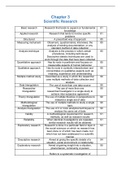
Basic research Research that tends to expand on fundamental 81
knowledge
Applied research Research that tends to involve specific 81
problems
Structured A prescribed way of approach 85
Measuring instrument Observers, questionnaires, interviews, the 85
analysis of existing documentation, or any
standard method of data collection
Analysis technique Analysis is the process in which certain 85
procedures, including techniques
Descriptive statistic techniques are used to
work through the data that have been collected
Quantitative approach Has its roots in positivism and focuses on 85
measurable aspects of human behaviour
Qualitative approach Has its roots in symbolic interactionism and 85
concentrates on qualitative aspects such as
meaning, experience and understanding
Multiple method study Described as a study in which the researcher 90
uses multiple methods of data collection and
analysis
Data triangulation The use of more than one data source 90
Researcher The use of more than one 90
triangulation researcher/investigator in a single study to
achieve inter-subjective agreement
Theory triangulation The use of multiple theories or perspectives to 90
interpret a single set of data
Methodological The use of multiple methods to study a single 90
triangulation topic
Analysis triangulation The use of 2 or more analytical techniques to 90
analyse the same set of data
Validity A methodological requirement for research 91
methods, as well as research results
Reliability When identical investigations are repeated, 91
similar research results will be obtained
Exploratory research Research is done in a particular field or topic in 93
the social sciences on which no research has
been done or of which has been made, but
which has not been addressed in a scientific
manner
Descriptive research Aimed at giving the specific details of a 94
situation, social environment or relationship
Explanatory research Aimed at gaining insight into a situation, 95
phenomenon, community or person
Refers to a systematic investigation of
, Correlational research relationships between 2 or more variables to 97
explain the nature of the relationship in the
world and not to examine cause and effect
Cross sectional study Nonrecurrent in nature and is done at a 98
specific point in time
Longitudinal study Done over a longer period of time 98
Prospective studies Refer to studies where data is first collected 98
about a presumed cause and then
subsequently the effect or outcome is
measured
Retrospective studies Involve collecting data on an outcome 98
occurring in the present and then linking it
retrospectively to determinants that occurred in
the past
Trend designs Investigate changes in the general population 101
in relation to a particular phenomenon
Basic and Applied Research
Basic research:
o Researcher first states what social phenomenon is researched, and
then describes and/or explains the phenomenon
Applied research:
o The researcher aims to address a specific practical social problem
o The problem is then investigated and treated in a specific manner by
applying acquired researched knowledge
If the tendency is to concentrate more on a contribution to knowledge, the
research is more basic in nature, and if the tendency is for the research to be
more practice-oriented, it is more applied in nature
Basic research:
Undertaken to enhance or extend fundamental knowledge about social reality
or within a discipline
This type of research is used to support or reject theories by explaining social
relationships
It is also used to interpret changes in communities, in order to enhance new
scientific ideas/knowledge about our social world
Makes use of exploratory, descriptive and explanatory research
Criticism – the knowledge so acquired sometimes doesn’t offer short-term
practical solutions
Advantage – it creates a basis for the application of knowledge and insight to
many social problems, areas or research or policies
Applied research:
Try to solve specific problems or try to make specific recommendations
Since this type of research usually focuses on specific problems and their
short-term solutions the focus in this type of research is not so much on
theory
Generally descriptive in nature
Scientific Research
Basic research Research that tends to expand on fundamental 81
knowledge
Applied research Research that tends to involve specific 81
problems
Structured A prescribed way of approach 85
Measuring instrument Observers, questionnaires, interviews, the 85
analysis of existing documentation, or any
standard method of data collection
Analysis technique Analysis is the process in which certain 85
procedures, including techniques
Descriptive statistic techniques are used to
work through the data that have been collected
Quantitative approach Has its roots in positivism and focuses on 85
measurable aspects of human behaviour
Qualitative approach Has its roots in symbolic interactionism and 85
concentrates on qualitative aspects such as
meaning, experience and understanding
Multiple method study Described as a study in which the researcher 90
uses multiple methods of data collection and
analysis
Data triangulation The use of more than one data source 90
Researcher The use of more than one 90
triangulation researcher/investigator in a single study to
achieve inter-subjective agreement
Theory triangulation The use of multiple theories or perspectives to 90
interpret a single set of data
Methodological The use of multiple methods to study a single 90
triangulation topic
Analysis triangulation The use of 2 or more analytical techniques to 90
analyse the same set of data
Validity A methodological requirement for research 91
methods, as well as research results
Reliability When identical investigations are repeated, 91
similar research results will be obtained
Exploratory research Research is done in a particular field or topic in 93
the social sciences on which no research has
been done or of which has been made, but
which has not been addressed in a scientific
manner
Descriptive research Aimed at giving the specific details of a 94
situation, social environment or relationship
Explanatory research Aimed at gaining insight into a situation, 95
phenomenon, community or person
Refers to a systematic investigation of
, Correlational research relationships between 2 or more variables to 97
explain the nature of the relationship in the
world and not to examine cause and effect
Cross sectional study Nonrecurrent in nature and is done at a 98
specific point in time
Longitudinal study Done over a longer period of time 98
Prospective studies Refer to studies where data is first collected 98
about a presumed cause and then
subsequently the effect or outcome is
measured
Retrospective studies Involve collecting data on an outcome 98
occurring in the present and then linking it
retrospectively to determinants that occurred in
the past
Trend designs Investigate changes in the general population 101
in relation to a particular phenomenon
Basic and Applied Research
Basic research:
o Researcher first states what social phenomenon is researched, and
then describes and/or explains the phenomenon
Applied research:
o The researcher aims to address a specific practical social problem
o The problem is then investigated and treated in a specific manner by
applying acquired researched knowledge
If the tendency is to concentrate more on a contribution to knowledge, the
research is more basic in nature, and if the tendency is for the research to be
more practice-oriented, it is more applied in nature
Basic research:
Undertaken to enhance or extend fundamental knowledge about social reality
or within a discipline
This type of research is used to support or reject theories by explaining social
relationships
It is also used to interpret changes in communities, in order to enhance new
scientific ideas/knowledge about our social world
Makes use of exploratory, descriptive and explanatory research
Criticism – the knowledge so acquired sometimes doesn’t offer short-term
practical solutions
Advantage – it creates a basis for the application of knowledge and insight to
many social problems, areas or research or policies
Applied research:
Try to solve specific problems or try to make specific recommendations
Since this type of research usually focuses on specific problems and their
short-term solutions the focus in this type of research is not so much on
theory
Generally descriptive in nature


