
Chapter 2
The Role of Theory in Research
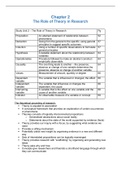
Study Unit 2 – The Role of Theory in Research Pg
Proposition An abstract statement of relationship between 52
phenomena
Deduction Going from the general to the specific; using general 57
principles to suggest specific outcomes
Induction Using a number of specific observations to formulate 57
general principles
Hypothesis A testable statement about the relationship between 64
variables
Operationalise Procedure followed to make an abstract construct 64
empirically observable
Causality The one thing leads to another – the presence, 64
absence or change of one variable determines the
presence, absence or change of another variable
Values Measurement of amount, quantity or degree 66
Dependent The variable that is influenced or changed, the effect 66
variable
Independent The variable that influences or changes the 66
variable dependent, the cause
Intervening A variable that is the effect on one variable and the 68
variable cause of another variable
Indicator An observable measure of a variable or concept 69
The theoretical grounding of research:
Theory is equated to speculation
A conceptual framework that provides an explanation of certain occurrences
or phenomena
Theories consists of logically interconnected propositions
o Generalised abstractions about social reality
o Statements about the state of the world supported by evidence (facts)
Theory provides our inquiry with a focus, by suggesting what evidence we
need
Provides a sifting mechanism
Potentially yields new insight by organising evidence in a new and different
way
Sets of interrelated propositions can be logically rearranged
Theory provides research with “scaffolding” by organising and generating new
ideas
Theory asks why and how
Concepts give researchers and theorists a shorthand language through which
they can communicate
The Role of Theory in Research
Study Unit 2 – The Role of Theory in Research Pg
Proposition An abstract statement of relationship between 52
phenomena
Deduction Going from the general to the specific; using general 57
principles to suggest specific outcomes
Induction Using a number of specific observations to formulate 57
general principles
Hypothesis A testable statement about the relationship between 64
variables
Operationalise Procedure followed to make an abstract construct 64
empirically observable
Causality The one thing leads to another – the presence, 64
absence or change of one variable determines the
presence, absence or change of another variable
Values Measurement of amount, quantity or degree 66
Dependent The variable that is influenced or changed, the effect 66
variable
Independent The variable that influences or changes the 66
variable dependent, the cause
Intervening A variable that is the effect on one variable and the 68
variable cause of another variable
Indicator An observable measure of a variable or concept 69
The theoretical grounding of research:
Theory is equated to speculation
A conceptual framework that provides an explanation of certain occurrences
or phenomena
Theories consists of logically interconnected propositions
o Generalised abstractions about social reality
o Statements about the state of the world supported by evidence (facts)
Theory provides our inquiry with a focus, by suggesting what evidence we
need
Provides a sifting mechanism
Potentially yields new insight by organising evidence in a new and different
way
Sets of interrelated propositions can be logically rearranged
Theory provides research with “scaffolding” by organising and generating new
ideas
Theory asks why and how
Concepts give researchers and theorists a shorthand language through which
they can communicate


