

LIFE SCIENCES:
IEB: strand 3.1
DNA code of life
Proteins
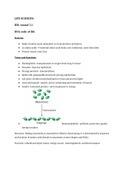
● Made of amino acids (monomer) to form proteins (polymers)
● 2o amino acids -9 essential amino acid (body cant synthesize, come from diet)
● Prevent muscle mass loss
Types and functions
● Haemoglobin- transportation of oxygen from lung to tissue
● Enzymes- dna/rna replication
● Storage proteins- storemetalions
● Spider silk, polypeptide,structural (strong and ductile)
● rod opsin-receptor proteins(found in retina and process light)
● Actin and myosin- muscle, aid in contracting and movement of muscle
● Insulin- hormonal protein- converts glucose to energy
● Immunoglobulin- antibody, protection against
foreign invaders
Structure: folding of proteins is essential for effective functioning. It is determined by sequence
and location of amino acids (bonds in monomers creates shapes and folds)
Function: rebuild and repair tissue, energy source, osmoregulation, nutrient transport
, Bonds between monomers and polymer chain = peptide bonds
Nucleic acid
Stores information and controls cellular activity
Controls synthesis of proteins and chemical processes
Deoxyribose nucleic acid
● Structure: double helix, coiled, phosphate sugar, bases
● Found mainly in nucleus
● Forms chromosomes and makes up chromatin network
● Extra nuclear DNA- found outside nucleus in mitochondria and chloroplasts
● DNA in mitochondria: round, circular, inherited from maternal line
Genetic replication
● Watson and crick: pairing of bases (C=G and A=T)
○ Therefore each strand can be separated and used as a template to create another
strand of DNA
● Crick and brenner: 1961- genetic proof that triplet code was used in reading genetic
material DNA
○ Transfer of this information from nucleus through to cytoplasm via RNA
○ Found that the sequence of base forms a genetic code that can be used as
instructions : replicator create protein through complementary base pairing
● Nobel prize? - Franklin had discovered the helical shape of DNA and was the only one
out of the four with a degree in chemistry. She did not announce her finding and died at
37 due to cancer. The nobel prize was won by watson crick and brenner as it is only able
to be won through live recipients and shared amongst three people. If she were alive,
would she have been one of the recipients?
Where is DNA found?
- Found mainly in the nucleus, forms chromosome which make up the chromatin network
- chromatin= chromosomal material made up of DNA, RNA and histone proteins as found
on non-dividing cells
- Coiled so as to fit inside nucleus (2 metres of DNA in each cell)
IEB: strand 3.1
DNA code of life
Proteins
● Made of amino acids (monomer) to form proteins (polymers)
● 2o amino acids -9 essential amino acid (body cant synthesize, come from diet)
● Prevent muscle mass loss
Types and functions
● Haemoglobin- transportation of oxygen from lung to tissue
● Enzymes- dna/rna replication
● Storage proteins- storemetalions
● Spider silk, polypeptide,structural (strong and ductile)
● rod opsin-receptor proteins(found in retina and process light)
● Actin and myosin- muscle, aid in contracting and movement of muscle
● Insulin- hormonal protein- converts glucose to energy
● Immunoglobulin- antibody, protection against
foreign invaders
Structure: folding of proteins is essential for effective functioning. It is determined by sequence
and location of amino acids (bonds in monomers creates shapes and folds)
Function: rebuild and repair tissue, energy source, osmoregulation, nutrient transport
, Bonds between monomers and polymer chain = peptide bonds
Nucleic acid
Stores information and controls cellular activity
Controls synthesis of proteins and chemical processes
Deoxyribose nucleic acid
● Structure: double helix, coiled, phosphate sugar, bases
● Found mainly in nucleus
● Forms chromosomes and makes up chromatin network
● Extra nuclear DNA- found outside nucleus in mitochondria and chloroplasts
● DNA in mitochondria: round, circular, inherited from maternal line
Genetic replication
● Watson and crick: pairing of bases (C=G and A=T)
○ Therefore each strand can be separated and used as a template to create another
strand of DNA
● Crick and brenner: 1961- genetic proof that triplet code was used in reading genetic
material DNA
○ Transfer of this information from nucleus through to cytoplasm via RNA
○ Found that the sequence of base forms a genetic code that can be used as
instructions : replicator create protein through complementary base pairing
● Nobel prize? - Franklin had discovered the helical shape of DNA and was the only one
out of the four with a degree in chemistry. She did not announce her finding and died at
37 due to cancer. The nobel prize was won by watson crick and brenner as it is only able
to be won through live recipients and shared amongst three people. If she were alive,
would she have been one of the recipients?
Where is DNA found?
- Found mainly in the nucleus, forms chromosome which make up the chromatin network
- chromatin= chromosomal material made up of DNA, RNA and histone proteins as found
on non-dividing cells
- Coiled so as to fit inside nucleus (2 metres of DNA in each cell)



