
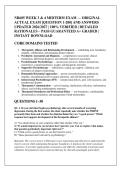
NR605 WEEK 3 & 4 MIDTERM EXAM — ORIGINAL
ACTUAL EXAM [QUESTION 1-200] AND ANSWERS
UPDATED 2026/2027 | 100% VERIFIED | DETAILED
RATIONALES – PASS GUARANTEED A+ GRADED |
INSTANT DOWNLOAD
CORE DOMAINS TESTED
1. Therapeutic Alliance and Relationship Development — establishing trust, boundaries,
empathy, collaboration, and managing alliance ruptures.
2. Psychiatric Assessment and Diagnosis — comprehensive assessment, clinical
formulation, differential diagnosis, and culturally responsive assessment.
3. Psychodynamic Psychotherapy — unconscious processes, defense mechanisms,
transference, countertransference, insight, and therapeutic neutrality.
4. Supportive Psychotherapy — stabilization, coping, ego support, validation, and
restoration of adaptive functioning.
5. Humanistic/Existential Approaches — person-centered principles, authenticity,
empathy, unconditional positive regard, autonomy, and self-directed growth.
6. Interpersonal Psychotherapy (IPT) — interpersonal deficits, grief, role transitions, and
interpersonal disputes.
7. Therapeutic Communication — active listening, clarification, reflection, confrontation,
silence, and avoiding nontherapeutic responses.
8. Therapeutic Boundaries and Professional Ethics — role boundaries, confidentiality,
documentation, termination, and management of dual relationships.
QUESTIONS 1–50
Q1: A 32-year-old client begins psychotherapy after several months of worsening
depression. During the first session, the client repeatedly asks whether the PMHNP
personally likes them and whether the clinician thinks they are “a good person.” Which
response best supports development of the therapeutic alliance?
A) “You should focus on your symptoms rather than whether I like you.”
B) “It sounds important to you to know how I perceive you. Can we explore what makes
that question particularly important right now?”
C) “I think you're a good person, so you don't need to worry.”
D) “Those questions aren't relevant to psychotherapy.”
Rationale: The correct answer is B because it uses exploration and reflection to understand the
client's concern while maintaining therapeutic boundaries. A dismisses the client's emotional
experience. C provides inappropriate reassurance and shifts the relationship toward personal
validation. D prematurely rejects material that may be clinically meaningful, particularly
,because concerns about the therapist's perception may reflect interpersonal patterns or
transference.
Q2: A client becomes visibly tense whenever the PMHNP moves closer while speaking. The
clinician notices the reaction and changes to a greater physical distance. Which therapeutic
principle is demonstrated?
A) Interpretation
B) Confrontation
C) Responsiveness to nonverbal communication
D) Transference analysis
Rationale: The correct answer is C because the PMHNP recognizes the client's nonverbal
response and modifies behavior to increase psychological safety. A involves identifying
unconscious meaning. B involves directly addressing discrepancies or problematic behavior. D
concerns the client's displacement of feelings or expectations from previous relationships onto
the therapist.
Q3: A client tells the PMHNP, “You're the only person who understands me. I wish you
could be my friend outside this office.” What is the most appropriate response?
A) Agree to meet socially after treatment ends.
B) Explain that friendship would improve the therapeutic relationship.
C) Ignore the statement and change the subject.
D) Acknowledge the importance of the relationship while maintaining the professional
boundary.
Rationale: The correct answer is D because therapeutic relationships require clear professional
boundaries even when the client develops strong attachment. A and B create boundary
violations. C misses an opportunity to explore the client's feelings and interpersonal needs.
Q4: During a psychotherapy session, a client pauses for nearly 30 seconds after discussing
the death of a parent. The PMHNP remains attentive and does not immediately fill the
silence. Which intervention is most appropriate?
A) Change the subject to reduce discomfort.
B) Ask a series of closed-ended questions.
C) Use therapeutic silence while remaining emotionally present.
D) Tell the client that continuing to discuss grief is necessary.
,Rationale: The correct answer is C because therapeutic silence can provide space for emotional
processing and allow the client to determine when and how to continue. A avoids clinically
relevant material. B may interrupt emotional processing. D pressures the client rather than
supporting autonomy.
Q5: A client says, “I keep telling myself that I'm fine, but every morning I feel like I can't
get out of bed.” Which response best demonstrates reflection of feeling?
A) “Why do you think you are depressed?”
B) “You should probably start exercising.”
C) “Part of you is telling yourself you're fine, while another part seems overwhelmed.”
D) “Have you experienced this before?”
Rationale: The correct answer is C because it reflects the emotional conflict expressed by the
client without imposing an interpretation. A asks for explanation. B immediately provides advice.
D seeks history but does not directly respond to the emotional content.
Q6: A PMHNP notices that a client consistently arrives late and then becomes defensive
when the issue is discussed. Which intervention is most appropriate when the behavior
interferes with therapy?
A) Ignore the lateness to preserve rapport.
B) Terminate therapy immediately.
C) Explore the meaning and consequences of the behavior collaboratively.
D) Tell the client that lateness demonstrates disrespect.
Rationale: The correct answer is C because exploration can identify practical barriers,
avoidance, interpersonal patterns, or resistance while preserving collaboration. A allows
potentially important treatment-interfering behavior to continue. B is premature. D is
judgmental and may damage the alliance.
Q7: A client repeatedly describes the PMHNP as “just like my controlling father,”
although the clinician has not behaved in a controlling manner. Which psychodynamic
concept should the PMHNP consider first?
A) Countertransference
B) Projection by the therapist
C) Transference
D) Resistance by the therapist
, Rationale: The correct answer is C because transference involves feelings, expectations, or
relational patterns from previous significant relationships being redirected toward the therapist.
A refers to the therapist's emotional responses to the client. B incorrectly attributes the process
to the therapist. D is not the appropriate concept.
Q8: A PMHNP begins feeling unusually protective toward a client and notices an urge to
make exceptions to clinic rules. What is the most important initial professional response?
A) Make the exception because the client needs additional support.
B) Tell the client about the therapist's personal feelings.
C) Recognize the emotional response and seek supervision or consultation as appropriate.
D) End treatment immediately without discussion.
Rationale: The correct answer is C because awareness of countertransference is essential to
maintaining objectivity and boundaries. A risks boundary violations. B places the therapist's
needs into the therapeutic relationship. D may be unnecessary unless the clinician cannot
maintain safe professional care.
Q9: Which clinical situation most strongly suggests countertransference?
A) A client develops anger toward the therapist.
B) A client believes the therapist resembles a former teacher.
C) The therapist becomes unusually irritated whenever the client discusses dependency.
D) A client becomes fearful when the therapist asks about trauma.
Rationale: The correct answer is C because countertransference refers to emotional reactions
arising within the therapist in response to the client or therapeutic relationship. A, B, and D
describe client experiences and therefore do not specifically demonstrate countertransference.
Q10: A client states, “I know everyone thinks I'm incompetent because I made one mistake
at work.” Which response best promotes therapeutic exploration without reinforcing the
client's assumption?
A) “Everyone makes mistakes, so you're obviously wrong.”
B) “Why would you think everyone is judging you?”
C) “What experiences have led you to conclude that everyone sees you as incompetent?”
D) “You should ask your coworkers what they think.”
ACTUAL EXAM [QUESTION 1-200] AND ANSWERS
UPDATED 2026/2027 | 100% VERIFIED | DETAILED
RATIONALES – PASS GUARANTEED A+ GRADED |
INSTANT DOWNLOAD
CORE DOMAINS TESTED
1. Therapeutic Alliance and Relationship Development — establishing trust, boundaries,
empathy, collaboration, and managing alliance ruptures.
2. Psychiatric Assessment and Diagnosis — comprehensive assessment, clinical
formulation, differential diagnosis, and culturally responsive assessment.
3. Psychodynamic Psychotherapy — unconscious processes, defense mechanisms,
transference, countertransference, insight, and therapeutic neutrality.
4. Supportive Psychotherapy — stabilization, coping, ego support, validation, and
restoration of adaptive functioning.
5. Humanistic/Existential Approaches — person-centered principles, authenticity,
empathy, unconditional positive regard, autonomy, and self-directed growth.
6. Interpersonal Psychotherapy (IPT) — interpersonal deficits, grief, role transitions, and
interpersonal disputes.
7. Therapeutic Communication — active listening, clarification, reflection, confrontation,
silence, and avoiding nontherapeutic responses.
8. Therapeutic Boundaries and Professional Ethics — role boundaries, confidentiality,
documentation, termination, and management of dual relationships.
QUESTIONS 1–50
Q1: A 32-year-old client begins psychotherapy after several months of worsening
depression. During the first session, the client repeatedly asks whether the PMHNP
personally likes them and whether the clinician thinks they are “a good person.” Which
response best supports development of the therapeutic alliance?
A) “You should focus on your symptoms rather than whether I like you.”
B) “It sounds important to you to know how I perceive you. Can we explore what makes
that question particularly important right now?”
C) “I think you're a good person, so you don't need to worry.”
D) “Those questions aren't relevant to psychotherapy.”
Rationale: The correct answer is B because it uses exploration and reflection to understand the
client's concern while maintaining therapeutic boundaries. A dismisses the client's emotional
experience. C provides inappropriate reassurance and shifts the relationship toward personal
validation. D prematurely rejects material that may be clinically meaningful, particularly
,because concerns about the therapist's perception may reflect interpersonal patterns or
transference.
Q2: A client becomes visibly tense whenever the PMHNP moves closer while speaking. The
clinician notices the reaction and changes to a greater physical distance. Which therapeutic
principle is demonstrated?
A) Interpretation
B) Confrontation
C) Responsiveness to nonverbal communication
D) Transference analysis
Rationale: The correct answer is C because the PMHNP recognizes the client's nonverbal
response and modifies behavior to increase psychological safety. A involves identifying
unconscious meaning. B involves directly addressing discrepancies or problematic behavior. D
concerns the client's displacement of feelings or expectations from previous relationships onto
the therapist.
Q3: A client tells the PMHNP, “You're the only person who understands me. I wish you
could be my friend outside this office.” What is the most appropriate response?
A) Agree to meet socially after treatment ends.
B) Explain that friendship would improve the therapeutic relationship.
C) Ignore the statement and change the subject.
D) Acknowledge the importance of the relationship while maintaining the professional
boundary.
Rationale: The correct answer is D because therapeutic relationships require clear professional
boundaries even when the client develops strong attachment. A and B create boundary
violations. C misses an opportunity to explore the client's feelings and interpersonal needs.
Q4: During a psychotherapy session, a client pauses for nearly 30 seconds after discussing
the death of a parent. The PMHNP remains attentive and does not immediately fill the
silence. Which intervention is most appropriate?
A) Change the subject to reduce discomfort.
B) Ask a series of closed-ended questions.
C) Use therapeutic silence while remaining emotionally present.
D) Tell the client that continuing to discuss grief is necessary.
,Rationale: The correct answer is C because therapeutic silence can provide space for emotional
processing and allow the client to determine when and how to continue. A avoids clinically
relevant material. B may interrupt emotional processing. D pressures the client rather than
supporting autonomy.
Q5: A client says, “I keep telling myself that I'm fine, but every morning I feel like I can't
get out of bed.” Which response best demonstrates reflection of feeling?
A) “Why do you think you are depressed?”
B) “You should probably start exercising.”
C) “Part of you is telling yourself you're fine, while another part seems overwhelmed.”
D) “Have you experienced this before?”
Rationale: The correct answer is C because it reflects the emotional conflict expressed by the
client without imposing an interpretation. A asks for explanation. B immediately provides advice.
D seeks history but does not directly respond to the emotional content.
Q6: A PMHNP notices that a client consistently arrives late and then becomes defensive
when the issue is discussed. Which intervention is most appropriate when the behavior
interferes with therapy?
A) Ignore the lateness to preserve rapport.
B) Terminate therapy immediately.
C) Explore the meaning and consequences of the behavior collaboratively.
D) Tell the client that lateness demonstrates disrespect.
Rationale: The correct answer is C because exploration can identify practical barriers,
avoidance, interpersonal patterns, or resistance while preserving collaboration. A allows
potentially important treatment-interfering behavior to continue. B is premature. D is
judgmental and may damage the alliance.
Q7: A client repeatedly describes the PMHNP as “just like my controlling father,”
although the clinician has not behaved in a controlling manner. Which psychodynamic
concept should the PMHNP consider first?
A) Countertransference
B) Projection by the therapist
C) Transference
D) Resistance by the therapist
, Rationale: The correct answer is C because transference involves feelings, expectations, or
relational patterns from previous significant relationships being redirected toward the therapist.
A refers to the therapist's emotional responses to the client. B incorrectly attributes the process
to the therapist. D is not the appropriate concept.
Q8: A PMHNP begins feeling unusually protective toward a client and notices an urge to
make exceptions to clinic rules. What is the most important initial professional response?
A) Make the exception because the client needs additional support.
B) Tell the client about the therapist's personal feelings.
C) Recognize the emotional response and seek supervision or consultation as appropriate.
D) End treatment immediately without discussion.
Rationale: The correct answer is C because awareness of countertransference is essential to
maintaining objectivity and boundaries. A risks boundary violations. B places the therapist's
needs into the therapeutic relationship. D may be unnecessary unless the clinician cannot
maintain safe professional care.
Q9: Which clinical situation most strongly suggests countertransference?
A) A client develops anger toward the therapist.
B) A client believes the therapist resembles a former teacher.
C) The therapist becomes unusually irritated whenever the client discusses dependency.
D) A client becomes fearful when the therapist asks about trauma.
Rationale: The correct answer is C because countertransference refers to emotional reactions
arising within the therapist in response to the client or therapeutic relationship. A, B, and D
describe client experiences and therefore do not specifically demonstrate countertransference.
Q10: A client states, “I know everyone thinks I'm incompetent because I made one mistake
at work.” Which response best promotes therapeutic exploration without reinforcing the
client's assumption?
A) “Everyone makes mistakes, so you're obviously wrong.”
B) “Why would you think everyone is judging you?”
C) “What experiences have led you to conclude that everyone sees you as incompetent?”
D) “You should ask your coworkers what they think.”


