

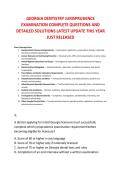
GEORGIA DENTISTRY JURISPRUDENCE
EXAMINATION COMPLETE QUESTIONS AND
DETAILED SOLUTIONS LATEST UPDATE THIS YEAR
JUST RELEASED
Exam Coverage Areas
1. Georgia Dental Licensure Requirements — Examination, application, jurisprudence testing, credentials,
and license-related requirements.
2. License Renewal and Continuing Education — Renewal cycles, CPR, continuing education, inactive status,
and reinstatement.
3. Dental Hygiene Supervision and Scope — Direct/general supervision and permitted dental hygiene
functions.
4. Dental Assistant Delegation — Authorized duties, supervision, prohibited procedures, and dentist
responsibility.
5. Prescriptions and Dental Laboratory Requirements — Laboratory prescriptions, documentation,
retention, and technician restrictions.
6. Unprofessional Conduct and Ethics — Professional standards, controlled substances, patient care,
records, and misconduct.
7. Advertising and Specialty Representation — Truthful advertising, fees, specialty claims, and advertising
records.
8. Sedation and Anesthesia — Minimal, moderate, deep sedation/general anesthesia, permits, monitoring,
personnel, and reporting.
9. Investigations and Board Authority — Complaints, investigations, confidentiality, interviews, and
disciplinary proceedings.
10. Other Georgia Practice Rules — Faculty/volunteer licenses, specialty practice, appliances, prostheses, and
administrative procedures.
1.
A dentist applying for initial Georgia licensure must successfully
complete which jurisprudence examination requirement before
becoming eligible for licensure?
A. Score of 60 or higher in any language
B. Score of 70 or higher only if nationally licensed
C. Score of 75 or higher on Georgia dental laws and rules
D. Completion of an oral interview without a written examination
,Answer: C
Rationale: Georgia requires dental licensure applicants to pass the
jurisprudence examination concerning laws and rules governing
dentistry in Georgia with a score of 75 or higher. (
2.
A Georgia dental licensure candidate passes the jurisprudence
examination but receives a score of 74; what does this result generally
indicate?
A. The candidate automatically passes because the examination is
advisory
B. The candidate has not achieved the required passing score
C. The candidate passes if the clinical examination score exceeds 75
D. The candidate passes because 74 is rounded upward
Answer: B
Rationale: The Board's rule establishes 75 or higher as the required
passing score, so a score of 74 does not satisfy the jurisprudence
examination requirement.)
3.
Under Georgia dental licensure rules, how long is a passing
jurisprudence examination score generally considered valid for
licensure purposes?
A. Six months
B. One year
,C. Two years
D. Five years
Answer: B
Rationale: Georgia Rule 150-3-.01 specifies that a passing jurisprudence
examination score is valid for one year, making timely completion of
licensure requirements important. ()
4.
Which examination language is specified by Georgia's dental
jurisprudence examination rule for candidates seeking dental licensure?
A. English
B. English or Spanish
C. Any language approved by the applicant
D. English with mandatory interpreter assistance
Answer: A
Rationale: The Georgia Board rule expressly provides that the
jurisprudence examination for dental licensure is administered in the
English language. (
5.
A dentist wants to understand which regulatory topics are addressed
within Georgia Board of Dentistry rules; which chapter specifically
addresses unprofessional conduct?
, A. Chapter 150-3
B. Chapter 150-5
C. Chapter 150-8
D. Chapter 150-13
Answer: C
Rationale: The Georgia Board of Dentistry identifies Chapter 150-8 as
its chapter addressing unprofessional conduct and professional
disciplinary standards. (
6.
Which Georgia Board chapter specifically addresses the requirements
and rules governing dental laboratory prescriptions?
A. Chapter 150-6
B. Chapter 150-8
C. Chapter 150-10
D. Chapter 150-15
Answer: A
Rationale: Chapter 150-6, Prescription Requirements, establishes
requirements concerning laboratory prescriptions and related
documentation. (
7.
A Georgia dentist sends laboratory work to an outside technician;
which document must generally accompany that laboratory work?
EXAMINATION COMPLETE QUESTIONS AND
DETAILED SOLUTIONS LATEST UPDATE THIS YEAR
JUST RELEASED
Exam Coverage Areas
1. Georgia Dental Licensure Requirements — Examination, application, jurisprudence testing, credentials,
and license-related requirements.
2. License Renewal and Continuing Education — Renewal cycles, CPR, continuing education, inactive status,
and reinstatement.
3. Dental Hygiene Supervision and Scope — Direct/general supervision and permitted dental hygiene
functions.
4. Dental Assistant Delegation — Authorized duties, supervision, prohibited procedures, and dentist
responsibility.
5. Prescriptions and Dental Laboratory Requirements — Laboratory prescriptions, documentation,
retention, and technician restrictions.
6. Unprofessional Conduct and Ethics — Professional standards, controlled substances, patient care,
records, and misconduct.
7. Advertising and Specialty Representation — Truthful advertising, fees, specialty claims, and advertising
records.
8. Sedation and Anesthesia — Minimal, moderate, deep sedation/general anesthesia, permits, monitoring,
personnel, and reporting.
9. Investigations and Board Authority — Complaints, investigations, confidentiality, interviews, and
disciplinary proceedings.
10. Other Georgia Practice Rules — Faculty/volunteer licenses, specialty practice, appliances, prostheses, and
administrative procedures.
1.
A dentist applying for initial Georgia licensure must successfully
complete which jurisprudence examination requirement before
becoming eligible for licensure?
A. Score of 60 or higher in any language
B. Score of 70 or higher only if nationally licensed
C. Score of 75 or higher on Georgia dental laws and rules
D. Completion of an oral interview without a written examination
,Answer: C
Rationale: Georgia requires dental licensure applicants to pass the
jurisprudence examination concerning laws and rules governing
dentistry in Georgia with a score of 75 or higher. (
2.
A Georgia dental licensure candidate passes the jurisprudence
examination but receives a score of 74; what does this result generally
indicate?
A. The candidate automatically passes because the examination is
advisory
B. The candidate has not achieved the required passing score
C. The candidate passes if the clinical examination score exceeds 75
D. The candidate passes because 74 is rounded upward
Answer: B
Rationale: The Board's rule establishes 75 or higher as the required
passing score, so a score of 74 does not satisfy the jurisprudence
examination requirement.)
3.
Under Georgia dental licensure rules, how long is a passing
jurisprudence examination score generally considered valid for
licensure purposes?
A. Six months
B. One year
,C. Two years
D. Five years
Answer: B
Rationale: Georgia Rule 150-3-.01 specifies that a passing jurisprudence
examination score is valid for one year, making timely completion of
licensure requirements important. ()
4.
Which examination language is specified by Georgia's dental
jurisprudence examination rule for candidates seeking dental licensure?
A. English
B. English or Spanish
C. Any language approved by the applicant
D. English with mandatory interpreter assistance
Answer: A
Rationale: The Georgia Board rule expressly provides that the
jurisprudence examination for dental licensure is administered in the
English language. (
5.
A dentist wants to understand which regulatory topics are addressed
within Georgia Board of Dentistry rules; which chapter specifically
addresses unprofessional conduct?
, A. Chapter 150-3
B. Chapter 150-5
C. Chapter 150-8
D. Chapter 150-13
Answer: C
Rationale: The Georgia Board of Dentistry identifies Chapter 150-8 as
its chapter addressing unprofessional conduct and professional
disciplinary standards. (
6.
Which Georgia Board chapter specifically addresses the requirements
and rules governing dental laboratory prescriptions?
A. Chapter 150-6
B. Chapter 150-8
C. Chapter 150-10
D. Chapter 150-15
Answer: A
Rationale: Chapter 150-6, Prescription Requirements, establishes
requirements concerning laboratory prescriptions and related
documentation. (
7.
A Georgia dentist sends laboratory work to an outside technician;
which document must generally accompany that laboratory work?


