Aristotle’s Virtue Ethics
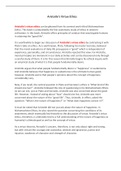
Aristotle’s virtue ethics can be gleaned from his seminal work titled Nichomachean
Ethics. This book is undoubtedly the first systematic study of ethics in western
civilization. In this book, Aristotle offers principles of conduct that would guide humans
in attaining the “good life”.
It is worthwhile to begin our discussion of Aristotle’s virtue ethics by contrasting it with
Plato’s take on ethics. As is well known, Plato, following his master Socrates, believed
that the moral evaluations of daily life presuppose a “good” which is independent of
experience, personality, and circumstances. Aristotle rejected this view. For Aristotle,
moral principles are immanent in our daily activities and can be discovered only through
a careful study of them. It is for this reason that Aristotle begins his ethical inquiry with
an empirical study of what it is that people fundamentally desire.
Aristotle argues that what people fundamentally desire is “happiness” or eudaimonia.
And Aristotle believes that happiness or eudaimonia is the ultimate human good;
however, Aristotle warns that people’s opinions about the concept of happiness
considerably vary.
Now, if we recall, the central question in Plato and Socrates’s ethics is “What kind of life
should one live?”. Aristotle followed this line of questioning in his Nichomachean Ethics.
As we can see, just as Plato and Socrates, Aristotle was also concerned about the good
life. However, instead of asking about “how” should one live, Aristotle was more
concerned about the nature of the “good life”. Thus, Aristotle, in effect, asked the
question: “What is the nature of happiness?” or “What does happiness consist in?”.
It must be noted that Aristotle did not just ask about the nature of happiness. In
Nichomachean Ethics, he also raised the question concerning the conditions of its
attainment, which eventually led Aristotle to the discussion of virtue. Aristotle’s virtue
ethics, therefore, is ultimately tied to a full understanding of the nature of happiness as
humanity’s ultimate goal as well as the concept of virtue.
As a virtue theorist, Aristotle’s concern, therefore, is not only about right and wrong,
but with virtues like courage and cowardice, wisdom and ignorance, justice and
injustice, weakness of character and strength of character.
Aristotle’s virtue ethics can be gleaned from his seminal work titled Nichomachean
Ethics. This book is undoubtedly the first systematic study of ethics in western
civilization. In this book, Aristotle offers principles of conduct that would guide humans
in attaining the “good life”.
It is worthwhile to begin our discussion of Aristotle’s virtue ethics by contrasting it with
Plato’s take on ethics. As is well known, Plato, following his master Socrates, believed
that the moral evaluations of daily life presuppose a “good” which is independent of
experience, personality, and circumstances. Aristotle rejected this view. For Aristotle,
moral principles are immanent in our daily activities and can be discovered only through
a careful study of them. It is for this reason that Aristotle begins his ethical inquiry with
an empirical study of what it is that people fundamentally desire.
Aristotle argues that what people fundamentally desire is “happiness” or eudaimonia.
And Aristotle believes that happiness or eudaimonia is the ultimate human good;
however, Aristotle warns that people’s opinions about the concept of happiness
considerably vary.
Now, if we recall, the central question in Plato and Socrates’s ethics is “What kind of life
should one live?”. Aristotle followed this line of questioning in his Nichomachean Ethics.
As we can see, just as Plato and Socrates, Aristotle was also concerned about the good
life. However, instead of asking about “how” should one live, Aristotle was more
concerned about the nature of the “good life”. Thus, Aristotle, in effect, asked the
question: “What is the nature of happiness?” or “What does happiness consist in?”.
It must be noted that Aristotle did not just ask about the nature of happiness. In
Nichomachean Ethics, he also raised the question concerning the conditions of its
attainment, which eventually led Aristotle to the discussion of virtue. Aristotle’s virtue
ethics, therefore, is ultimately tied to a full understanding of the nature of happiness as
humanity’s ultimate goal as well as the concept of virtue.
As a virtue theorist, Aristotle’s concern, therefore, is not only about right and wrong,
but with virtues like courage and cowardice, wisdom and ignorance, justice and
injustice, weakness of character and strength of character.